
1. Reclaimed Wood Cabinetry
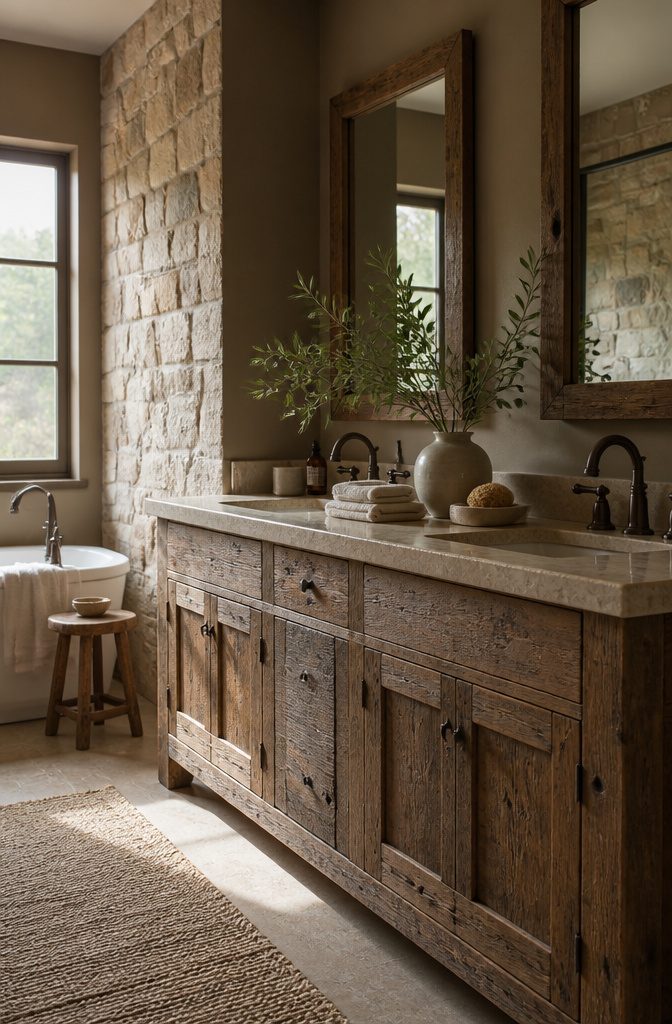
Reclaimed wood carries a history that factory distressing never quite copies. Grain patterns from decades of drying, nail holes, and the soft graying that comes from real weathering give bathroom vanities a warmth that feels earned rather than performed.
Barn boards or salvage-yard timbers bring that genuine patina, though the hunt takes patience and a willingness to sort through warped or rotted pieces.
The bathroom environment demands respect. Steam and splashes will eventually lift unsealed boards, so marine-grade polyurethane or a penetrating epoxy sealer needs to go on every surface, including the backs and underside.
Two thin coats beat one thick one; thick applications pool and craze. End grain drinks in moisture fastest, so pay particular attention there.
I have seen vanities where the owner skipped the underside to save time.
Within two years the boards had cupped enough to crack the countertop. The extra hour of sealing would have prevented it.
Salvage yards often sell oak or pine at a fraction of retail, but factor in the cost of kiln-drying if the wood is still green. Air-dried barn wood can hold surprising moisture inside.
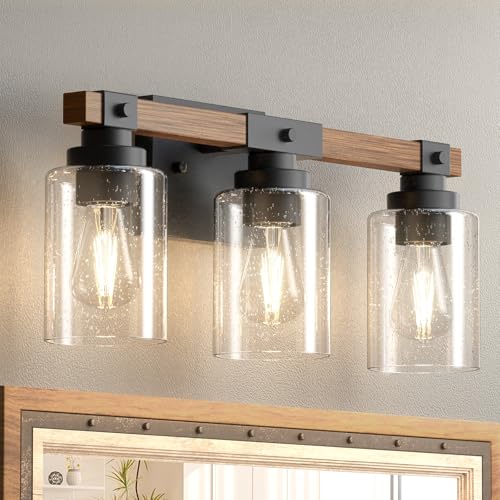
Farmhouse Style Design: Amico 3-light vanity lights feature an antique wood finish and bubble glass shades, perfect for rustic and farmhouse decor. These bathroom light fixtures add a touch of simple elegance to any home, making them an ideal choice for your lighting needs.

Integrated Sink:Bathroom double vanity with an integrated sink that is easy to clean without dead corners, features an overflow, and a deep basin that prevents water from splashing and is highly resistant to impact
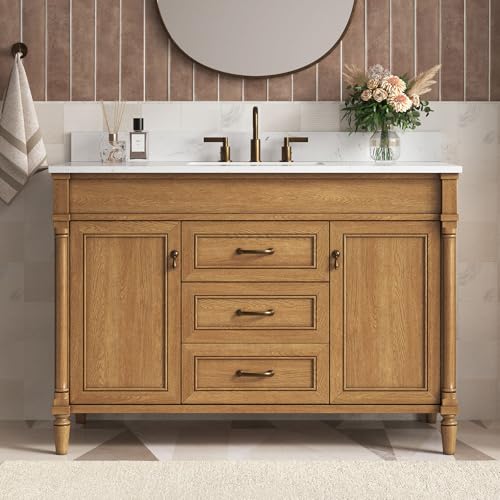
Base Cabinet:This vanity base is crafted from solid poplar wood — a material that is both durable and sturdy, ensuring it delivers long-lasting performance. Solid poplar wood also offers excellent resistance to expansion, contraction, and moisture. These high-quality materials work together to guarantee our vanity performs reliably in your bathroom.
2. Slate and Travertine Tiles
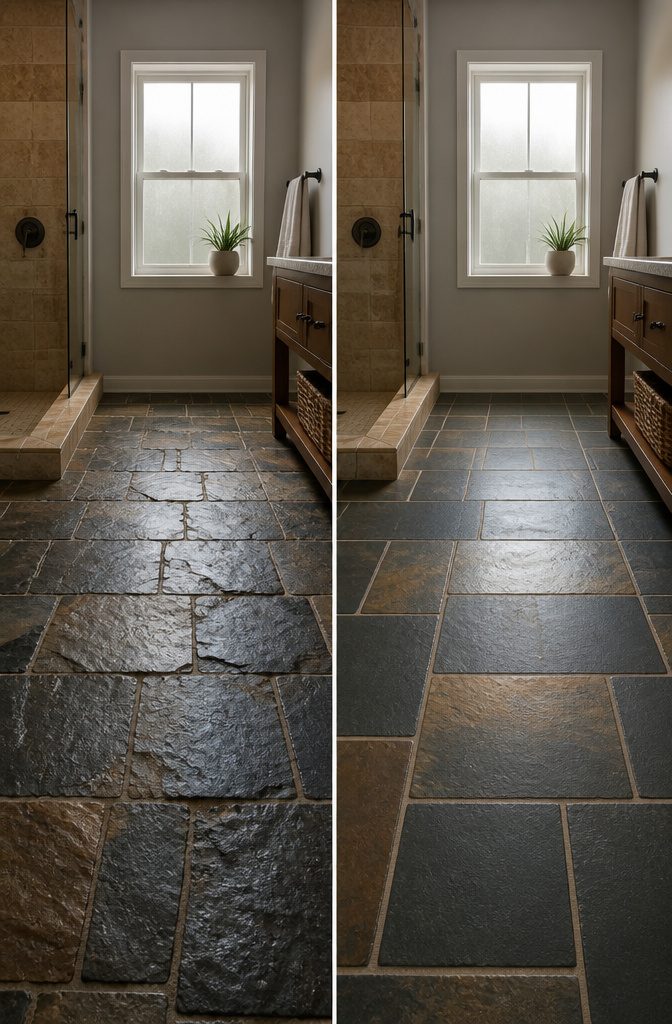
Slate flooring brings the kind of rugged, uneven surface that makes a bathroom feel like it was carved from the earth itself.
The varied color patterns shift underfoot, and that slight irregularity keeps the space from ever looking too finished or sterile.
I have seen it work beautifully on shower floors where the texture adds grip, though the maintenance commitment is real: the stone needs sealing, and uneven grout lines collect more than their share of moisture.
Travertine offers something softer.
Its porous surface and warm, honeyed tones lean more Tuscan farmhouse than mountain cabin, but the rustic register holds. The stone drinks in light rather than reflecting it, which matters in a bathroom where you want calm, not clinical brightness.
For renters or anyone who needs the look without the upkeep, porcelain alternatives close the gap convincingly.
Juliet 7×8 Hexagon Matte Porcelain Tile in Rust carries the same earthy, handcrafted warmth with a matte finish that reads as stone until you touch it.
For larger format walls or floors, Adeline 12×24 Matte Porcelain Tile in Taupe gives the muted, natural variation of travertine with none of the sealing or staining risk. Both handle high-moisture daily use without the vigilance natural stone demands.

Safe Deep Cleaning – Gently removes dirt and grime from polished and honed natural stone and tile without damage.

CONCENTRATED FLOOR CLEANER – Granite Gold Stone and Tile Floor Cleaner is a cleaning solution specially formulated for your stone, slate and tile floors. It comes in a cost-saving, concentrated 32 ounce bottle.
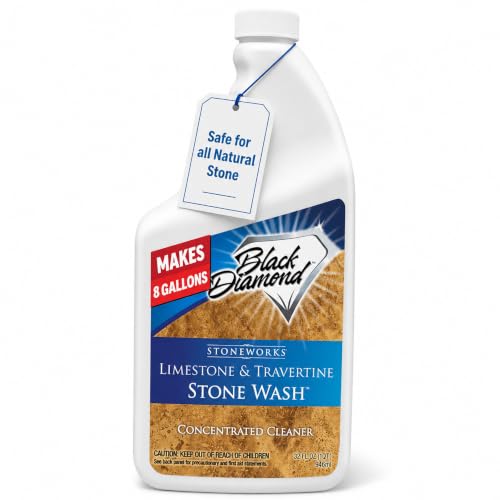
Safe for All Natural Stone Floors: Specially formulated for limestone, travertine, marble, granite, slate, sandstone, quartzite, flagstone, and all other sealed and unsealed natural stone flooring
3. Stone Vessel Sinks
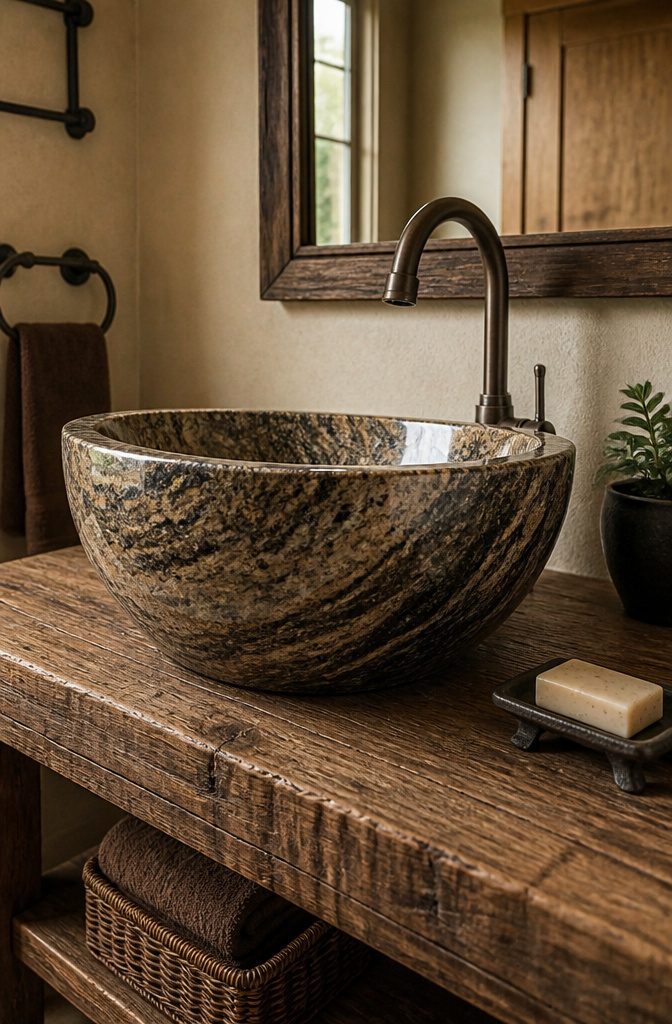
A stone vessel sink sits entirely on top of the counter instead of dropping into it, which turns the basin itself into something that reads more like sculpture than plumbing. That height changes how you use the space.
The rim sits several inches above a standard undermount, so your faucet needs enough reach to clear the edge without splashing, and the extra lift can feel awkward for shorter users or kids who lean in to wash their hands.
Granite and marble are the stones you see most often, though onyx turns up if you want something that backlights well.
Weight is the practical limit most people hit first. A solid granite bowl can run past eighty pounds before you add water, so a standard vanity with a particleboard top will flex and eventually crack.
You want a cabinet with a reinforced top or a steel frame inside, or you are looking at replacing the whole unit inside a year or two.
The look is dramatic, but the height and heft are not negotiable.
Plan the faucet before you order, and check the vanity specs for weight capacity, not just width. A stone vessel without that prep cracks its own base or sits too high to use comfortably.

LONG LASTING REPAIRS: Convenient kit quickly repairs holes, voids, cracks and missing travertine fill

Stunning Azurite Hexagon Mosaic Tile: Luxurious blue porcelain tile measuring 10 x 11 inches, perfect for adding elegance to any space.
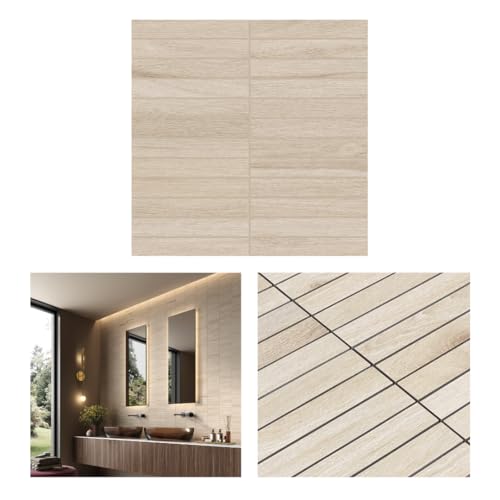
Premium Porcelain Mosaic Tile: Crafted from high-quality porcelain with a matte beige finish, delivering a stunning wood-look design that complements any home or office décor.
4. Pebble Floors
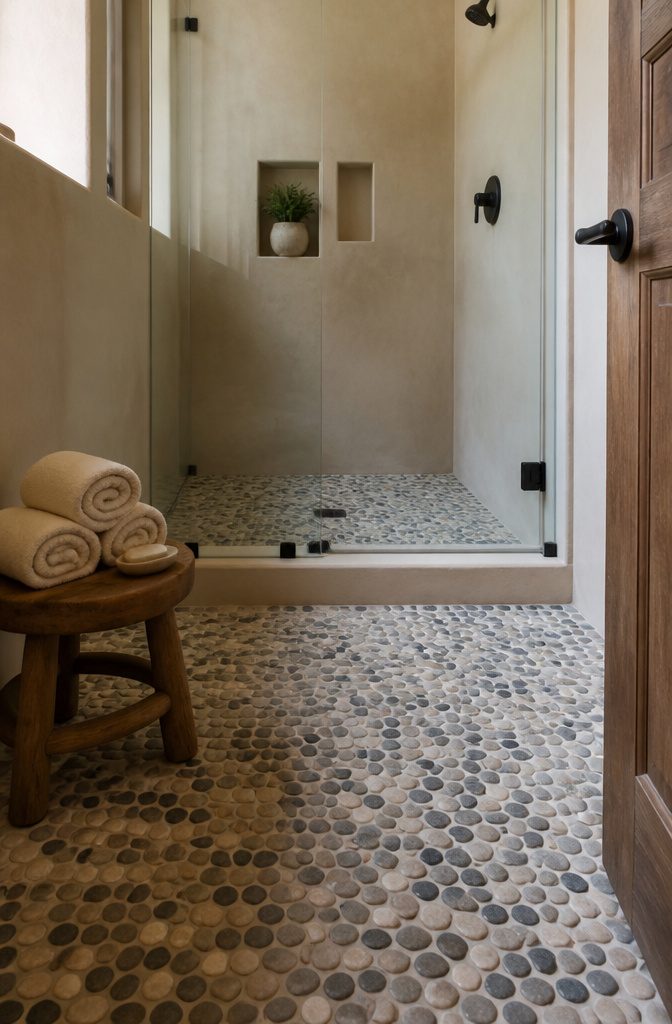
Mosaic sheets of smooth river stones turn a shower floor into something that wakes your feet up every morning.
The rounded tops massage bare soles in a way flat tile never manages, and the varied tones of gray, tan, and cream read as genuine riverbed rather than manufactured pattern.
What separates a floor that lasts from one that turns grimy is whether the pebbles are flat-cut and sealed on top or left in their raw, domed state.
Raw stones with high crowns pool water in the valleys between them.
Soap scum collects in those same low spots, and the grout lines stay damp enough to darken within months. Flat-cut pebbles, sometimes called sliced or honed, drain faster and let a squeegee actually make contact across the surface.
The grout still needs sealing twice yearly in a working shower; the texture that feels so good underfoot also creates more linear feet of joint than any other flooring choice.
For a full bathroom beyond the shower, the same sheets work if the subfloor can handle the weight and if you commit to the maintenance rhythm.
I would not lay them in a powder room that sees rushed morning traffic; the texture rewards bare feet, not socked ones scrambling for the door.

【 Rectangular Vessel Sink 】 20.1"(L) x 14.4"(W) x 4.8"(H) ( 510 x 365 x 123 mm ). Standard 1.77" (45mm) drain opening. With a rectangular design shape and exclusive stone resin material by Cpingao, this bathroom sink matches innovation with style to create a highly functional art fixture for your bathroom.

Peace of Mind: No harmful heavy metals or VOCs, ensuring a 100% safe and healthy environment. Lifetime warranty. Easy returns.

🪨 Hand-Carved from Solid Natural Marble – Every Sink Is Naturally Unique: Each vessel sink is carved from a single block of genuine marble, featuring a hand-finished exterior and a smooth polished interior. Natural variations in color, mineral deposits, and stone patterns ensure every sink is truly one of a kind.
5. Exposed Beams
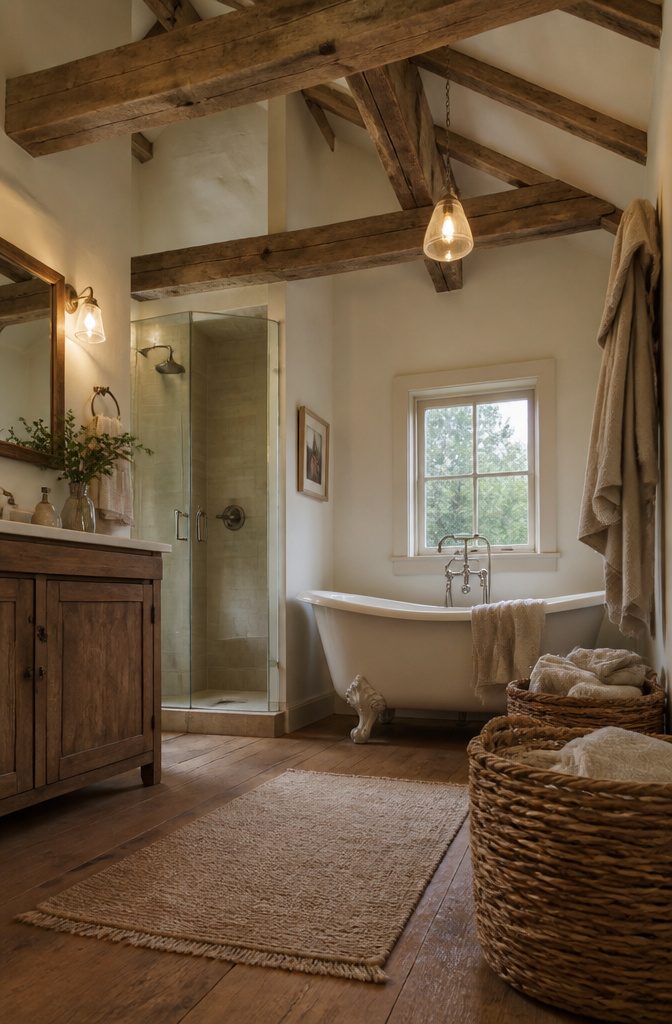
Ceiling beams pull the eye upward and give a bathroom the pitched-roof feeling of a cabin, even when the actual ceiling is flat and standard height.
A single beam running the width of the room changes the proportions enough that the space stops reading like a standard builder bathroom.
You have two routes here. Structural beams are the real load-bearing members, usually heavier timber with the irregularities that come from actual use.
Box beams are hollow shells built around a frame and attached to the ceiling for visual effect alone. They weigh less, cost less, and let you control the exact dimensions.
In a bathroom with 8-foot ceilings, that distinction matters because a solid 8×8 timber can feel oppressive overhead while a 6-inch-deep box beam reads as the same gesture without the cave effect.
I have seen both work, but the box beam wins for renters and anyone who does not want to calculate load paths.
The install is a Saturday project: locate ceiling joists, attach blocking, and mount the hollow shell with finish screws.
Paint or stain it before lifting it up, because touching up overhead while standing on a stepladder in a small room is the kind of detail you only forget once.

【Modern Stylish Style】★ Our bathroom vessel sink places more emphasis on personalized exterior design. This sleek and contemporary ceramic sink bowl can bring a modern and elegant touch to your bathroom, perfectly fits with any bathroom decoration.
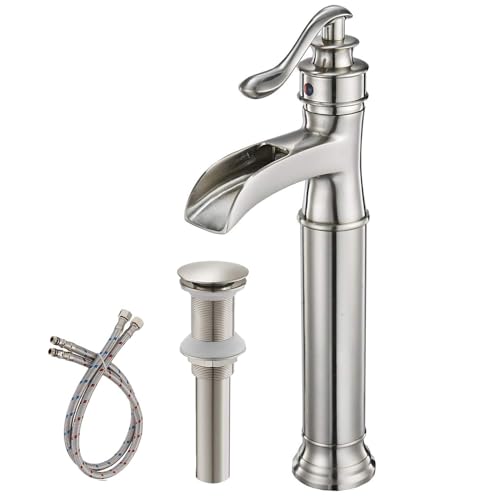
【Unique Waterfall Spout】Vessel sink faucet provides clear and steady laminar water flow, which provides a beautiful water presentation. Single lever handle design is easy to control the flow and temperature

Durable material, solid high quality brass construction matte black bathroom faucet, resistant to rust from daily use. The matte black finish creates a vintage look that adds a touch of stately elegance to any room.
6. Vintage Accents
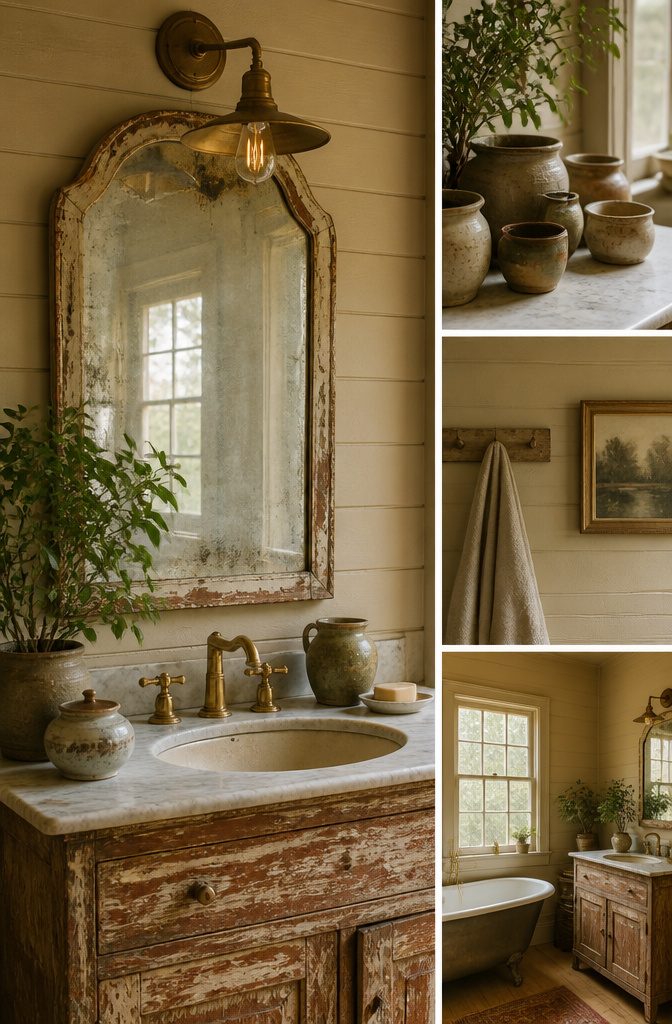
Reproductions of old mirrors and light fixtures look correct in a catalog photo, then flat once they are on your wall.
The weight is wrong, the patina is too even, and the glass never has that faint waviness that catches morning light.
A real mirror frame with chipped gesso or a brass fixture with wear marks where hands actually touched it carries a kind of proof that new metal cannot fake.
The best pieces come from salvage yards and estate sales, though both demand patience. Salvage yards reward repeat visits; inventory turns over fast, and the good brass or iron hardware often sells the day it arrives.
Estate sales are better for vanities, since an old dresser with a marble top or a solid pine washstand can become a sink base with a countertop cut and a few plumbing holes.
Family pieces work if you have them, but only if you are willing to drill through a top you have seen at Thanksgiving dinners for twenty years.
The tradeoff is time. A weekend of driving to three sales might yield nothing, or one perfect porcelain lever handle that costs less than a big-box reproduction and outlasts it.
Plan on three to six months of casual searching before the bathroom comes together, and do not build your plumbing schedule around a piece you have not found yet.
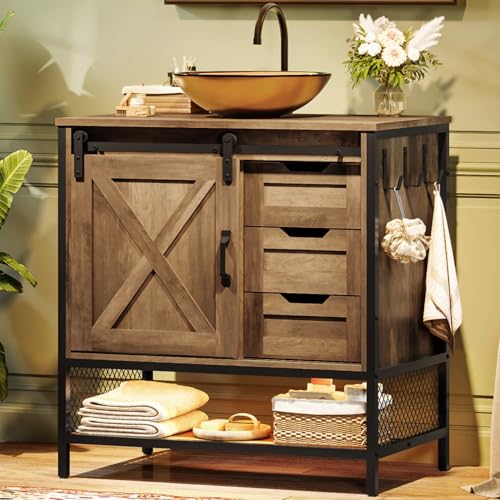
Tempered Glass Vessel Sink: As a core feature of this farmhouse bathroom vanity, the tempered glass sink is shock-resistant and shatterproof for long-lasting use. Its non-stick, smooth surface enables effortless cleaning—dirt and stains wipe away in seconds with no residues. It resists discoloration from water spots, toiletries, and daily wear, keeping your vanity cabinet bright and new. Equipped with a premium drain, the optimized structure of this bathroom sink cabinet ensures fast drainage, preventing water accumulation, balancing beauty and practicality.

Handcrafted Rustic Wall Mirror: The rectangular solid wood frame pairs dark antique iron corner brackets with decorative rivet accents, giving a vanity or entry wall a collected farmhouse look

Handcrafted Wood-and-Iron Statement Mirror: The substantial rectangular solid wood frame pairs dark antique iron corner brackets with decorative rivet accents, creating balanced presence above larger furniture without looking overly ornate
7. Modern Finishes
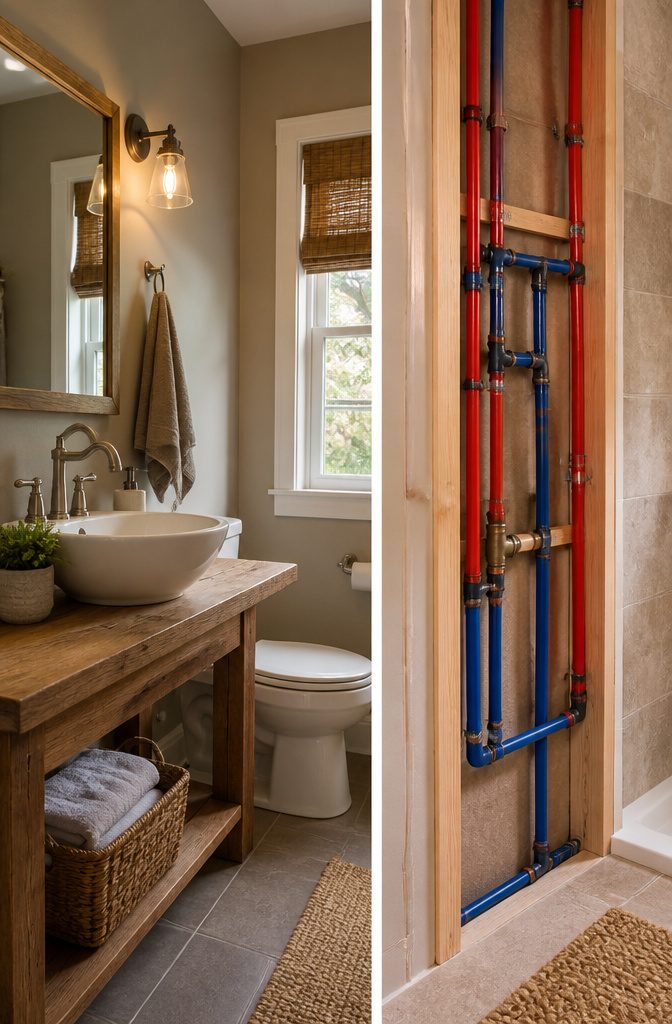
PEX tubing behind the walls lets you run water lines through a stud wall without the joint-heavy path of old copper.
I have opened up enough walls to know the difference: one pinhole in a buried fitting means tearing out tile you just paid to install.
The plastic lines flex around corners, stay quiet, and carry the same pressure without the solder points that fail invisibly.
A pressure-balancing valve is the piece that keeps your shower from turning scalding when someone flushes.
The outside trim can read as vintage cross-handle or simple porcelain lever, whatever matches the rest of the room. What matters is the cartridge inside, which reacts faster than you can move your hand.
Toilets that meet current water limits do not have to look like airport fixtures.
Several makers now build high-efficiency tanks inside rounded china bodies that read as 1920s or farmhouse depending on the lever shape and the bowl height you choose.
The 1.28-gallon flush standard is what to check for; anything older wastes enough water to notice on a bill.
The cost split is real.
The valve and the PEX are cheap insurance. The period-appropriate toilet and trim run a little above basic builder grade, but not by enough to break a weekend budget.
What you save is the future Saturday spent cutting open a wall because a joint you could not see finally let go.

Daily Cleaner - cleans everyday messes
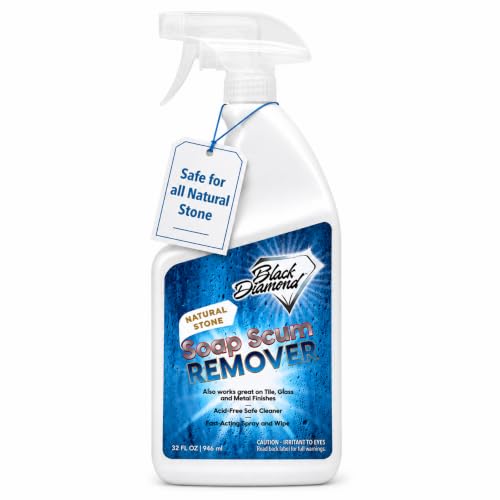
Effective Soap Scum Removal: Removes soap scum, hard water buildup, body oils, and everyday shower residue

Safe For Everyday - Perfect for everyday cleaning
8. Freestanding Copper Tubs
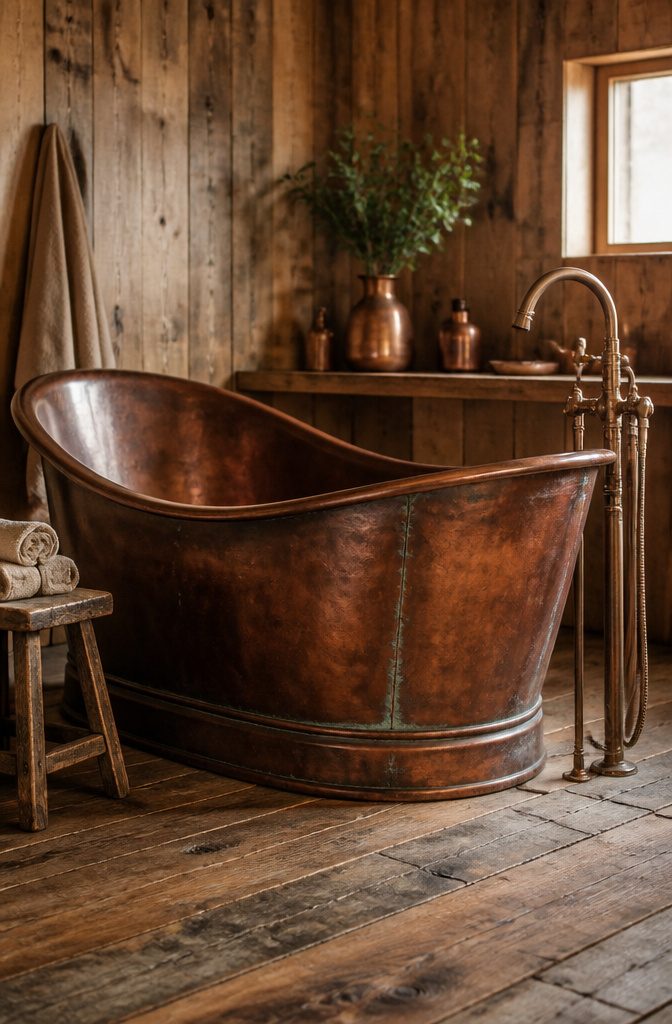
A freestanding copper tub brings sculptural weight to a rustic bathroom in a way few other pieces manage.
The living finish darkens over months and eventually carries green patina in the seams, which reads as character rather than wear if you are prepared for the change.
What stopped me from ordering one last year was not the price alone.
These tubs run heavy enough that floor loading becomes a real question in older homes, and the fill faucets need to be floor-mounted or riser-style rather than standard deck mounts.
The copper does hold heat longer than acrylic, so the soak stretches without topping off. Still, this is the splurge on a list built around weekend budgets.
If the rest of the room is reclaimed wood and a stone vessel sink you installed yourself, the tub either anchors the whole look or throws it off balance.
I would only add it after the other pieces are in place and the budget still has room.

ACCENT WALL TILE: Decorative tile liners are designed to accent and finish any ceramic, glass or stone tile surface. Visit our store for our full collection of all your home improvement needs

Tile Dimensions and Construction: 4x4 Tumbled Travertine tile with rounded edges and 3/8 inches thickness

Elegant travertine-inspired pattern adds natural flow and texture to any room
9. Woven Baskets for Storage
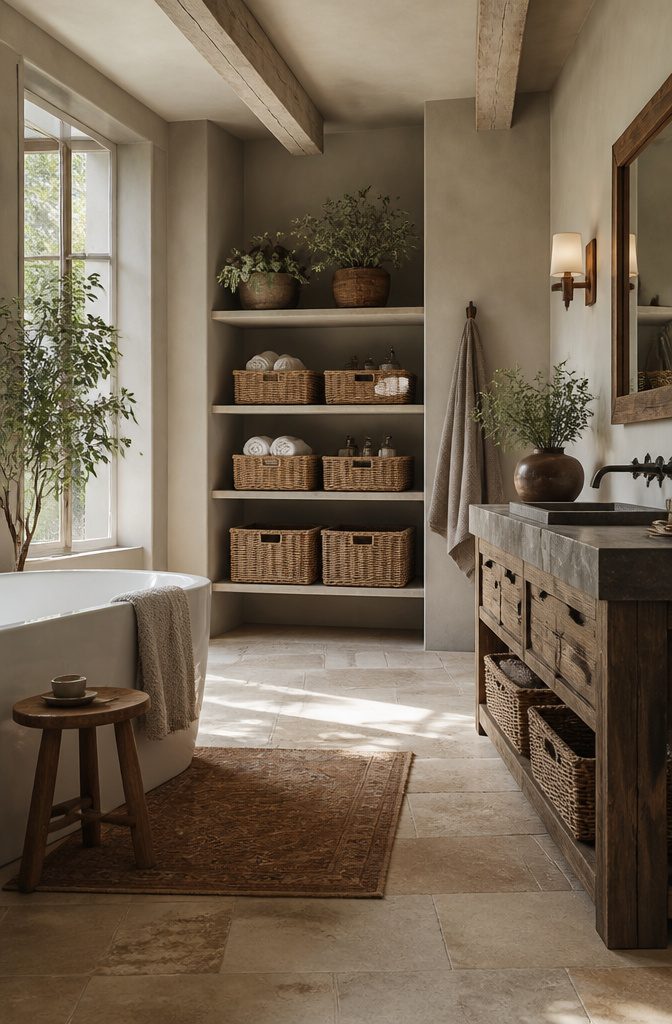
Natural fiber baskets look right in a rustic bathroom, but the fiber matters more than the weave.
Seagrass and finished rattan hold up to steam and splashes; cheap reed or unsealed paper cord will mildew within a season, turning from charming to musty fast.
I learned that difference the hard way in a first apartment, swapping out a set of reed baskets after six months when the bottom corners went soft and dark.
Scale is the other mistake that kills the look.
A basket too small for the shelf leaves towels spilling over the rim, which reads as clutter, not storage. Too large and you are sacrificing floor space you probably do not have in a bathroom to begin with.
I measure the shelf or cubby first, then look for a basket that sits about an inch inside on each side, enough to slide in and out without fighting it.
Toilet paper stores well stacked vertically in a taller narrow basket; hand towels fold better in something wide and shallow where you can see the whole stack at a glance.

Premium Stone Resin Material – Durable, scratch-resistant, and easy-to-clean surface, designed for long-lasting use in high-traffic bathrooms.

【High Quality Natural Stone】★ Made from high-density natural stone for superior strength. Resists chipping, scratches, and moisture. Heavy-duty build ensures long-term stability.

Natural River Stones: Natural Rocks Found In River Water Bodies, These Boulders Are Shaped Into Oval Shapes By The Flowing Water, The Most Common Colours Are Yellow-Brown, Grey-Brown Etc., They Are Natural And Environmentally Friendly Granite Stones!
10. Decorative Wrought Iron Details
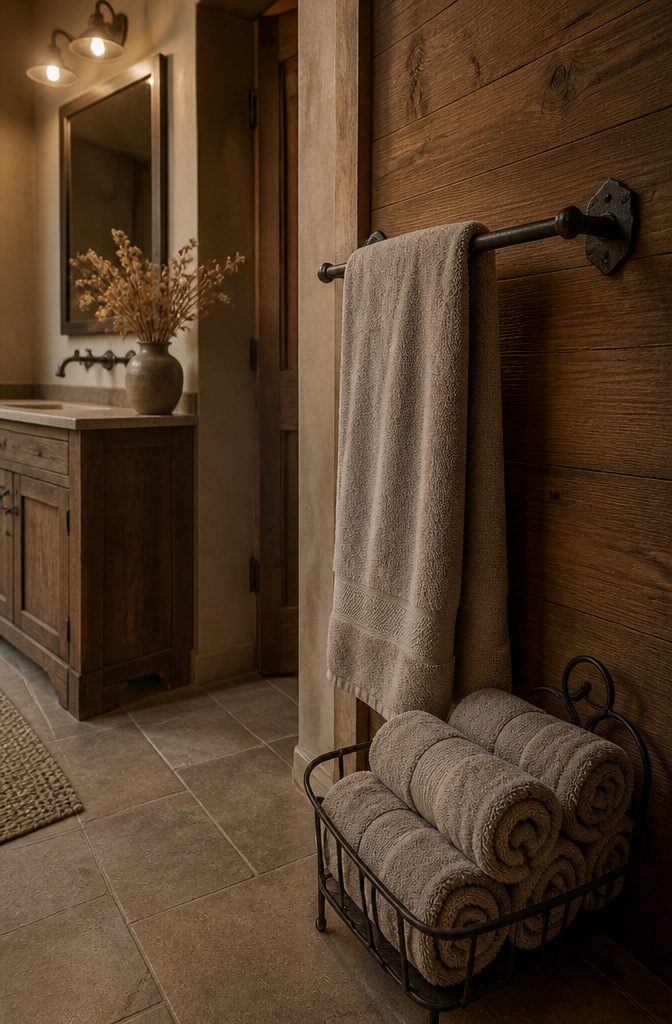
Genuine wrought iron hardware carries a heft that hollow steel tubing never matches.
I learned the difference the hard way after installing a powder-coated towel bar that rang hollow against the tile and started flaking at the bracket within two years.
Real iron settles against the wall with weight you feel when you lift the box, and the surface texture under an oil-rubbed finish shows slight irregularities instead of the perfect uniformity of a factory coating.
For a bathroom that sees daily steam, periodic light waxing every few months protects raw or finished iron better than relying on the factory coating alone.
I keep a tin of paste wax under the sink and hit the brackets and bars when I notice water beading less readily.
Toilet paper holders and mirror frames get the same treatment, though mirror frames need extra attention at the lower edge where condensation collects.
Shelf brackets are the one place I would consider going with steel instead, since they stay drier higher on the wall and the weight savings matter if you are anchoring into old plaster rather than studs.

【Black Bathroom Faucet】 Modern touch on bathroom faucet with matte black finish,creates an modern-looking. From its durable, long-lasting construction to the contemporary and decor-complementing design, this faucet belongs in your bathroom.

Crafted from high-grade ceramic and fired at 1380°C, this vessel sink offers exceptional durability with a seamless, crack-resistant surface. This sink is built to resist stains, scratches and fading. Simply wipe the sink surface with a damp cloth to keep it looking beautiful with minimal maintenance.

Complete Sink Set: Includes an 18 x 13 inch ceramic vessel sink, matte black faucet, pop-up drain, drain adapter, hot and cold supply lines, mounting ring, and installation instructions.
11. Mixed Metal Fixtures
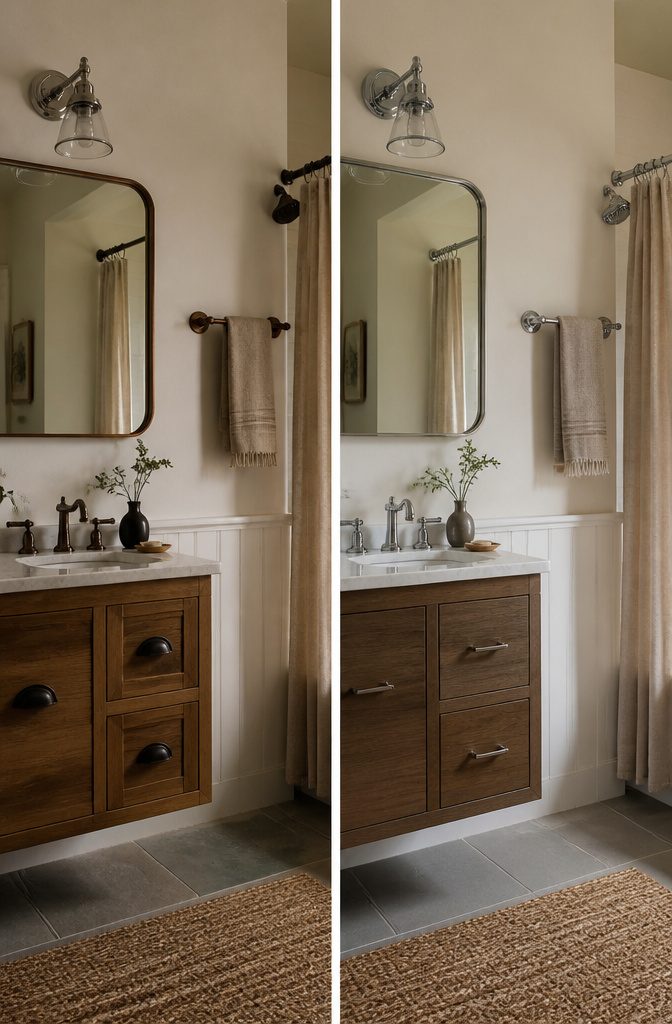
Aged bronze makes the most forgiving base for mixing metals in a rustic bathroom, and that matters because every big-box line carries it in faucets, shower sets, and cabinet pulls.
Start there for the fixtures you touch daily, then add one or two secondary metals in smaller pieces so the room never falls into that showroom-matched stiffness.
Copper works well on a mirror frame or a pair of vintage sconces; brushed nickel reads cooler but pairs cleanly with bronze on towel bars or a soap dish.
Black iron belongs on the smallest accents, maybe a toilet paper holder or a couple of drawer knobs, where its weight does not dominate.
The goal is variation that looks collected over time, not accidental. Limit yourself to three finishes total, and repeat each at least twice so nothing reads like a leftover.
In my own bathroom, the bronze faucet and shower hardware carry most of the visual load, a copper mirror I found secondhand adds warmth, and one brushed nickel towel ring ties to the chrome on an old medicine cabinet I kept.
The black iron stayed limited to two small knobs on the vanity. That ratio, roughly sixty percent base metal and forty percent accents, keeps the mix intentional without drifting into clutter.
12. Natural Textiles
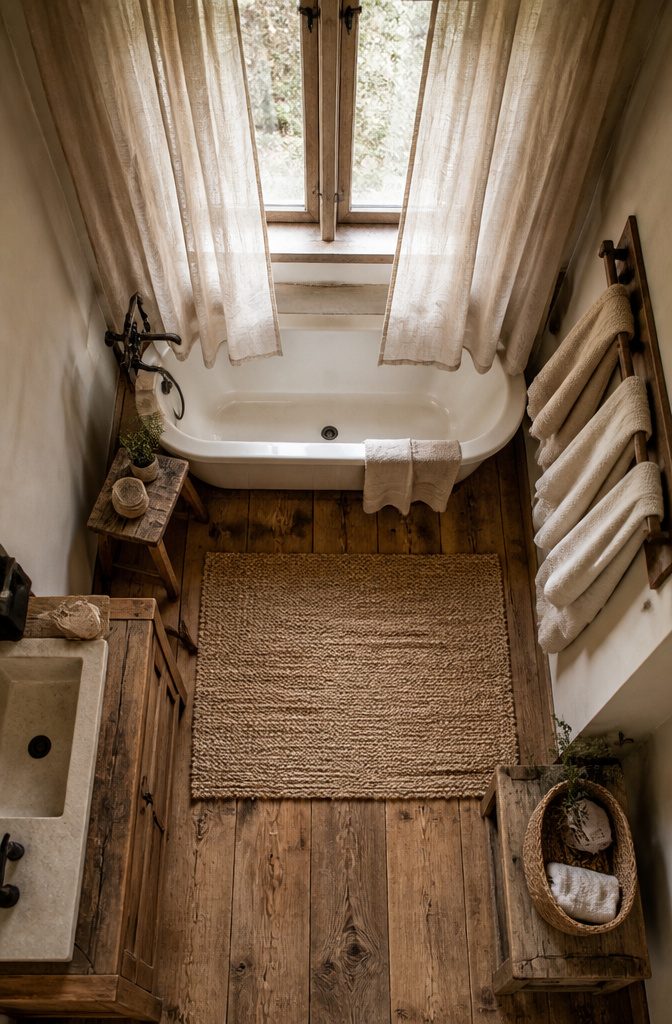
Jute underfoot wakes a rustic bathroom up, but the rough weave has limits. Water splashed from the tub or sink pools instead of drying, so a jute rug belongs outside the splash zone or needs a rubber pad beneath it.
Linen towels and shower curtains soften the room in a way jute cannot, and they survive the washing machine, though they come out wrinkled every time.
That wrinkling is part of the texture; fighting it with an iron misses the point.
Machine-washable cotton is the practical anchor for a bathroom that actually gets used, especially for shower curtains that face daily humidity and window treatments that collect dust near the vanity.
Cotton in tan, gray, or cream keeps the palette from sliding too dark, which is the heaviness readers worry about with rustic style.
Layer the three materials by zone: jute where feet land on dry tile, linen for the pieces that hang and move, cotton for the workhorses that need frequent laundering.
Rustic Bathroom Colors
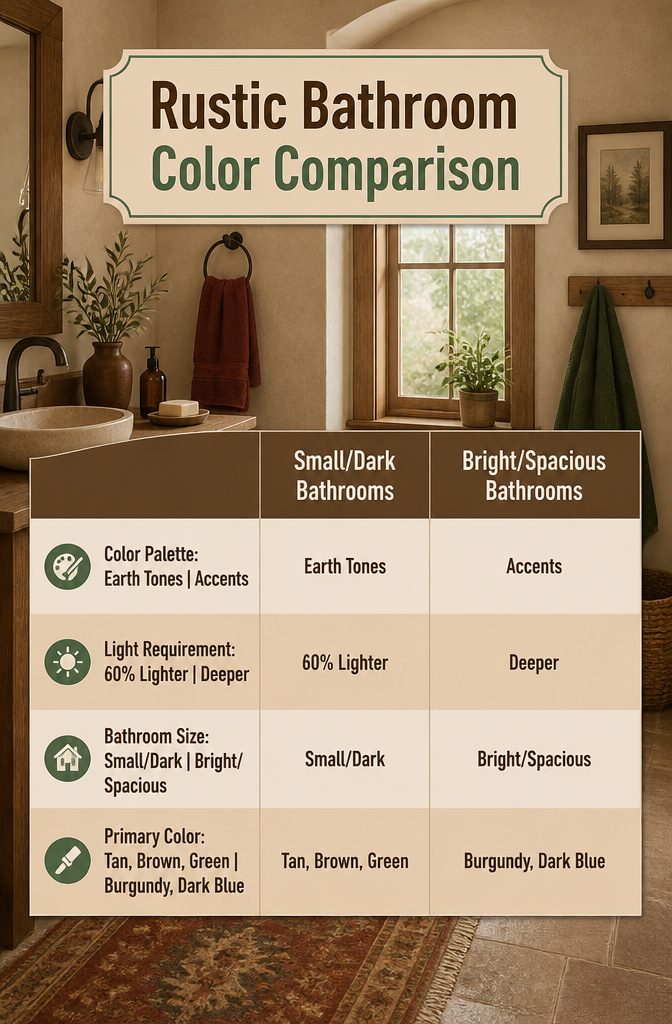
Earth tones form the backbone of any rustic bathroom, and the palette is narrower than you might expect.
Tan, brown, and muted green carry most of the weight, with burgundy or dark blue reserved for accents that add depth without taking over.
I keep those darker colors to small doses: a hand towel set, a ceramic soap dish, the inside of a medicine cabinet door.
Let them anywhere near a full wall and the room starts feeling like a lodge lobby rather than a bathroom you actually use.
Light matters here. A bathroom with a single window or a north-facing exposure needs lighter tans and warm whites on the larger surfaces to keep from turning cave-like.
I learned that the hard way in a rental with original brown tile that seemed charming at 10 a.m. and oppressive by 4 p.m.
A warm white on the upper walls, not a stark blue-white, pulled enough light back in to make the space functional.
Small or dark bathrooms need those lighter values on at least 60 percent of the visible surface; save the deeper browns and greens for flooring or a single feature wall.
The same palette works in a bright, spacious bath, just flipped: deeper base tones, lighter accents, and the room still reads as rustic rather than merely dim.
Wall Treatments That Warm the Room
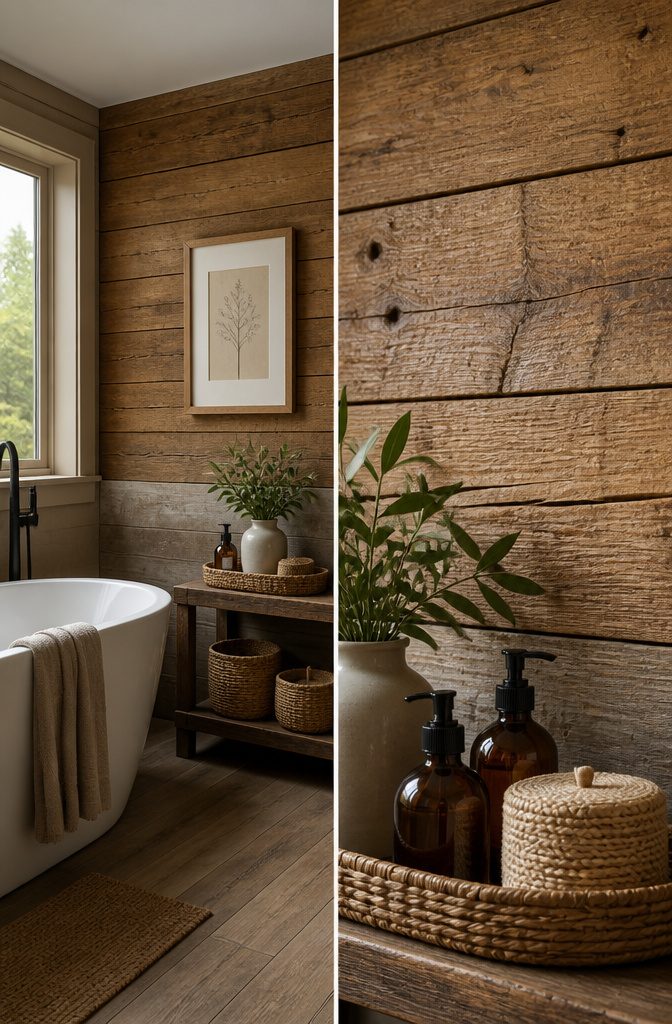
Rough-hewn wood planks on a bathroom wall look warm until they warp, which they will if you nail them straight to drywall.
Expansion gaps and a moisture barrier behind every board are non-negotiable; without them, the planks cup and the drywall behind grows mold you will not find until the wall smells.
Shiplap buys you cleaner lines with that same farmhouse feel, and beadboard gives you the tighter vertical grooves that read more cottage than cabin.
Run any of them horizontally and the room widens; run them vertically and the ceiling lifts. I have seen both work, but the direction matters more than most people plan for.
For a shower surround or any wall that gets soaked, wood-look porcelain tile is the practical move.
The Preston 8×48 Matte Porcelain Tile in Chestnut copies aged grain well enough that you will not miss the real thing, and it survives the wet cycles that destroy actual boards.
I would still use real wood on a powder-room accent wall or anywhere outside the splash zone, but the tile wins anywhere the shower runs twice daily.
Small Rustic Bathrooms
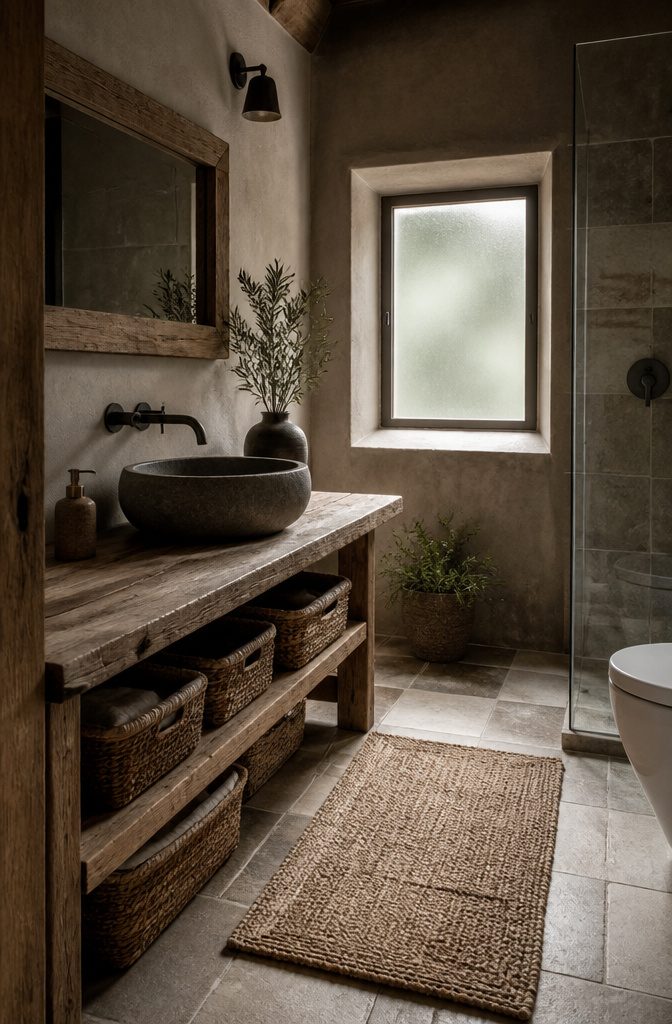
Rustic design scales to small spaces through texture and tone rather than bulky furniture.
In a tight bathroom, a compact vessel sink in gray stone sits on a thick wood countertop without swallowing the room the way a built-in vanity might.
Wall-mounted faucets in matte black keep the deck clear and add that rougher finish that reads as rustic, not cramped.
Vertical storage matters even more when square footage is scarce. Woven baskets stacked on open rustic cabinetry keep essentials reachable without protruding into the walkway.
The real discipline is restraint on materials.
One wood species, one stone type, and the eye rests. Mix reclaimed wood grain with slate mosaic and a rusty brown slate backsplash in the same 4-foot stretch, and the small space starts to feel like a crowded sample board.
A single strong material prevents visual clutter in tight quarters. I learned that reading through dozens of these setups: the calm ones commit to one story, not three.
Lighting in Rustic Bathrooms
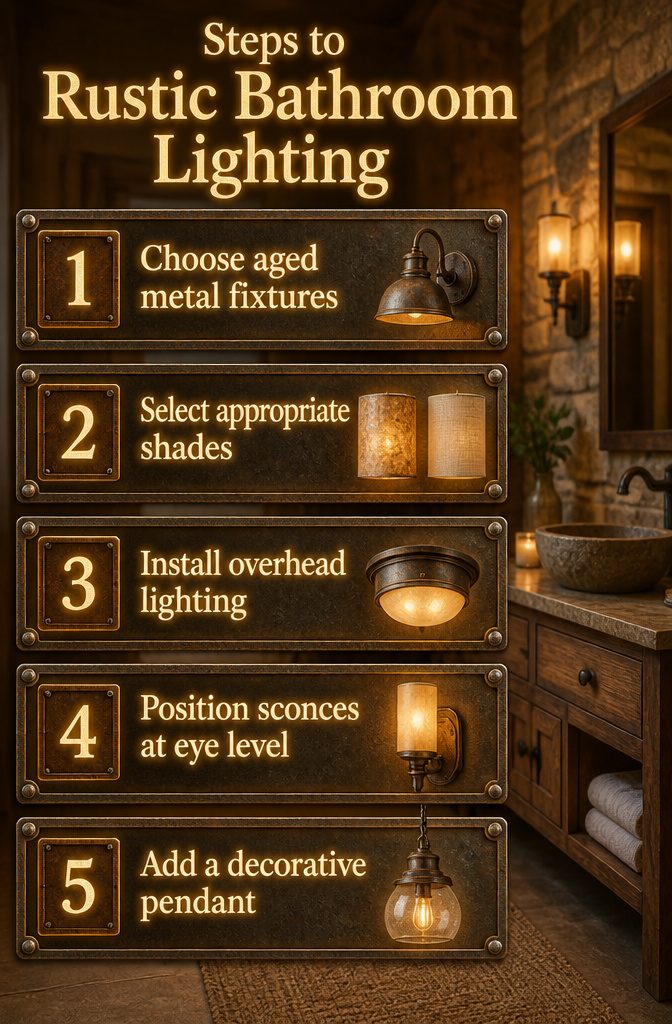
Aged metal fixtures carry most of the weight in a rustic bathroom’s lighting scheme.
Iron, brass, and copper all darken and soften over years of steam and handling, and that patina is what keeps the room from feeling like a showroom.
I have passed over plenty of bright chrome sconces that would have read modern against reclaimed wood or stone.
The shade matters as much as the arm.
Mica splits light into a warm, uneven glow that hides bulb glare, and linen does something similar with a softer edge. Either one keeps the ceiling from turning into a flat white field.
Layered light is non-negotiable in a bathroom this style tends to make darker.
Overhead fixtures handle the function, sconces at the mirror need to sit roughly eye level for shaving or makeup, and a third source, maybe a small pendant in a corner, gives the room depth after dark.
Rustic fixtures usually run warmer on the Kelvin scale, around 2700K, and that warmth shifts how paint and tile read.
A gray that looked crisp under 4000K turns muddy; a cream that seemed safe can go orange. Test your chips at night with the actual bulbs you plan to keep.
Mixed Wood Tones
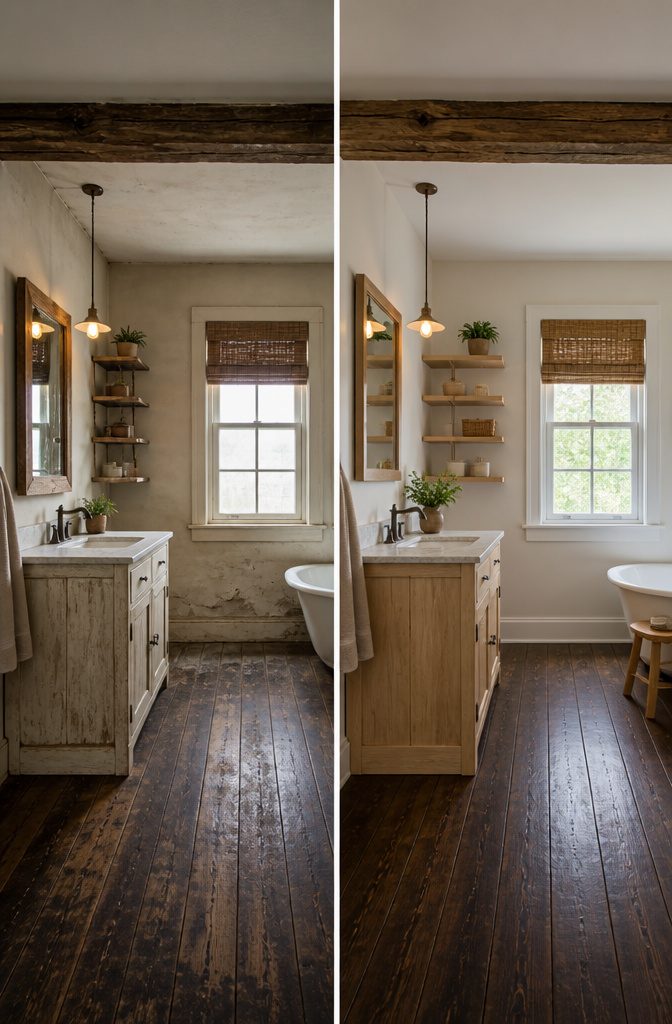
Rustic style lives on the idea that nothing came from the same factory on the same day.
A floor that spent decades in a barn, a vanity built from local oak, a beam someone pulled from a collapsed shed: each piece carries its own age and origin, and the variation is the whole point.
The question readers keep landing on is how many wood tones are too many. One dominant tone, one clear contrast, and small accents of a third keep the room from feeling like a furniture showroom.
In my own reading through dozens of these projects, the ones that fell flat were almost always trying too hard to coordinate. Matching stains read as forced because real aging does not match.
Let the floor sit darker and redder, run the vanity lighter and cooler, and let a single shelf or mirror frame carry something in between.
The contrast does the work. Your eye moves across the room and registers the difference as texture, not as error.
Avoid the temptation to stain new wood to "match" old.
The mismatch in grain density alone will betray you. Better to leave the new piece raw and let water and soap do their slow work, or pick a tone honest to what the board actually is.
Frequently Asked Questions
Can a rustic bathroom work in a small space?
Yes. A compact vessel sink in gray stone on a thick wood countertop, wall-mounted matte black faucets, and vertical storage with woven baskets keep the room open rather than crowded.
The discipline is using one wood species and one stone type so the eye rests; mixing too many materials in a tight space turns it into a sample board.
Is rustic style compatible with modern plumbing and fixtures?
Yes. PEX tubing behind walls avoids solder joints that fail invisibly, and pressure-balancing valves keep showers from scalding when someone flushes.
The outside trim can read as vintage cross-handle or simple porcelain lever to match the room, while the modern cartridge inside reacts faster than you can move your hand.
How do I prevent a rustic bathroom from feeling too dark?
Put lighter tans and warm whites on at least 60 percent of visible surfaces, especially in a small or north-facing bathroom.
Save deeper browns and greens for flooring or a single feature wall, and test paint chips at night with the actual 2700K bulbs you plan to keep, since warm light shifts how colors read.
What type of lighting works best in a rustic bathroom?
Fixtures in aged iron, brass, or copper with mica or linen shades split light into a warm, uneven glow that hides bulb glare.
Layer three sources: overhead for function, sconces at eye level at the mirror, and a small pendant in a corner for depth after dark.
Can I mix different wood tones in a rustic bathroom?
Yes, and variation is the point of rustic style. Use one dominant tone, one clear contrast, and small accents of a third.
Let the floor sit darker and redder, run the vanity lighter and cooler, and let a single shelf or mirror frame carry something between. Never stain new wood to match old; the grain density mismatch will betray you.