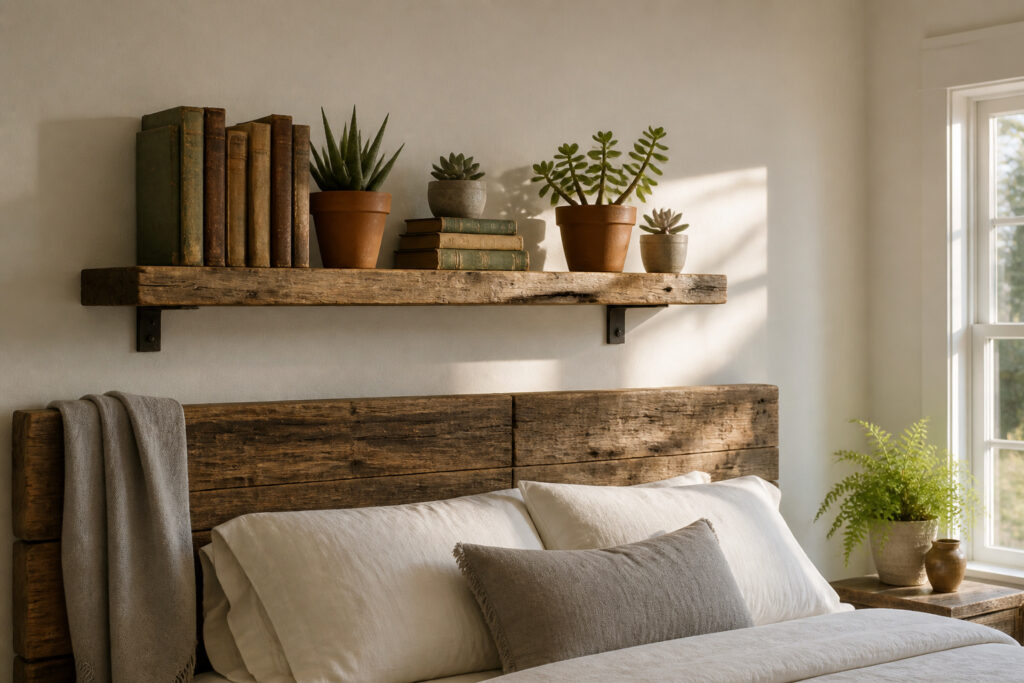
Wall shelves in a bedroom are mounted storage that either opens a cramped room or turns it into clutter you notice every time you lie down.
The difference is almost always depth: 8 inches above a headboard keeps the profile light, while 12 inches in a closet actually fits folded jeans without wasted air.
A standard queen headboard pairs cleanly with a shelf 36" to 48" wide, mounted 8 to 10 inches above the frame so you do not bump it sitting up to read.
Floating Shelves Above the Bed
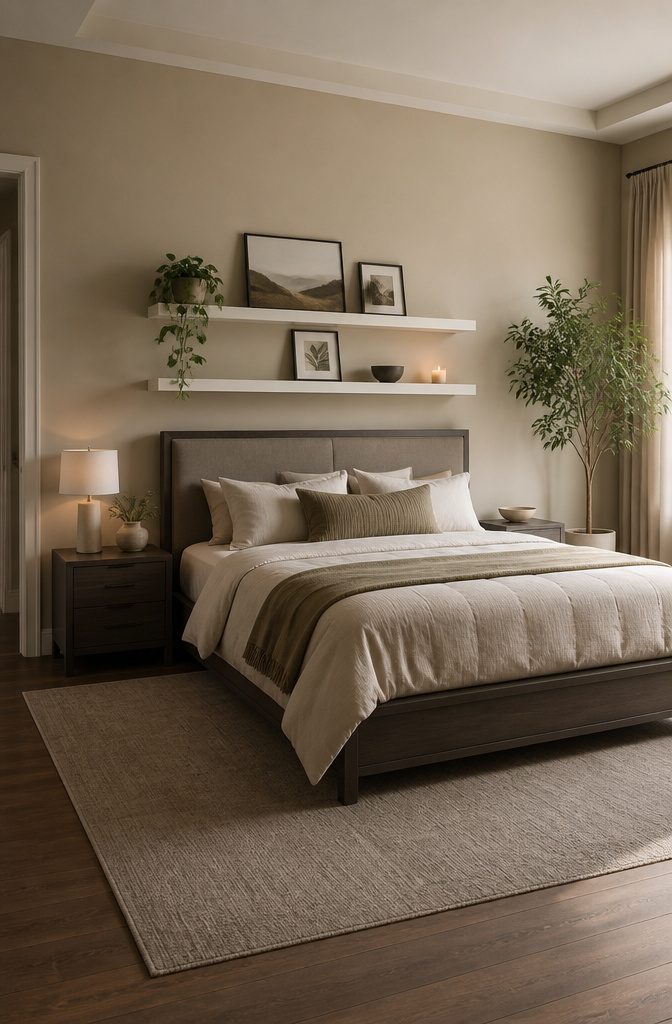
The wall above a headboard is usually empty, which makes it the first place most people think to mount a floating shelf.
A single shelf or a stacked pair turns that space into display territory for frames, a small trailing plant, or a candle.
A shelf 36" to 48" wide and 8" deep sits cleanly inside the width of a standard queen headboard without overhanging the edges, and the slim depth keeps the profile from feeling heavy directly above where you sleep.
Height matters more here than in other spots.
Mount the bottom shelf 8 to 10 inches above the top of the headboard; any lower and you will bump it sitting up in bed to read, any higher and it starts to float away from the bed visually.
If you are stacking two, space them 10" to 12" apart so the grouping still reads as one unit.
What goes up there should stay light, literally and visually. Framed photos, a small plant, a couple of books standing upright.
This is not storage. Load it up with too much weight or clutter and it stops being a design element and starts being a hazard you notice every time you lie down.
Shelves as Nightstand Replacements
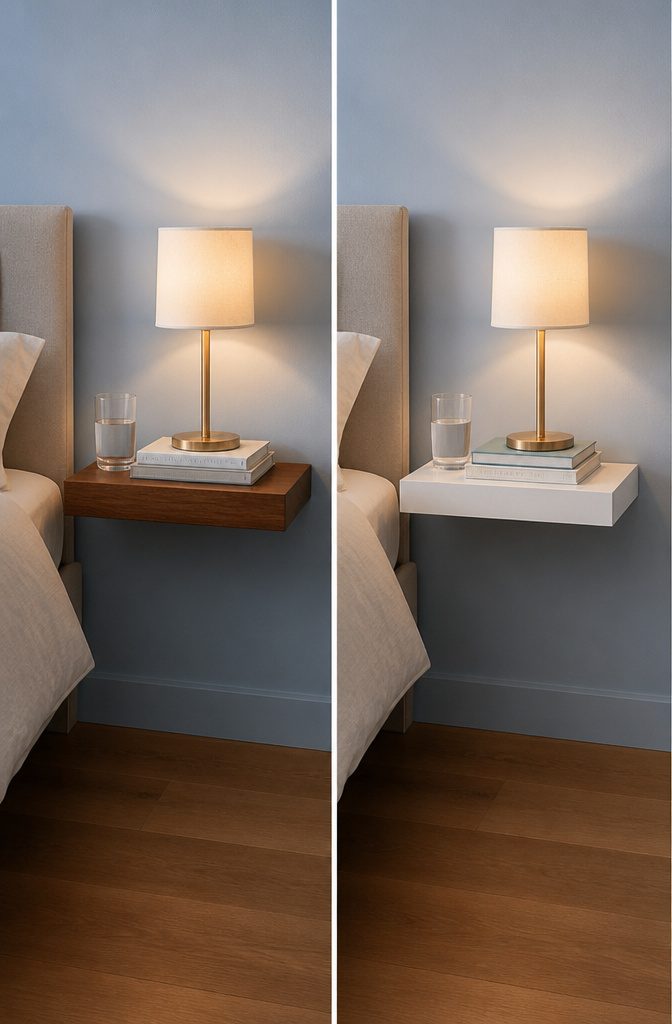
A single floating shelf at nightstand height, 24" to 26" from the floor, holds the same phone, lamp, book, and glass of water without the bulk of furniture legs.
The mounting level should sit even with the top of your mattress, so the surface feels natural when you reach over from bed.
The tradeoff is real. You lose the drawer where clutter used to disappear, so everything on display needs to earn its place.
A 24" x 10" shelf handles the basics, but charging cables and midnight snacks now sit in the open. What you gain is about 80% less visual weight and the ability to vacuum underneath without shifting furniture around.
In tight bedrooms, apartments, or kids’ rooms where floor space matters more than hidden storage, this swap opens the room up immediately. Matching shelves on each side at the same height keep the look intentional rather than improvised.
Closet Wall Shelves
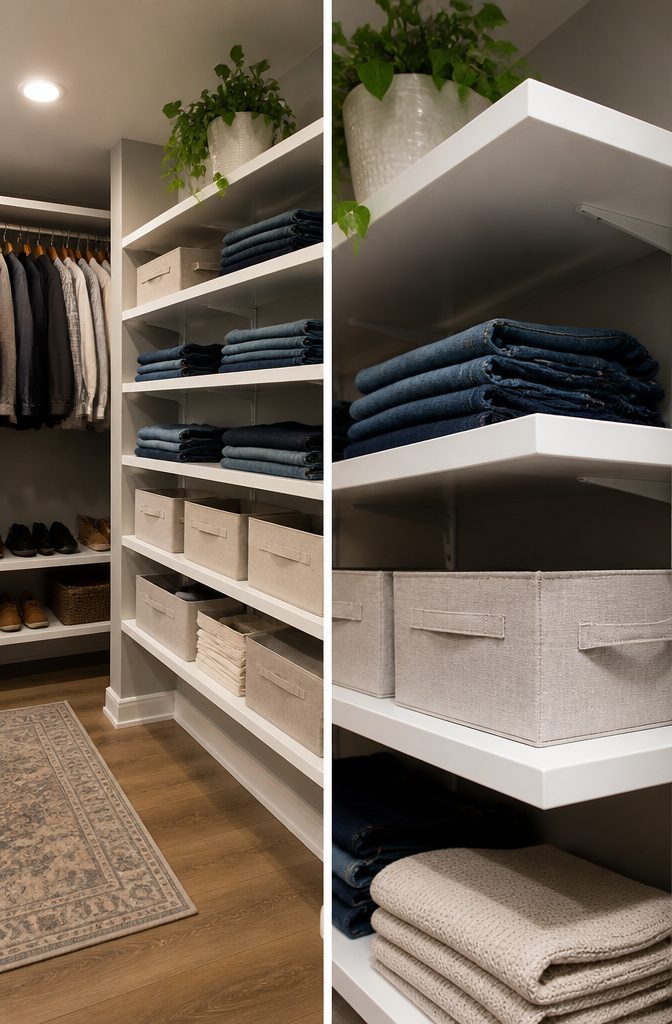
Closet wall shelves earn their space by actually fitting what goes on them.
A folded stack of jeans sits about 9 inches front to back, so 10 to 12 inches deep gives a clean edge with a little room to spare; anything deeper and you are wasting the limited depth of a standard closet on air.
Width runs 24 to 36 inches, which matches the span between most side walls or partition panels without asking the board to carry more than it should.
Vertical spacing matters just as much. Set shelves 10 to 12 inches apart and you get a stack that works for folded shirts, shoe boxes, or a fabric bin without crushing what is underneath.
Wider gaps leave dead space above each pile; tighter spacing and you are playing Tetris with every sweater.
Corners are rarely square, so measure front and back along the wall before cutting.
Ordering an eighth inch short of the full span leaves a sixteenth inch gap on each side, enough to slide the shelf in without jamming and still look fitted.
Reading Nook Bookshelves
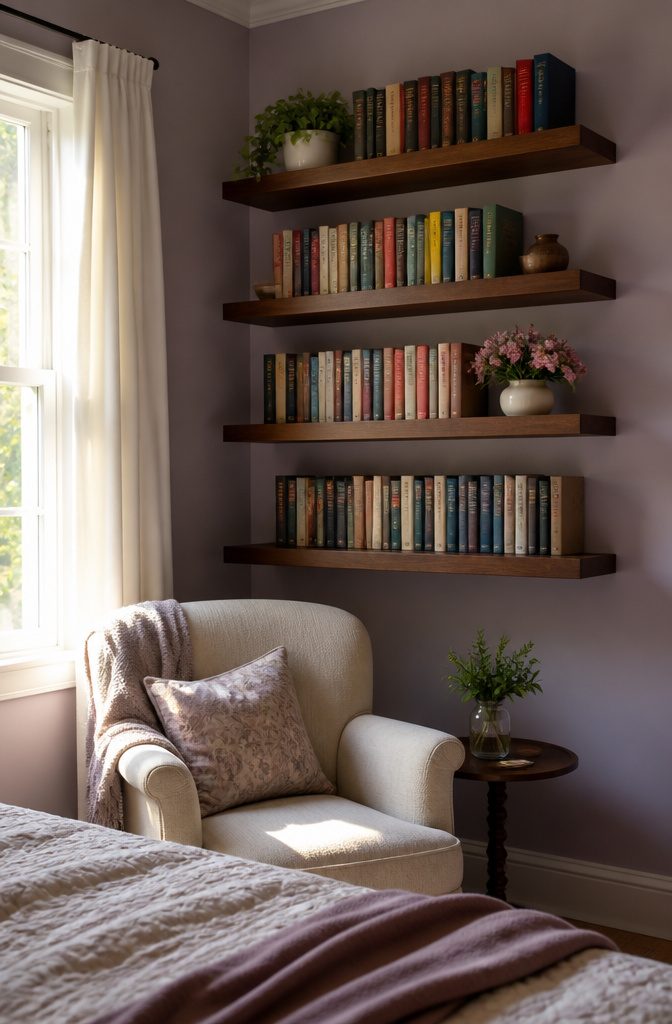
A bedroom reading nook built from wall-mounted shelves needs to carry actual books, not just look at them.
Go 10" to 11" deep so standard hardcovers sit flat with a little lip to grab, and stack three to five rows with 10" to 12" between them.
That spacing keeps the wall from turning into a library annex while still holding a serious collection.
Display shelves get away with 6" or 8" because a vase or framed photo weighs nothing and sits pretty.
Books are different. A 36" run of hardcovers hits 60 to 80 lbs without trying, which is why the bracket choice matters more here than anywhere else in the bedroom.
The Hovr system rates at 150 lbs per stud, no sag. I would not hang a loaded bookshelf on anything less rated, and I would not guess at the wall structure behind it.
Bedroom Workspace Shelves
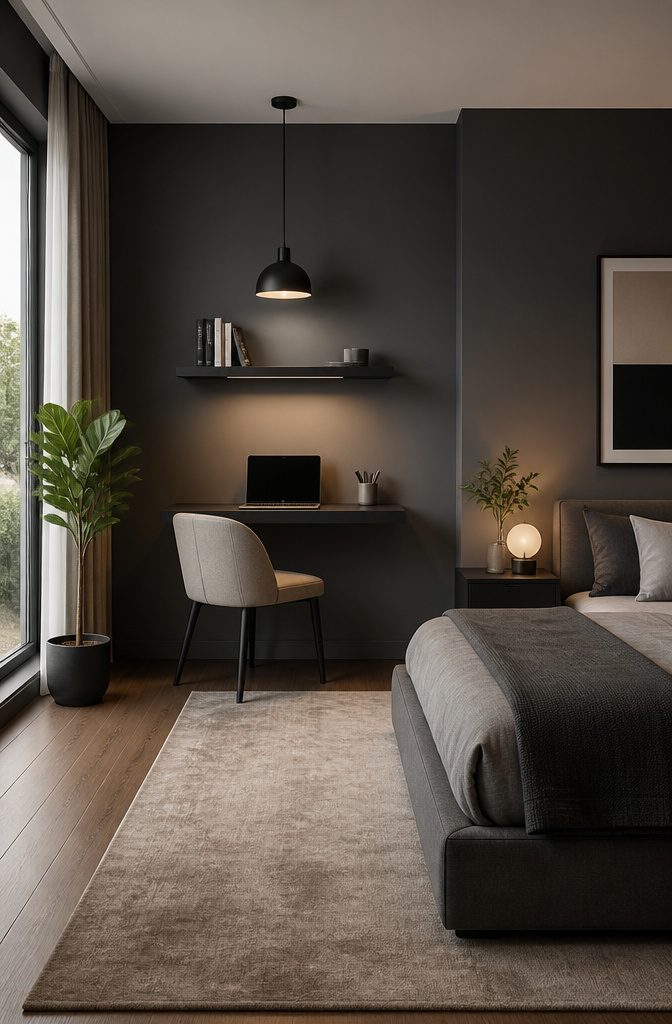
A desk pushed against a bedroom wall usually reads as an intrusion, a piece of office furniture that refuses to let the room settle.
Floating shelves change that equation. Mount the first shelf 28" to 30" from the floor, right at seated elbow height, and it becomes the work surface itself.
A second shelf 14" to 16" above it holds the books, the charger, the coffee cup. The laptop sits on the lower ledge, and the whole thing occupies no floor space at all.
The trick is keeping the profile low enough that the eye passes over it when the workday ends.
Matching the shelf material to whatever else hangs on that wall helps; a black ash shelf above a black ash ledge reads as one quiet plane rather than two objects competing for attention.
It is not a full home office, and it should not try to be.
For a bedroom that needs to double as a Monday-morning email spot, the setup works better than most people expect, and it tears down in twenty minutes when the lease ends or the room needs to become something else.
Picture Ledges for Art and Photos
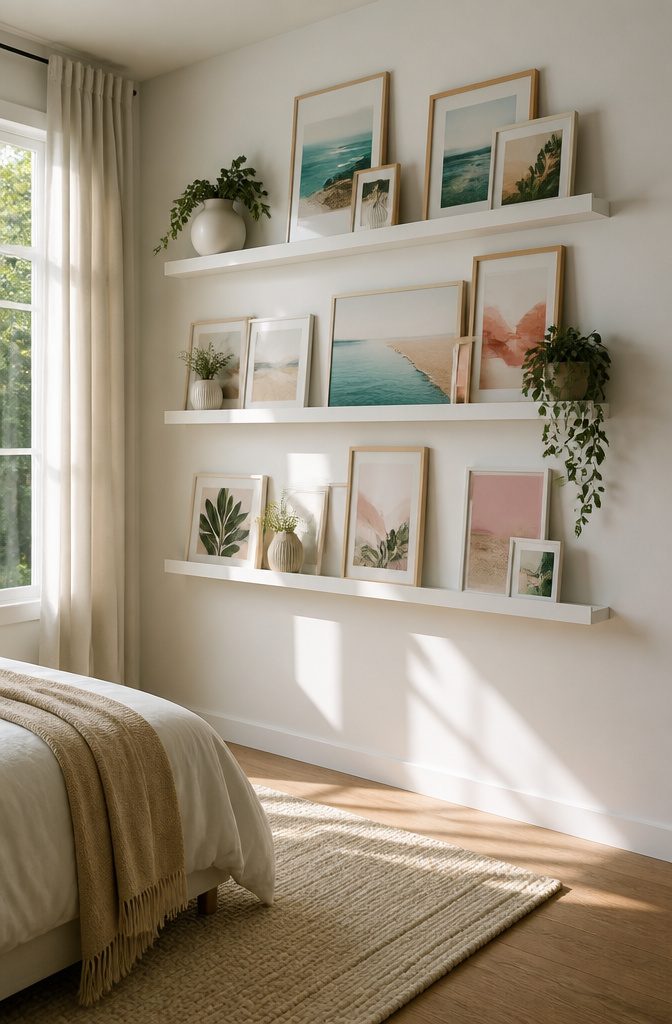
Picture ledges sit almost flush to the wall, usually two to three inches deep, which changes what they are for.
A standard floating shelf wants books or baskets; a ledge asks for framed prints, small canvases, or photographs you plan to swap out.
The shallow lip at the front keeps things from sliding, but it also means nothing heavy or deep belongs there.
The real difference is in commitment.
Hanging a gallery wall with nails and anchors locks you into an arrangement for months. A ledge lets you rotate a 5-by-7 print on Tuesday and a postcard on Friday without spackling holes.
In a bedroom, that flexibility matters because the mood shifts: winter calls for darker tones, summer for something lighter, and the ledge keeps up without a project.
Two to three ledges stacked vertically, spaced about a foot apart, give you a column of changing display without the clutter of a full shelf unit.
The top one can hold a single framed piece; the lower ones layer smaller items that overlap slightly, which reads as collected rather than crowded. Deeper shelves cannot do this overlap gracefully; the ledge format was built for it.
I would not use a picture ledge for anything you touch daily. Water glasses, phones, alarm clocks all want more depth and a steadier surface.
The ledge is for looking at, not leaning on. Keep it above bedside height or across from the bed where it catches morning light on the frames, and treat it as a slow-rotation display rather than storage.
Shelves With Integrated Lighting
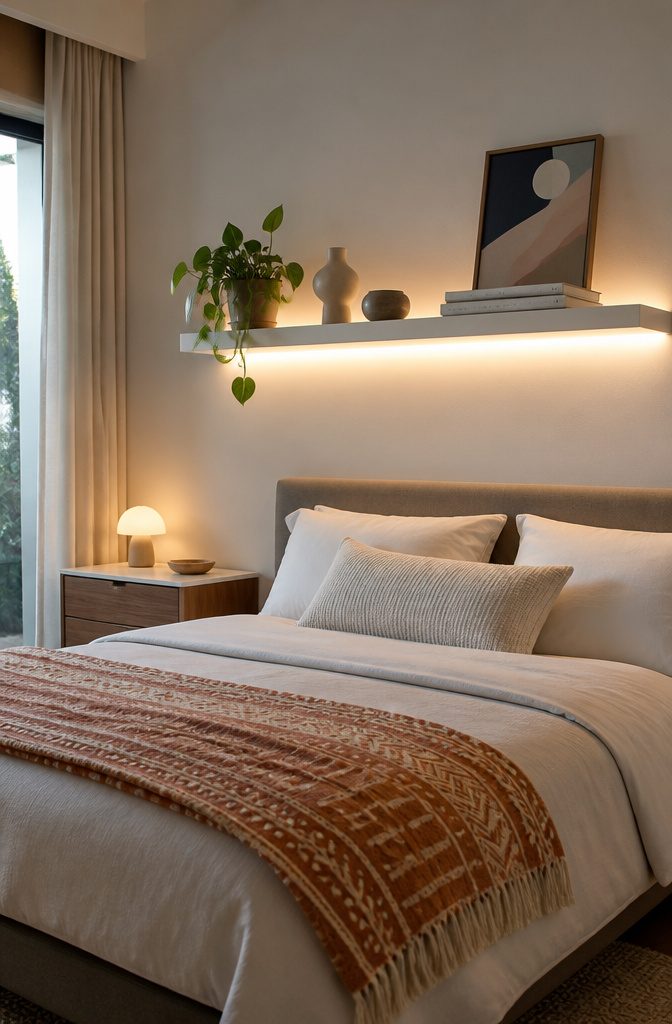
LED channels routed directly into the shelf itself give the bedroom something overhead fixtures and bedside lamps never manage: light that washes down the wall instead of pushing across it.
The source sits hidden inside the wood, no adhesive strips or visible hardware, with the cord running through a drilled hole in the back.
The glow lands on whatever sits below, the bed or the wall flanking a TV, and at night the effect is soft enough to read by, steady enough to navigate by, but never the harsh pool of light you get from a ceiling fixture snapping on at 2 a.m.
The install is permanent, which matters more in a bedroom than people admit.
Renter-friendly stick-on strips peel, shift, and die in sections. A channel cut into the shelf itself runs about $50 per shelf, and the result is built in, not tacked on.
The tradeoff is the cord management and the commitment to one wall. For a shelf above the headboard, the payoff is ambient light that does not flicker or need a lampshade dusted.
Where Shelves Go and How High
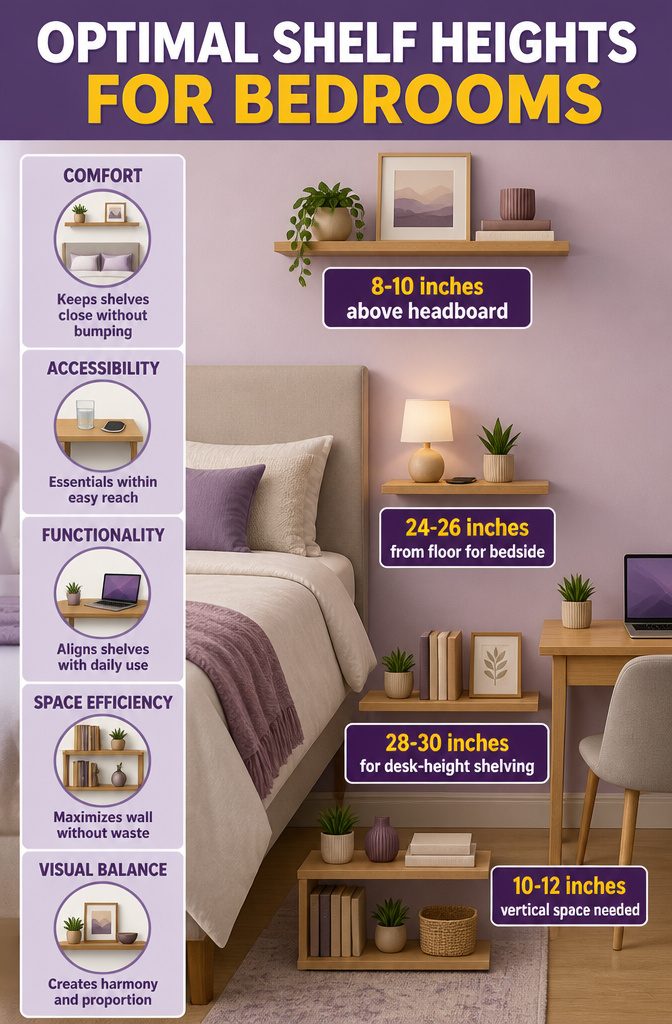
The 8–10 inches above a headboard is not a random margin; it is the gap that keeps you from sitting up straight into a shelf while still letting the bed and the wall feel like one unit.
Wider than that and the shelf starts to float in space, disconnected from the furniture below. Narrower and you will knock a frame off it every time you reach for the light switch.
A floating shelf beside the bed, used as a nightstand replacement, wants to sit at 24–26 inches from the floor.
That puts a phone or a glass of water within reach from a typical mattress height without forcing you to grope downward.
The same logic governs desk-height shelving: 28–30 inches off the floor matches standard desk surface, and a second shelf 14–16 inches above it holds books without crowding a laptop screen.
Stacked shelves anywhere in the room need 10–12 inches of vertical breathing room. Less and tall bottles or standing books fight for space; more and you waste wall you could have used for another row.
Wood Species and What They Cost
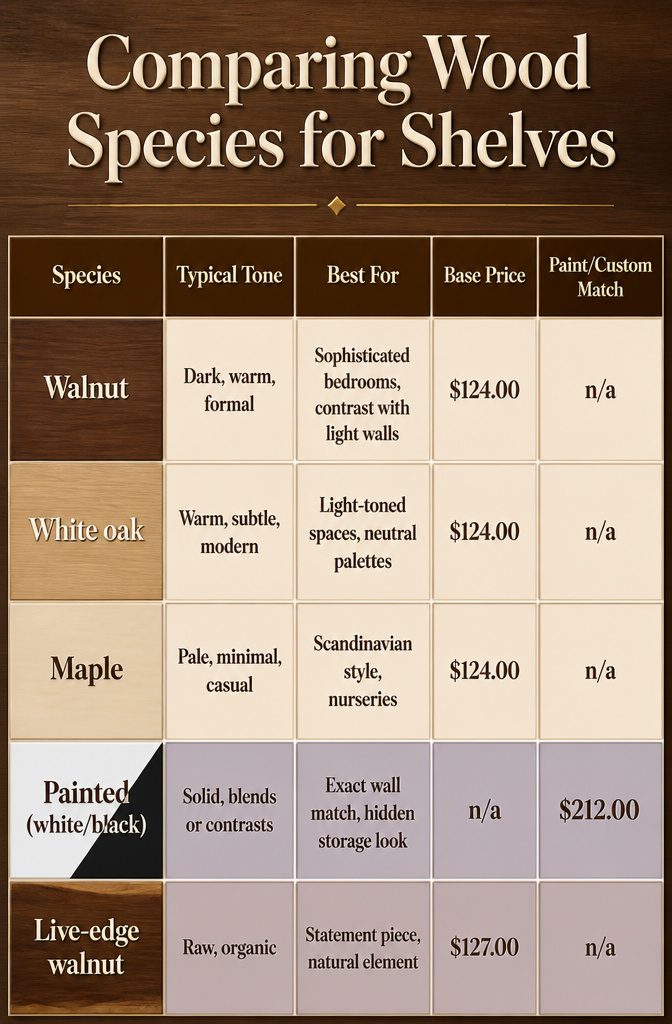
Walnut shelves carry the darkest, warmest grain of the three species most shops stock for bedrooms, and that depth reads sophisticated against white bedding without turning heavy.
White oak sits in the middle, its subtle grain and warm but non-yellow tone blending quietly into modern, lighter schemes.
Maple is the palest and most minimal, the one that almost disappears into the wall in a Scandinavian-styled room or nursery.
Paint and stain flip the usual cost logic.
The same shop prices walnut, white oak, and maple identically at $124.00 for standard floating shelves, so the species itself does not drive the price. What does is the finish.
Painted white or black shelves run $212.00, a jump of nearly seventy percent over any stained hardwood. Live-edge walnut, kept raw and organic, lands only slightly above standard walnut at $127.00.
If the goal is a custom paint match to a nursery wall color, that premium holds; if the goal is letting the wood speak, stain saves money and still gives the room its tone.
| Species | Typical Tone | Best For | Base Price | Paint/Custom Match |
|---|---|---|---|---|
| Walnut | Dark, warm, formal | Sophisticated bedrooms, contrast with light walls | $124.00 | n/a |
| White oak | Warm, subtle, modern | Light-toned spaces, neutral palettes | $124.00 | n/a |
| Maple | Pale, minimal, casual | Scandinavian style, nurseries | $124.00 | n/a |
| Painted (white/black) | Solid, blends or contrasts | Exact wall match, hidden storage look | n/a | $212.00 |
| Live-edge walnut | Raw, organic | Statement piece, natural element | $127.00 | n/a |
The choice between stain and paint is really a choice between flexibility and precision. Stain lets the grain show and the species matter; paint erases both, and you pay for that erasure.
What Stays Off the Shelf
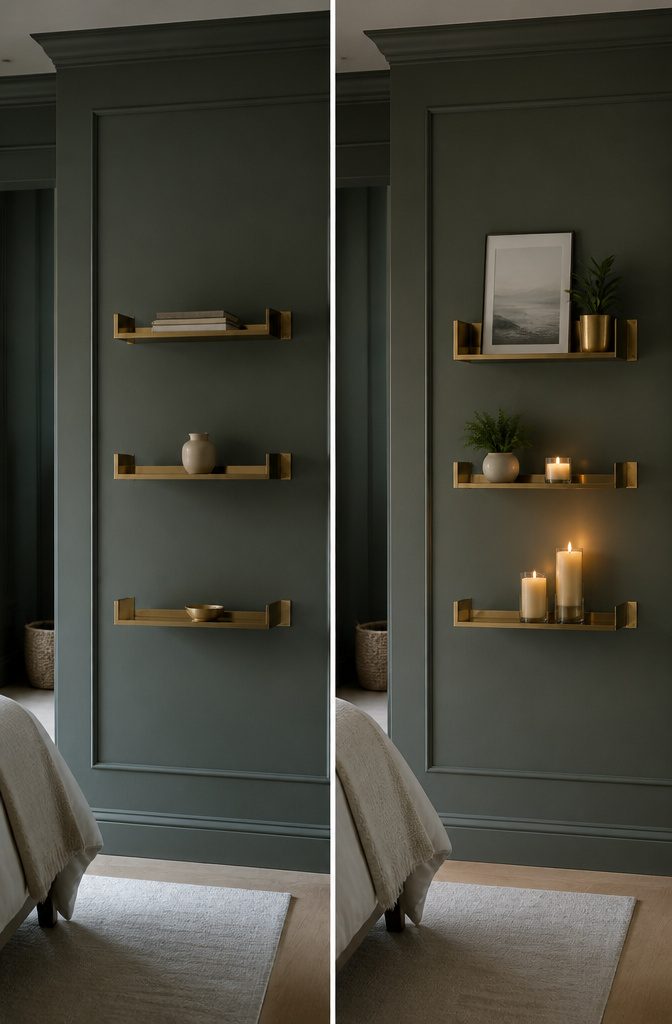
The three-object formula, plants plus books plus personal pieces, works until it doesn’t.
I have watched the same corner shelf go from gallery wall to junk pile in about ten days, and the shift is never the objects themselves. It is the spacing.
Brass-trimmed shelves against deep sage paneling read as intentional because the bust, the marble, and the black-and-white books each hold their own territory. A mirror tucked between them doubles the breathing room instead of crowding it.
The monochrome family shelf keeps its dignity the same way: one commanding photo, one spill of vines, one candle grouping.
Each layer has a single job. When a fourth or fifth item squeezes in, the eye stops resting and starts scanning for somewhere to land.
That is the line. Crossed, the shelf becomes storage with ambition.
Stepping back takes removing the last thing added, not rearranging everything. Usually that is the small frame or the extra votive that felt necessary at the time.
Leave one shelf almost empty and the whole wall recovers. The empty space does more work than the object ever did.