
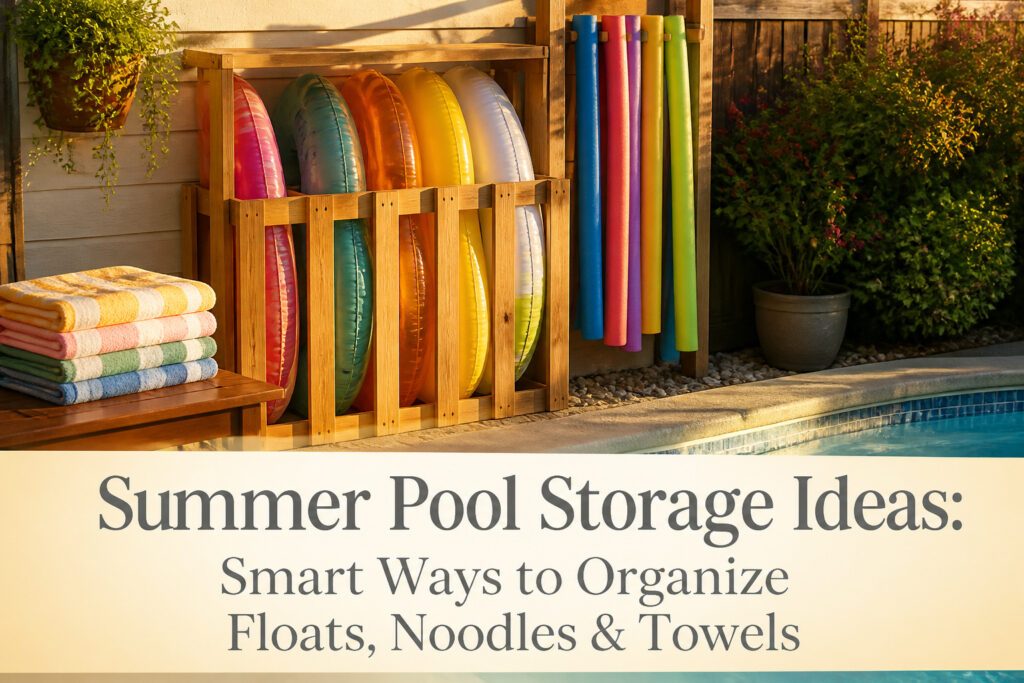
The best summer pool storage ideas run from a twenty-dollar PVC pipe rack to a locking resin deck box that costs ten times that.
What decides which one you build is not your budget but whether you have wall space, floor space, or neither.
The one detail most people miss until it is too late: standard steel rusts almost on contact with chlorinated water, so any hook or rack near the pool needs marine-grade stainless or powder-coated aluminum to survive past July.
1. Wine Rack for Towels
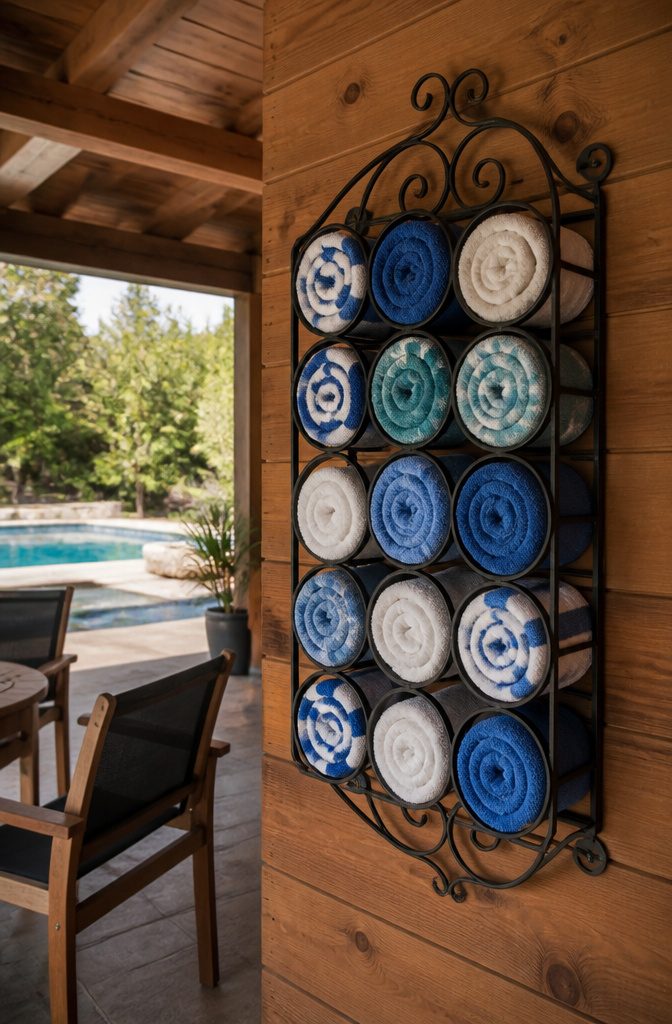
A standard wall-mounted wine rack turns into one slot per towel when you roll them tight enough.
The openings that fit a Bordeaux bottle handle a bath towel rolled to about six inches across; anything thicker and the roll jams or the frame strains.
Mount it within arm’s reach of where people step out of the pool, but under an overhang or eave if your area gets afternoon storms.
Direct rain will spot the towels and rust the hardware no matter what the label claims.
I like it just inside a covered patio wall, close enough that guests grab without dripping across the deck, far enough that the towels stay dry.
The look works best when the rack metal and your patio furniture already share a finish. A black wrought-iron rack against teak reads accidental; against black sling chairs it reads intentional.
If your only wall space faces full sun, painted steel will chip in a season. Go with powder-coated aluminum or plan to touch up yearly.
2. Coat Rack for Wet Towels
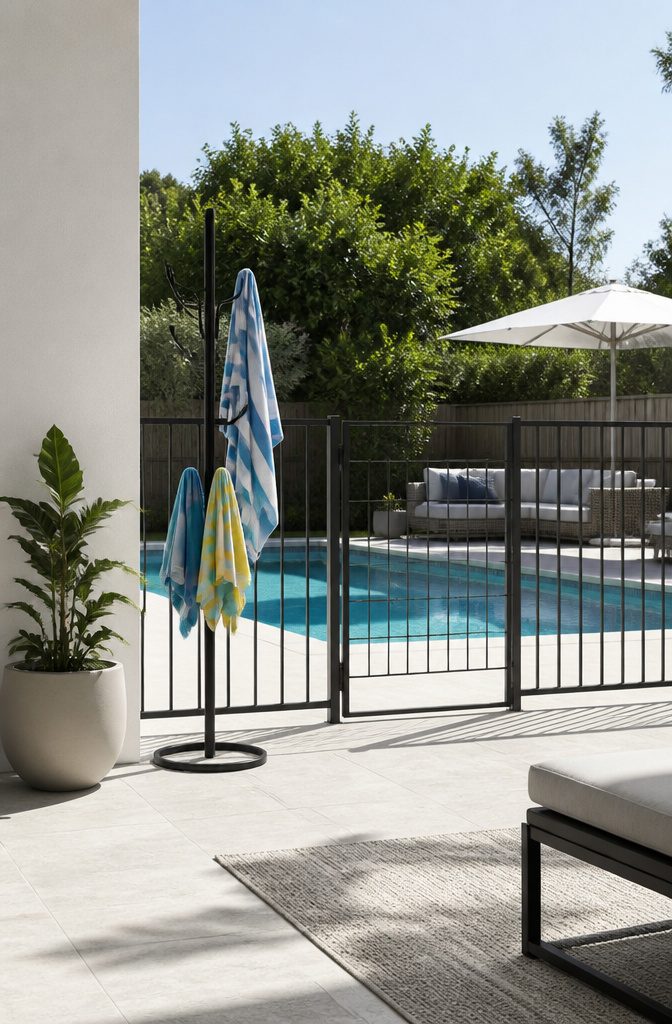
A freestanding coat rack with broad, curved hooks solves the wet-towel pile that otherwise turns into a mildewed heap by the back door.
Height matters more than hook count: the top hook should sit at least five feet up so towels hang clear of the ground and air circulates through both sides of the fabric.
A standard six-hook rack holds a full family’s swim load if you double the smaller towels on shared hooks, though the bottom rung ends up crowded and slow to dry.
Wall-mounted versions save deck space but need backing into a stud; freestanding units shift to chase the afternoon sun, which does more drying in two hours than shade manages all morning.
I position mine just inside the pool fence where it catches breeze and light without baking the plastic grips into brittleness.
The cheap bamboo racks warp within a season; painted metal or teak lasts and still costs under what you’d spend replacing two ruined beach towels.
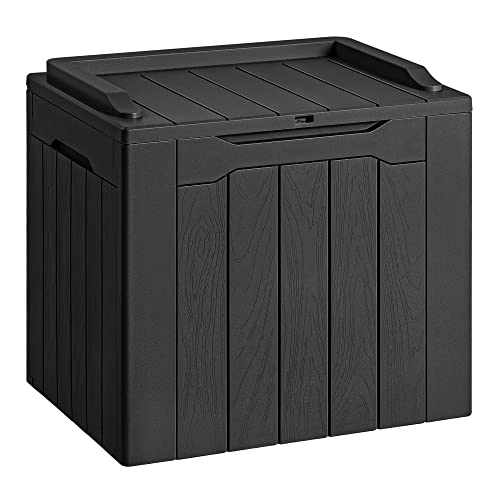
Light & Solid: Made of a high density resin material, it is stable, waterproof and UV resistant. The net weight of this deck box is only 8.8 pounds
3. Pallet for Pool Noodles
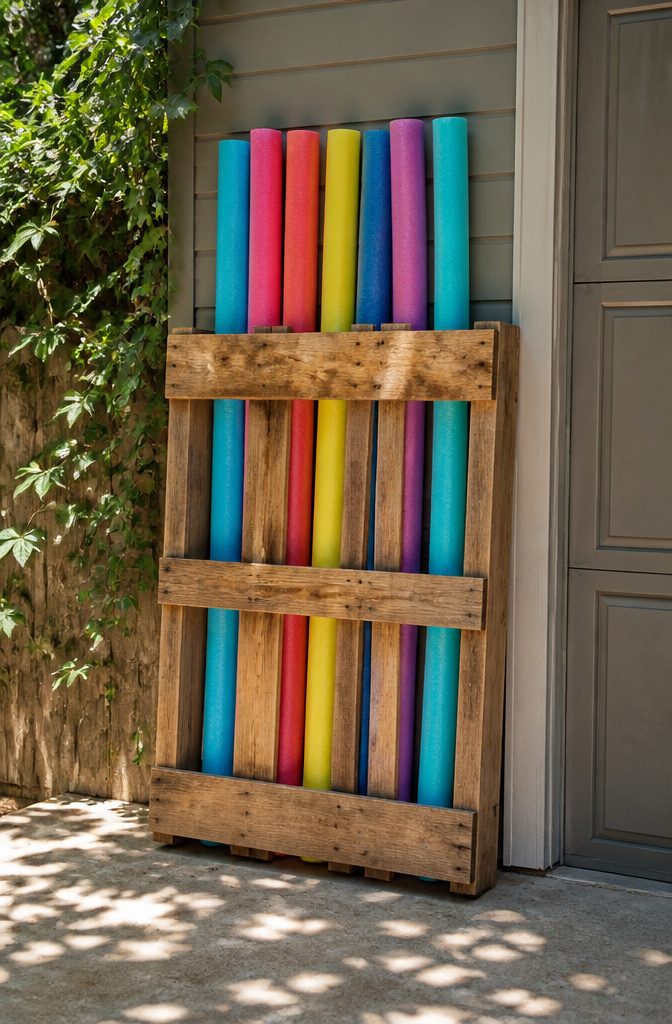
A wooden pallet cleaned up and stood on end gives pool noodles a place to stand straight instead of sagging into a curve.
I like this one because the slats already do half the work: vertical storage stops foam from taking a set in the bent shape it gets when left on the ground or crammed horizontal in a bin.
Sand the boards enough to lose splinters, then seal the wood so it holds up against drips.
You can leave the slats open for airflow, which helps noodles dry out and keeps mildew from getting a foothold, or run bungee cords across the front if yours tend to roll out every time a kid walks past.
Mounted to a fence or the garage wall, it stays off the floor entirely.
4. Cargo Net for Floats
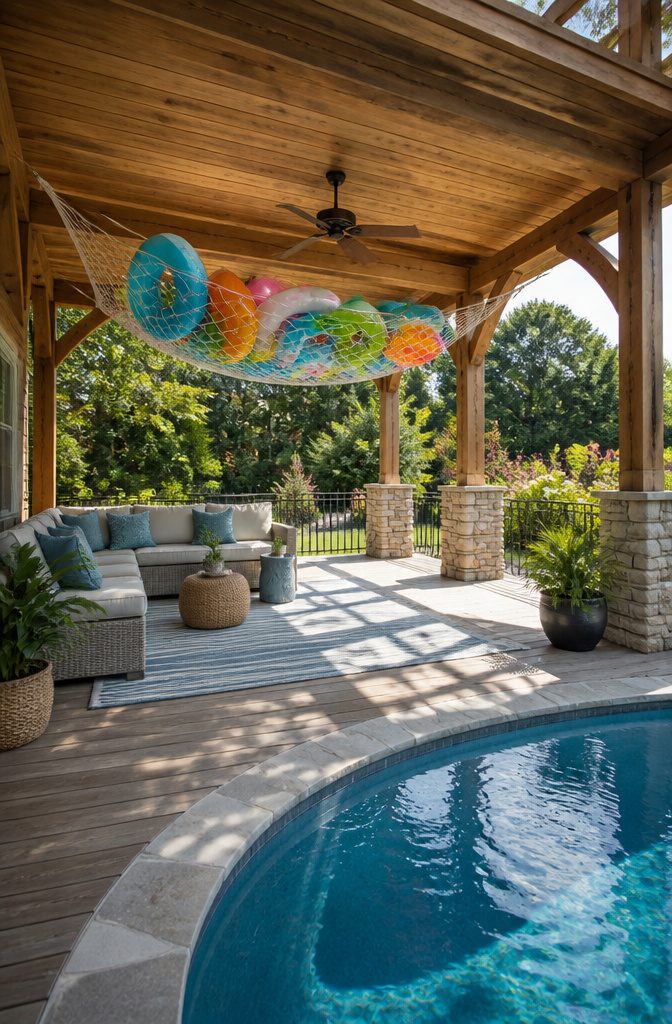
Pool floats are the sneakiest storage problem of all. They’re awkward, they’re bulky, and when they’re wet they can’t really be shoved into a closed box without getting everything else damp.
The best solution for floats isn’t a box at all. It’s a hanging mesh bag.
A cargo net hung from fence, pergola, or garage ceiling keeps inflatables off the ground, which prevents punctures and mold, and makes grabbing a float a one-second job instead of a five-minute excavation.
Water drips out, air circulates, and by the next morning everything is dry and ready to go.
The WMS Pool Float Storage Bag Net is a ready-made option sized exactly for this job. If you’d rather rig your own, a standard cargo net with eye bolts and carabiners works the same way.
Just check the weight limit before you load it up, and make sure floats are dry before storage. Wet storage defeats the whole point.

Main Product: Premium quality pool accessory organizer and pool supplies holder that holds up to 5 pool accessories plus 2 small to medium size poles can also be mounted to the sides of the holder. Also comes with swimming pool vacuum cleaner hose hanger harness: Easily Store & Carry Your Vacuum Hoses. (accesorios para piscina de plástico)

EXTRA LARGE CAPACITY POOL FLOAT STORAGE NET: Compared to traditional storage bags, the Nigelia storage net has a larger capacity and upgraded size to 71 x 47 inches. It can hold a lot of pool toys such as floating toys, swimming rings, inflatable balls, inflatable boats, surfboards, etc., helping you organize the clutter around the pool and have a clean space
5. Deck Box
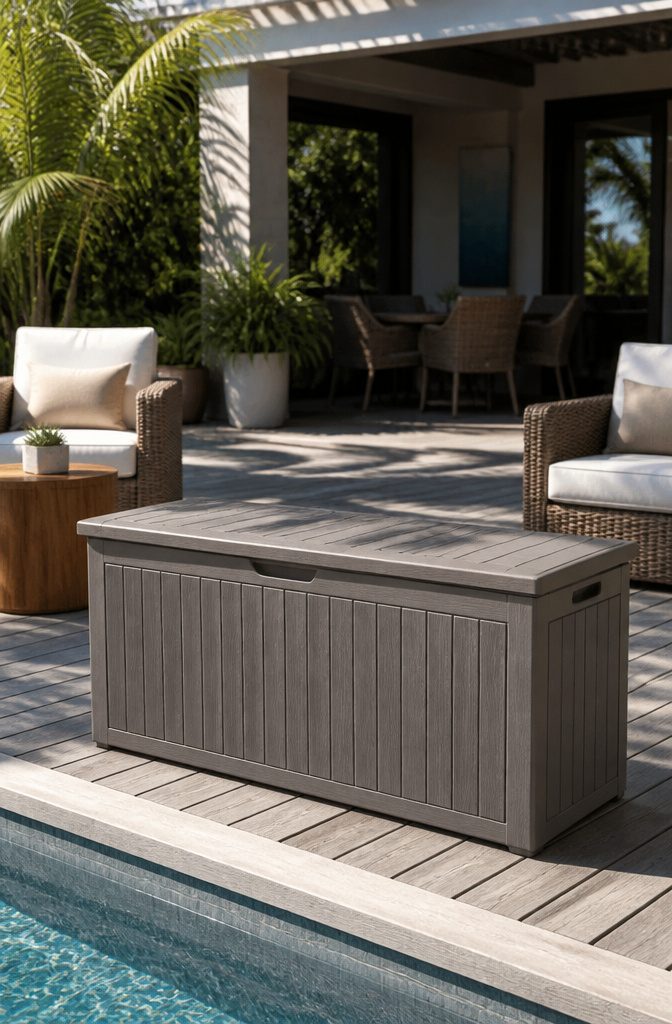
A deck box is the closest thing to a poolside closet, and the resin ones survive the sun without the warping or rust that kills wood and metal in one season.
The Keter line uses UV-protected resin that resists moisture and peeling, and with over forty sizes and styles, you can match it to actual patio furniture instead of parking a plastic tub next to your chairs.
The Marvel or Java finishes read more like storage benches than utility bins, which matters when the box sits in full view all summer.
For tighter spaces, the Suncast 50-Gallon Deck Box keeps the footprint small and the lid still holds up as extra seating when chairs run out.
Its resin resists fading and cracking, though at 50 gallons it tops out at towels, goggles, sunscreen, and smaller inflatables.
Full-size floats and noodles need the bigger capacity of something like the Lifetime 130-Gallon, or they will live outside the box and defeat the point.
The Suncast handles daily essentials; the large Keter models handle the gear that does not fold flat.

RUST-PROOF: Made of quality metal material, solid and rustproof. The smooth surface is coated black finish and will not scratch the towels or hands.

6 Tier rack to store towels for clear display in the bathroom.

Quantity : 6 Rack. Stores six standard wine and Champagne bottles or six bath and hand towels . No Wine. (including installation hardware)
6. Mesh Rolling Bin
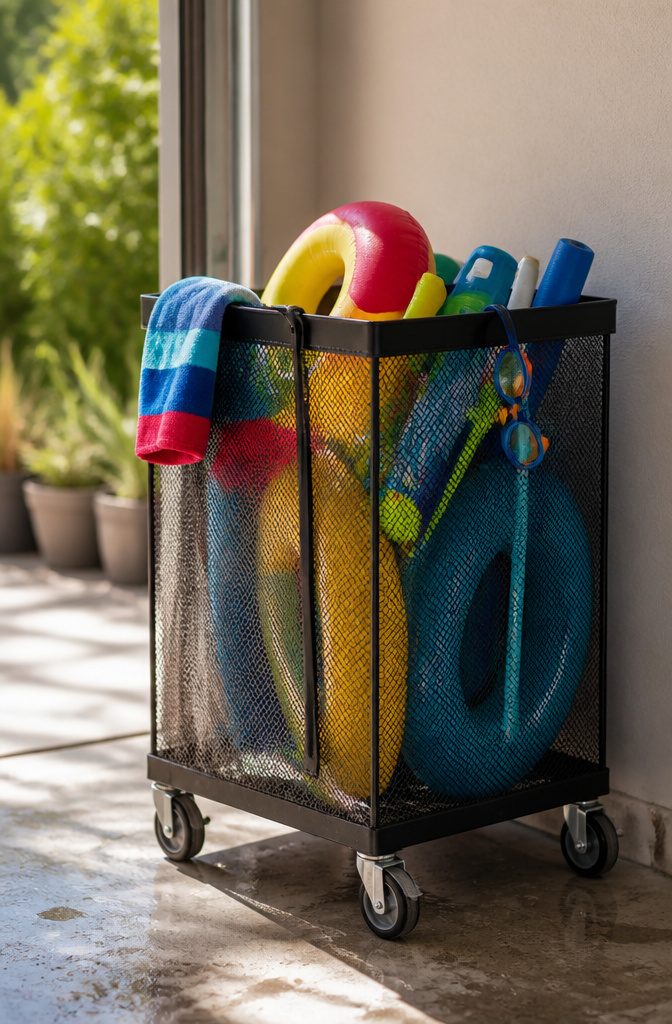
A mesh rolling bin handles the daily mess of wet pool toys better than any solid-sided cart I have seen.
The mesh walls let water drain straight through, so the bottom never turns into the standing-water science project that plastic tubs hide until you smell them. Air keeps moving, and mildew does not get the foothold it needs.
For a family collection, the workhorse versions run roughly 24 inches wide by 36 inches long, tall enough that dive rings and soggy basketballs do not spill over the top.
Side pockets are worth hunting for; that is where goggles and sunscreen live instead of sinking to the bottom and staying wet for days.
When the swimming is done, the wheels matter. I roll ours to the garage corner where it can keep dripping without staining concrete, or against a fence line where the breeze hits it.
Some people park theirs in a shed, but only if the space already has airflow; a closed box of a garage just trades one damp spot for another.

Marine Grade Heavy Duty Stainless Steel Triple Wardrobe Hook

【Marine Grade 316 Stainless Steel Built to Resist Rust & Corrosion】Crafted from premium marine grade 316 stainless steel, these stainless steel wall hooks deliver exceptional resistance to rust, corrosion, moisture, and salt air. Ideal for indoor and outdoor use, these stainless steel hooks outdoor perform reliably in garages, bathrooms, kitchens, sheds, boats, RVs, workshops, and coastal environments where ordinary steel hooks may deteriorate over time.

Made of 316 stainless steel, waterproof, rust-proof and corrosion-resistant.
7. Wall-Mounted Drying Station
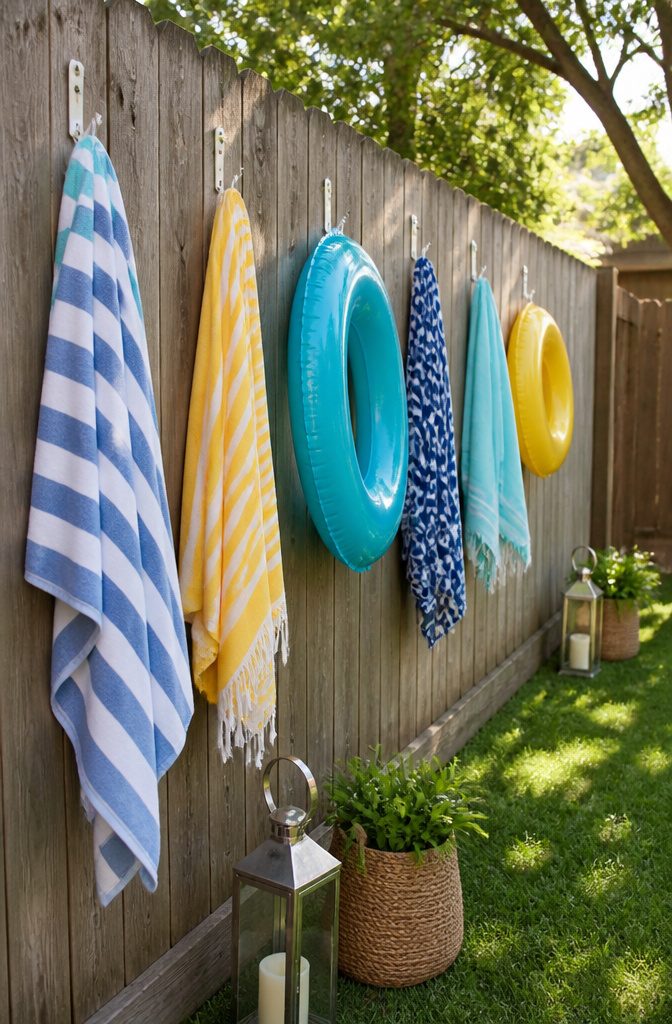
A row of marine-grade hooks along a fence or the house wall turns vertical space into a drying station that keeps towels and floats off the grass and open to airflow.
The spacing matters more than the hardware choice: items hung too close trap moisture between them and dry slower than if you draped them over a chair, which defeats the whole point.
I leave at least a hand’s width between hooks, more for the big inflatable rings that hold water in every crease.
The hardware has to survive humidity and direct sun. Marine-grade stainless or coated hooks cost a few dollars more than the hardware-store standard, but standard steel rusts through in a season and leaves stains on the fence.
Towels dry in an hour or two in open air; life jackets and vests hang the same way once the pool closes.
The system works because it keeps the drying process visible: you know at a glance whether the towels are ready to come down, and nothing gets folded into a deck box while still damp and headed for mold.

Sturdy Aluminum Frame - Domi pool lounge chair set is constructed with weather-resistant powder-coated finish aluminum frame. It is rust-resistant and sturdy, can provides sturdy support with max weight capacity of 350 lbs.

Sturdy Aluminum Frame - Domi pool lounge chair set is constructed with weather-resistant powder-coated finish aluminum frame. It is rust-resistant and sturdy, can provides sturdy support with max weight capacity of 350 lbs.
8. Floating Toy Catcher
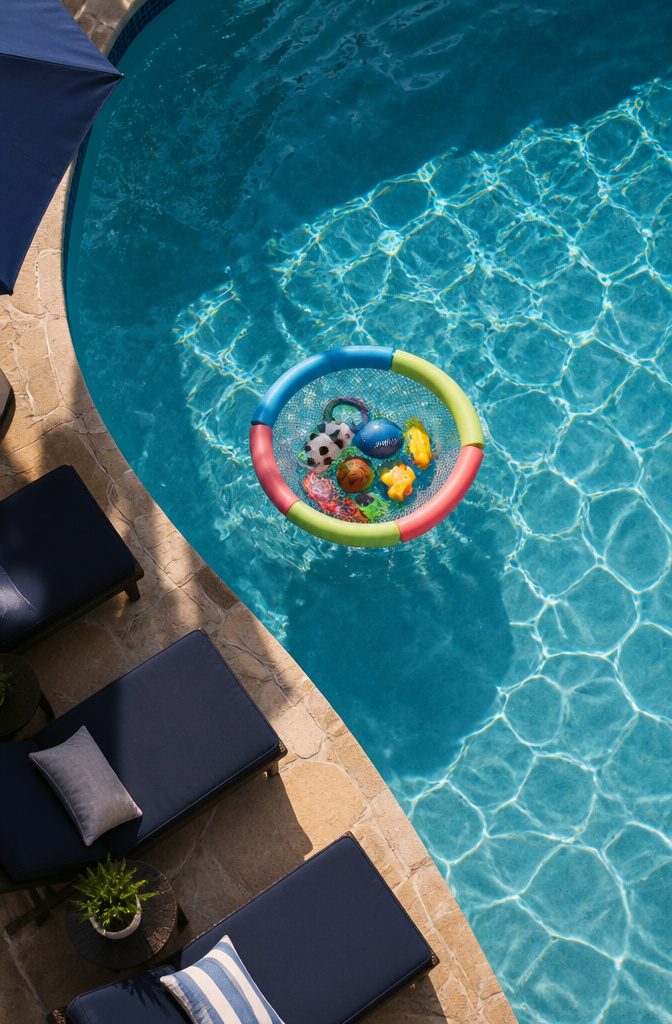
A mesh laundry basket from the dollar store and a few lengths of pool noodle turn into a floating corral that keeps toys from drifting to the skimmer.
I like this one because the work happens in the water, not on the deck. Cut the noodle into sections, thread them onto the basket’s rim or zip-tie them around the edge, and the whole thing rides at surface level.
Toys go in after use, the mesh drains as you lift, and you carry the dry-ish load out in one trip.
The basket needs drainage holes, which most already have; if not, a few quick snips with kitchen shears fix that.
A sturdier plastic basket holds shape better than flimsy mesh, but even the cheap ones last a season or two before the sun gets to them.
The real limit is size: too wide and it blocks the pool, too small and the toys stack up and topple. I aim for one that holds a couple of noodles and three or four small floats without crowding.
9. PVC Storage Solutions
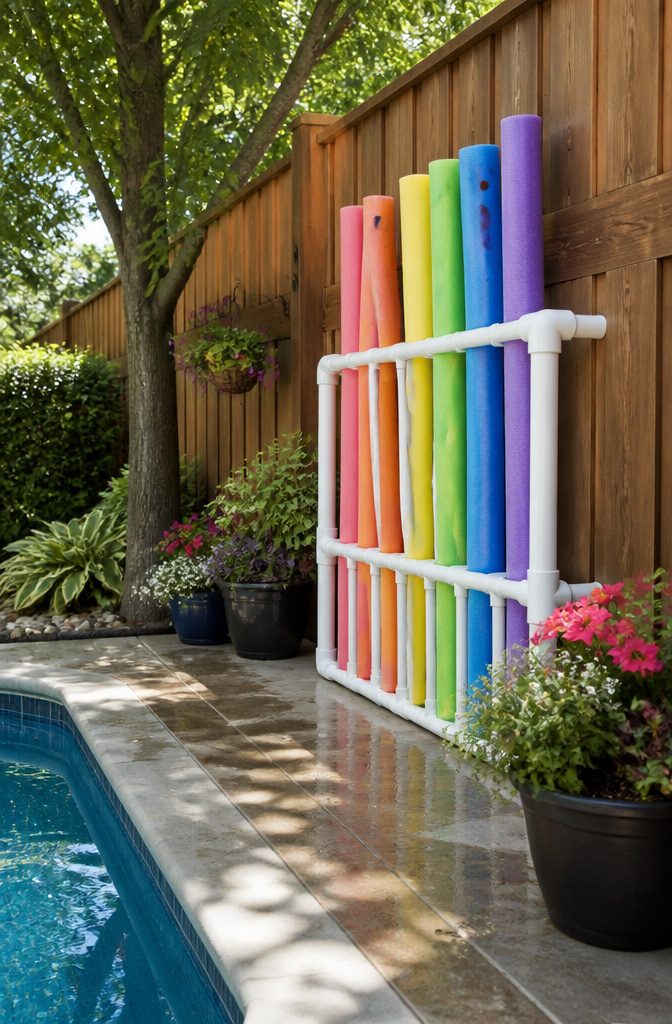
PVC pipe builds into storage that survives wet storage because the material itself won’t rust and takes the heat.
Three-quarter-inch pipe works for goggles and small toys; one-inch or one-and-a-quarter-inch fittings hold pool noodles upright without sagging. The trick is deciding whether to glue the joints.
Leave the vertical racks unglued and they knock down flat for winter storage in the garage. Glue only the base if you want a freestanding unit that kids can pull a noodle from without wobbling the whole frame.
Airflow matters more than enclosure. A PVC rack with open sides dries noodles faster than any bin with a lid, and that airflow is the only real defense against mildew.
Standard T-joints and 90-degree elbows cost a few dollars each at the hardware store; a basic four-foot rack runs under twenty dollars in parts.
Paint the pipe if you want it to look decent against siding, though the raw white blends fine against most pool fences.
I have seen these built as simple towers, as horizontal bins with dowels for goggles, and as wall-mounted grids.
The vertical tower wins for floor space, but the wall grid keeps everything at arm height for younger swimmers who otherwise leave the cleanup to you.
10. Laundry Hamper for Toys
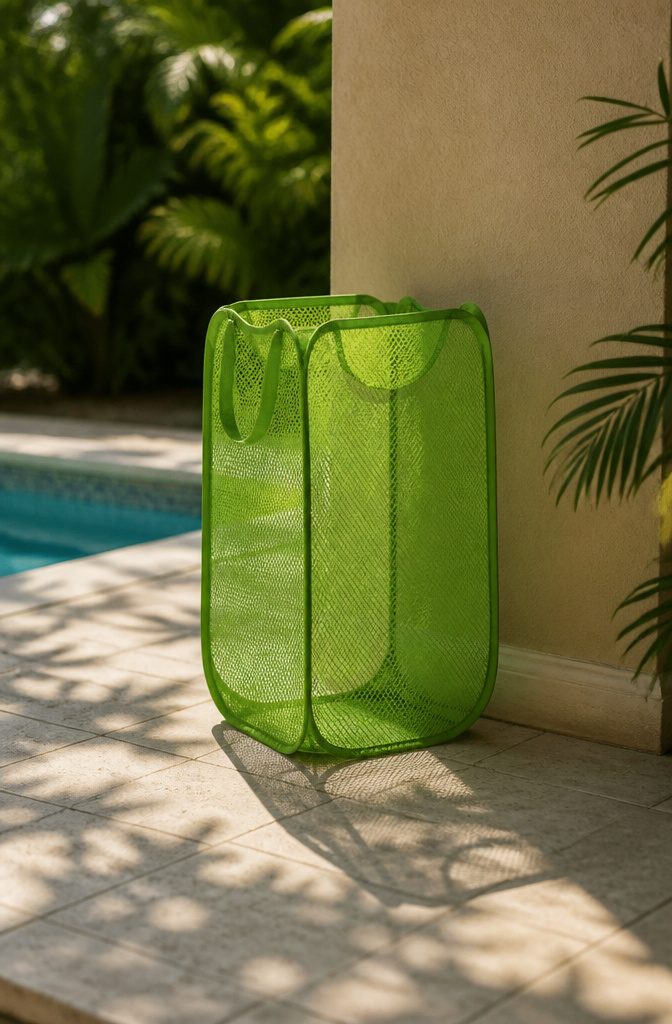
A foldable mesh laundry hamper handles the daily dump of wet pool toys better than anything that clips to a fence.
The pop-up frame springs open when you need it and collapses flat for off-season storage behind a garage shelf or under a bed. That matters when your garage already holds bikes, coolers, and the grill you swear you will clean.
Assign one hamper per child and the "that is mine" arguments mostly disappear. Each kid knows where their dive rings and water guns land, and the mesh walls let everything drain instead of pooling and mildewing in a plastic bin.
For younger children who cannot reach a hanging toy net, the low opening puts cleanup within their reach.
The same hamper works for towels and rash guards at the end of the day, carried straight to the laundry area in one trip.
Safety for Chemicals
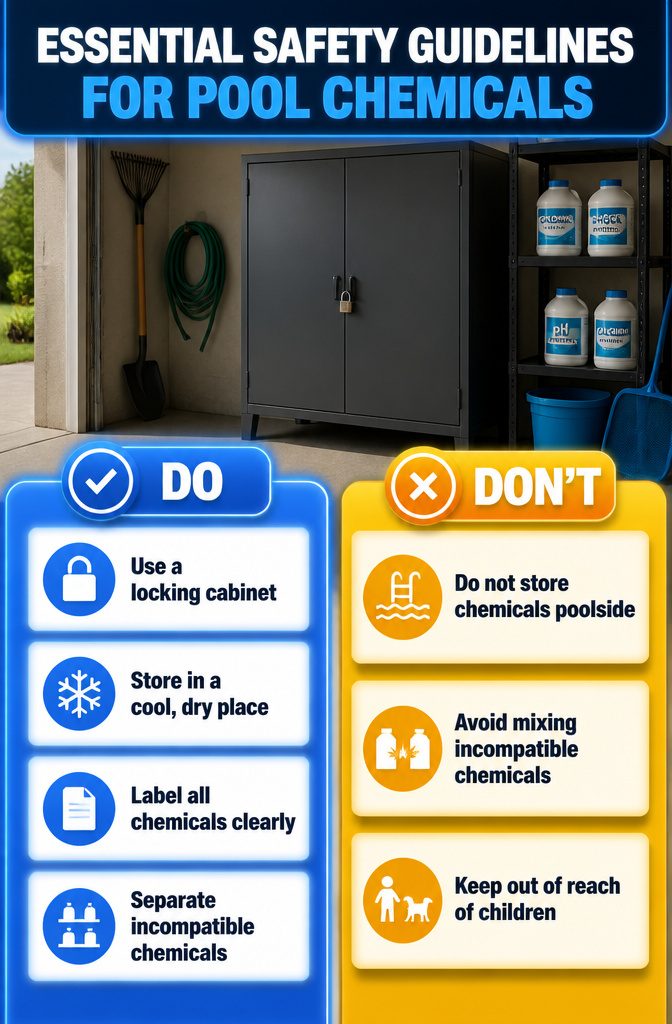
A locking outdoor cabinet is the baseline for any pool chemical setup.
The U.S. Consumer Product Safety Commission tracks improper chemical storage as a leading cause of pool-related accidents at home, which is why the rule is cool, dry, ventilated, and absolutely out of reach of children and pets.
I keep ours in the garage, not poolside. Humidity breaks down chemicals faster, and the walk back to the house is a built-in pause that keeps me from grabbing the wrong bottle mid-routine.
The real hazard is mixing.
Oxidizers and sanitizers stored together can react; even residue on the same shelf has caused problems. A cabinet with adjustable shelves lets you separate them completely, label facing out, so you never guess which white granule is which.
The Sunjoy Premium Steel Outdoor Cabana Locker is purpose-built for this: weather-resistant steel, locking doors, and the shelf spacing to keep incompatible products apart. For families with young kids, that lock is not a nice-to-have.
It is the part of the project you buy first, before the mesh bags and the deck boxes, because the rest of the storage plan does not matter if the chemicals are not handled.
Weather Resistance
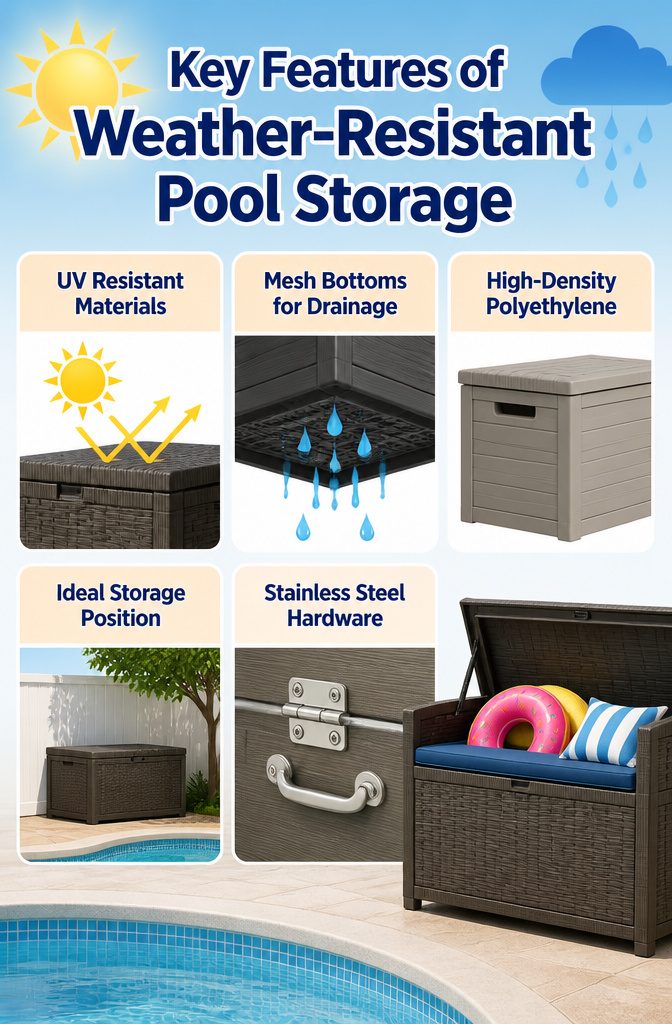
UV light and standing water will undo most summer pool storage ideas before August. Mesh bottoms or built-in vents matter more than capacity, because a bin that traps water becomes a mildew source, not a solution.
All-weather resin wicker or high-density polyethylene (HDPE) hold up to daily sun without the cracking and peeling that cheaper plastics show by mid-July.
Positioning helps too. A spot that catches afternoon shade extends the life of any material by half, and a slight tilt or raised feet keeps the drainage working after rain.
Stainless steel or powder-coated aluminum hardware is the only kind worth having near chlorinated water; standard steel rusts almost on contact.
The deck box route works for large floats, but the ones left hanging on fences fade faster and read as clutter from the yard.
A weather-resistant box that doubles as bench seating hides the neon pile entirely and survives the season without maintenance.
Kid-Accessible Cleanup
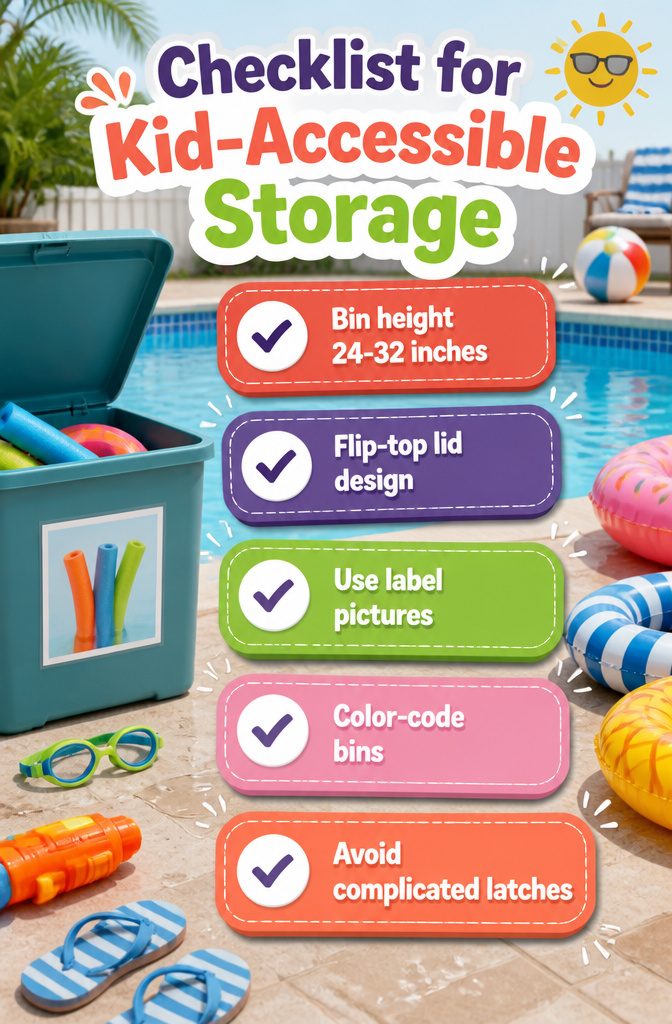
A bin kids can actually open makes the difference between toys put away and toys left in the grass to bake.
I learned this after watching my nephew wrestle a deck box latch that needed two hands and adult grip strength. He gave up halfway through, and the pool noodles stayed on the patio for three days.
Height between 24 and 32 inches lets a six-year-old reach the lid without standing on anything, and a twelve-year-old does not feel insulted using it. Flip-top lids work better than anything with a separate piece that gets dropped or lost.
My own mistake was a set of stackable bins with locking corners; the idea looked tidy in the store, but the corners pinched small fingers and the stacking meant the bottom bin was always buried.
Picture labels beat word labels for the younger half of that range.
A laminated photo of the actual float or noodle that belongs inside removes the guesswork. By ten or eleven, most kids read fine, but they still move faster when the bin itself is a different color for each category.
The adult version of organization, everything matching and hidden, just slows them down. They open it, do not immediately know where the thing goes, and they are already walking away.
When storage is built for adult aesthetics first, kids treat it like furniture to walk around, not tools to use.
Storage That Looks Decent
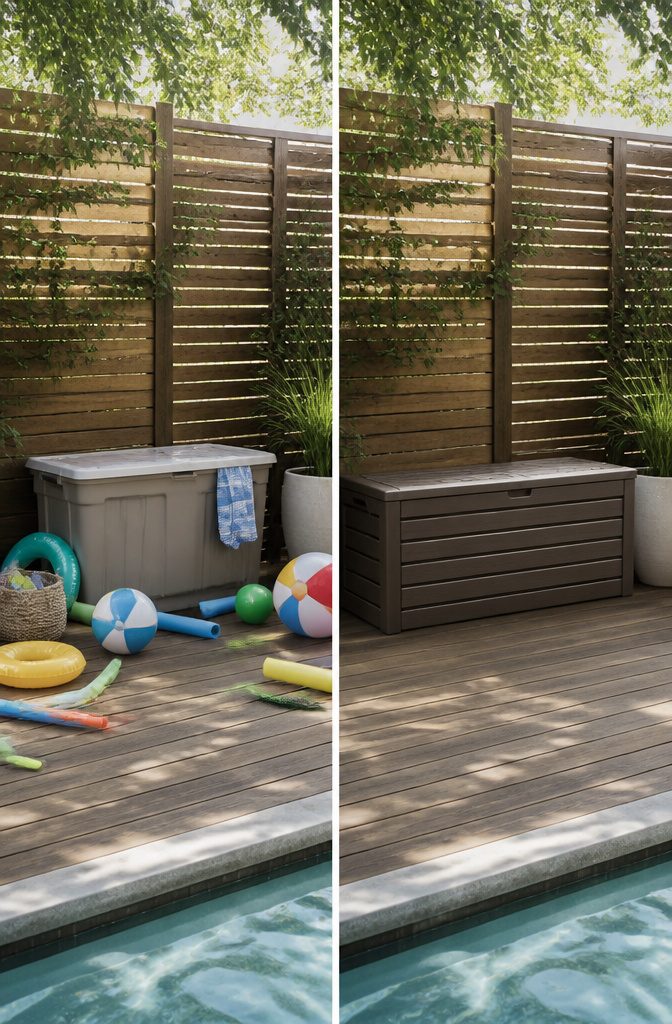
Bright pool toys against cedar mulch or stone always read as clutter, so color and material choice matter more than the storage type itself.
A resin deck box in warm gray-brown, something like Keter’s Java finish, sits against decking without shouting for attention, while the same box in stark white becomes the first thing a guest notices.
I look for storage that borrows from the hardscaping already in place: wicker-look weave if the patio furniture runs that way, slatted sides that echo fence rhythm, solid panels only when the house trim is equally plain.
Hidden versus shown depends on what you are storing. Clean towels folded in a bench with a hinged lid stay out of sight and stay useful; a cargo net of neon noodles hung on display defeats the purpose.
The line between practical and eyesore is usually a matter of proportion.
One large box reads as furniture. Three mismatched bins, even in neutral tones, read as a yard sale that never ended.
If the collection has grown past a single piece, spreading it to different zones, a bench near the door and a deck box at the far end, keeps any one view from accumulating too much visual weight.