

I install chair rails at 32 inches for standard 8-foot ceilings, which is one-third up the wall and creates visual balance. For 9-foot ceilings, I use 34–36 inches, and for those grand 10-foot foyers, I scale up to 36–40 inches.
I once installed trim at 36 inches on every wall without considering the space, and those rooms felt cramped and confined. Now I sit in the actual chairs and observe the wall proportions before installing anything, because proper scaling beats arbitrary rules. Your ceiling height determines the appropriate height.
There’s a whole art to making this trim work with wainscoting and avoiding the “gymnasium effect.” The key is taking time to assess the space before committing to installation.
The Real Chair Rail Height Range (and Why 32 Inches Is Just a Starting Point)

The Real Chair Rail Height Range (and Why 32 Inches Is Just a Starting Point)
Chair rail height stretches anywhere from 24 to 72 inches, depending on your wall height and what feels right in your space. Most carpenters default to 32-36 inches, but the one-third rule provides a practical solution. Position your rail about one-third up from the floor, which lands around 32 inches on standard 8-foot walls but increases proportionally for tall ceilings.
Your friend’s choice of 28 inches in her cozy bungalow demonstrates how this measurement can be adjusted to suit specific spaces. The key is finding what works visually and functionally in your room, rather than adhering to a single standard measurement.

DIY Installation Made Easy: Cut, peel, and stick in just 3 simple steps. No special tools required. Effortless installation for a quick and hassle-free experience.
DIY Installation Made Easy: Cut, peel, and stick in just 3 simple steps. No special tools required. Effortless installation for a quick and hassle-free experience.

Effortless Installation — Experience the simplicity of our 3-step installation process: simply cut, peel, and stick. It's a swift, hassle-free process.
How to Calculate Chair Rail Height for Your Ceiling

For standard 8-foot ceilings, mark 32 inches up from the floor. This measurement equals one-third of 96 inches. With 10 or 12-foot ceilings, rigid rules become less effective. Instead, adjust the height based on where your sofa actually hits your back rather than following an abstract ideal.

Reliable Stand Solution: The IMPRESA Arm Chair Stand Assist Rail offers robust support as a heavy duty stand assist for recliners, aiding in standing from armchairs and couches. It integrates seamlessly with furniture, transforming them into efficient mobility aids

Adjustable for 7-10 ft Ceilings: Our floor-to-ceiling grab bar can be adjusted to accommodate different ceiling heights based on your specific needs. It is compatible with heights as low as 7 ft for bathrooms and restrooms, and up to 10 ft for spaces like dining rooms and living rooms
Standard Ceiling Calculations
| Ceiling Height | Chair Rail Height | The Vibe |
|---|---|---|
| 8 feet | ~32 inches | Classic, cozy, totally timeless |
| 9 feet | ~36 inches | Elegant lift, breathing room |
| 10-12 feet | 36-40 inches | Grand, but still grounded |
The one-third rule works because it creates visual balance. In my own living room with 8-foot ceilings, that 32-inch sweet spot aligns with where my sofa back rests. Your eye naturally gravitates to this proportion. The result feels intentional and welcoming, as if the room’s design was thoughtfully considered.
Taller Ceiling Adjustments
So what happens when your ceilings stretch way past the standard eight feet? Simply placing the chair rail higher won’t work. I tried that once, and my living room looked like a confused gymnasium.
I use the one-third rule as my starting point, then adjust for ceiling height. For my friend’s 10-foot foyer, we landed at 36 inches, higher than standard but proportional. The chair rail height needs to work with the room’s proportions.
Taller ceilings can handle more, but push too far and suddenly everything feels squat and chopped off. I’ve learned to assess the space by walking around and sitting down to evaluate whether it feels balanced. The one-third rule guides me, but measurement and visual assessment seal the decision.
Proportional Height Guidelines
Because I’ve measured walls at midnight with a flashlight clenched between my teeth, I can tell you that math saves you from disaster. The one-third rule is your best friend here; it’s the foundation for proportional design. For an 8-foot ceiling, that puts your chair rail height right around 32 inches, which creates a balanced, human-scale appearance. Now, bump that ceiling height to 9 feet. You’re looking at 34 to 36 inches. Ten feet. Stretch toward 36, maybe even approach it. I’ve seen rails everywhere from 24 to 72 inches, but start with one-third, then adjust based on your room’s specific proportions. Your space will achieve proper visual balance.
Chair Rail Height Mistakes That Shrink Your Room
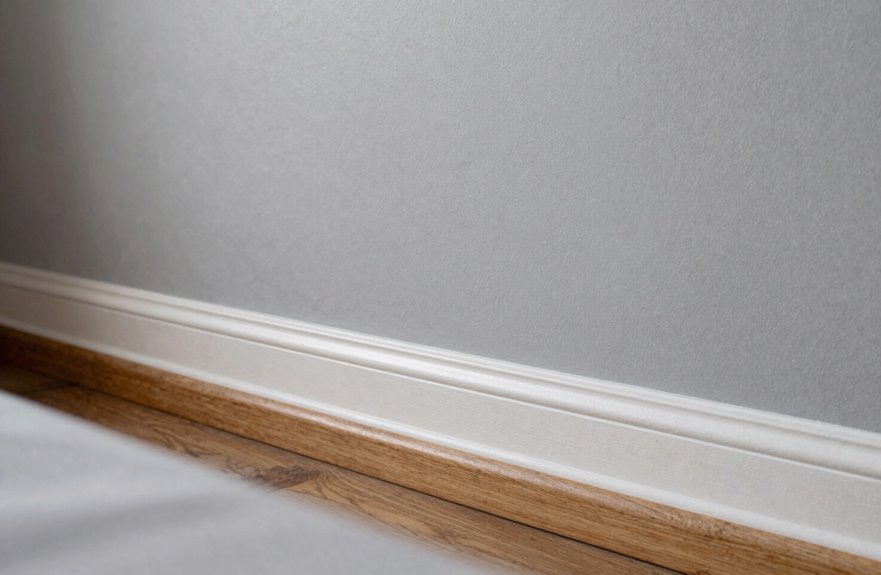
Placement absolutely matters here, and I’ve learned this the hard way after nailing chair rails way too high and watching my living room feel like a dollhouse. When you stick that rail at 36 inches on a standard 8-foot wall, you’re chopping your space into visual confusion. Suddenly the walls feel shorter, the ceiling drops, and everything feels cramped. Rooms with rails positioned just a few inches too high create a visual effect similar to wearing cropped pants; the proportions feel off and the space loses its sense of height and openness.
DIY Installation Made Easy: Cut, peel, and stick in just 3 simple steps. No special tools required. Effortless installation for a quick and hassle-free experience.

Product Size: the package includes 1 roll of white peel and stick chair rail panel molding measuring 9.8 feet x 2.36 inches/ 3 meters x 6 cm,which provides you with adequate length to cover large areas; Additionally, its width will well define edge to most applications, enhancing your home decor with minimal effort

TPE Material: Made of TPE material, soft, flexible, reliable and durable, lighter than traditional PVC molding strips, less odour, not easy to peel off, fade or deform after installation, stand the test of time
Why Placement Matters
Why does a few inches of wood trim suddenly make my cozy living room feel like a cramped elevator? I learned the hard way that chair rail height isn’t just decorative; it’s architectural destiny.
When I slapped mine at 36 inches in my modest 8-footer, the walls looked stubby and ceilings felt low, like wearing high-waters to a gala. The one-third rule saved me: roughly 32 inches for standard ceilings keeps room scale human and harmonious, not top-heavy.
I’ve seen carpenters default high, but in smaller spaces, lower wins. Match your dining chair backs. Mine hit 30 inches, and suddenly furniture and architecture work together instead of fighting. We’re crafting belonging here, not museum dioramas. Go slightly lower than maximum; your eye will breathe easier.
Visual Impact Errors
How high is too high? I’ve seen chair rail height disasters that instantly shrink rooms, and I’ve made them myself.
| Common Mistake | What Actually Happens |
|---|---|
| 36″ rails under 10′ ceilings | Crushes room scale, feels top-heavy. |
| Following chair backs blindly | Weird proportions, awkward sight lines |
| One-third rule without adapting | Visual balance completely off |
| Inconsistent heights across rooms | Jarring transitions, no flow |
In my old apartment, I nailed rails at 36 inches. That was a mistake. My 9-foot ceiling felt like a cave. Room scale must respect actual proportions, not arbitrary rules. Lower ceilings need 28–30 inches. Visual balance requires adapting to your space, not copying generic guidelines. Your space deserves proper proportion, not visual compression.
How to Measure and Mark Chair Rail Height Before Installing
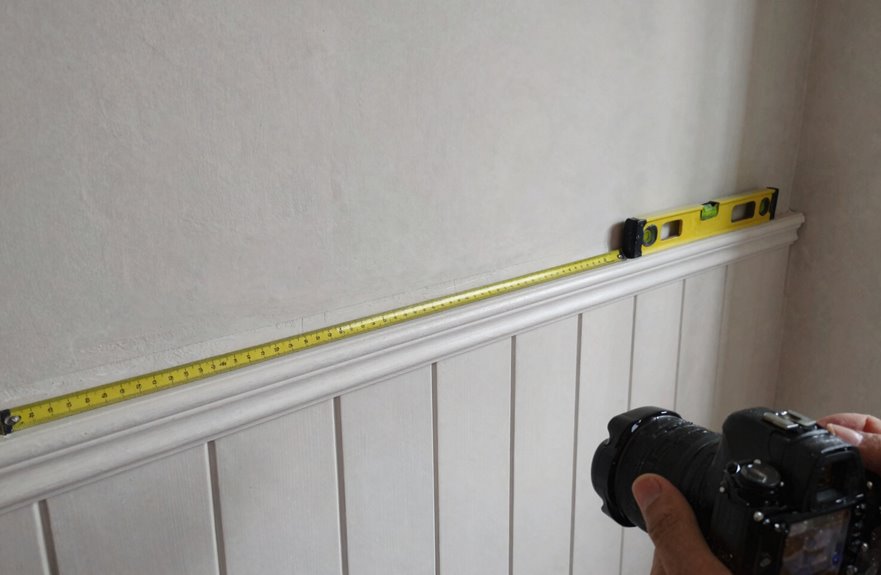
Where exactly do I start when I’m staring at a blank wall, tape measure in hand? I take a deep breath and measure.
First, I settle on chair rail height using the classic one-third rule: 32 inches for standard 8-foot ceilings, or 36 inches when walls stretch taller. I mark that height with a pencil, then snap a level chalk line across the wall to keep everything straight.
I measure each wall’s length, adding generous inches for cuts since surprises happen, and I clean every surface. Grease and dust compromise adhesion. Dry-fitting pieces before committing prevents mistakes and saves time. Pre-drill, fasten confidently, step back, and verify the installation looks correct.

Includes 3 pre-cut 20"x27" wall molding frames and 2 chair rail trim pieces, Covers 78.7"W x 39.9"H wall area (6.5 ft wide). All pieces feature a peel-and-stick design for easy installation

PLASTPRO PVC TRIM KIT, 2 PIECE: Complete your Plastpro wainscoting panels installation with the matching trim kit. Includes 1 pre-finished white PVC chair rail and 1 base molding with integrated rubber seal that blocks moisture from seeping between wall and panels. Pre-grooved to snap directly onto Plastpro 3 Ft and 8 Ft PVC wall panels.

When Chair Rail and Wainscoting Heights Work Together
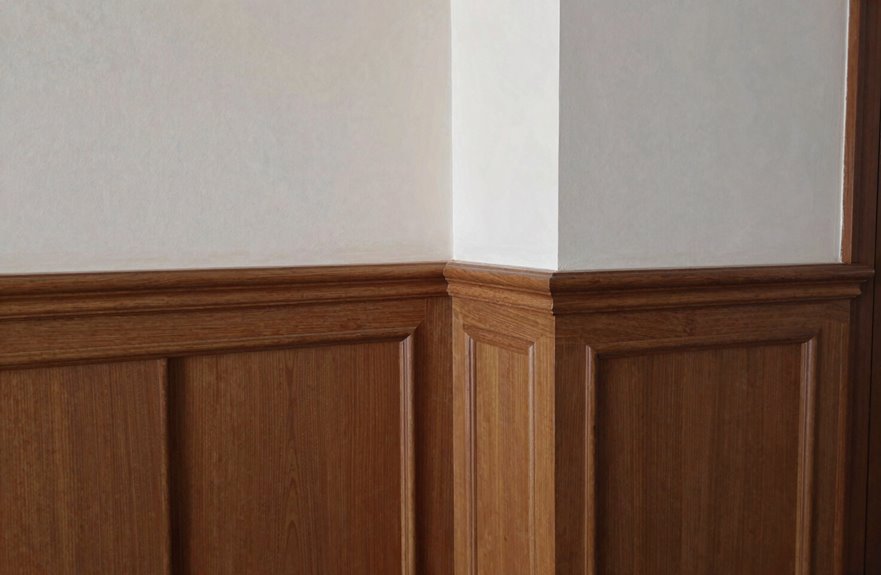
I learned this the hard way in my dining room, where I installed beadboard to 30 inches then randomly positioned my chair rail at 36 inches because that’s what the blog said. The result was disastrous. The gap looked amateurish, and I cringed every time I walked past.
Chair rail height and wainscoting must work together visually. I aim for roughly one-third of my wall height, which calculates to about 32 inches on standard eight-foot ceilings, so everything feels balanced rather than chopped. For taller ceilings, I increase to 36 inches while maintaining that proportion. The chair rail should align with the top of your wainscoting, not float awkwardly above it. Positioning it at the midpoint of the wall disrupts your room’s visual flow. Measuring twice prevents costly drywall repairs.


Quick Reference: Chair Rail Height by Room and Ceiling Type
Getting those measurements wrong in my dining room taught me there’s no one-size-fits-all solution. The one-third rule eliminates guesswork: divide your wall height by three to achieve proper proportion. For standard spaces, ceiling height dictates everything.
| Ceiling Height | Chair Rail Height | Best For |
|---|---|---|
| 8 feet | ~32 inches | Cozy kitchens, compact dining nooks |
| 9 feet | ~36 inches | Living rooms, generous entryways |
| 10–12 feet | 36+ inches | Grand foyers, tall parlors |
| Low/awkward | ~28 inches | Basements, attic conversions |
Higher ceilings require a higher rail. Lower ceilings call for a more modest height. Chair rail height determines visual balance and how a room’s proportions function in practice.

Unfinished not stained solid hardwood. Natural color may vary from piece to piece.

【Extra Long Size】Measuring 23ft x 1.1" in length, our peel and stick wall molding offers perfect coverage for various applications. The ultra-soft material cuts easily with scissors, allowing you to customize the perfect fit for any project - whether you need short sections for cabinet edges or long runs for wall applications.
Effortless Installation — Experience the simplicity of our 3-step installation process: simply cut, peel, and stick. It's a swift, hassle-free process.