
1. Declutter Like Crazy
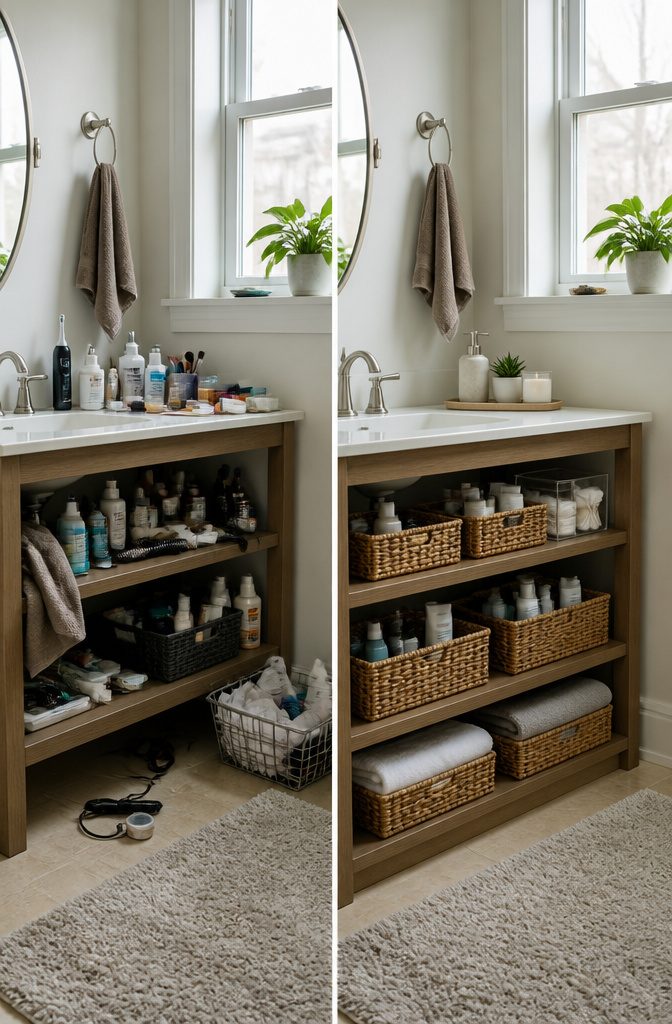
The first thing to pull out of a bathroom is everything that hasn’t been touched in a year.
Half-used hotel shampoos, the skin cream that broke you out, three spare toothbrushes from the dentist: they look small until they’re filling drawers that could hold what you actually reach for.
The mistake is organizing the clutter instead of removing it first, buying matching bins for bottles you’ll never finish and then wondering why the space still feels crowded.
I did this in my last rental, sorting products into neat rows before I checked a single expiration date, and the cabinets looked tidy for about a week before the overflow started again.
Now I run everything through the same filter: used in the last twelve months, or gone.
The emotional weight of starting with less surprised me. Opening a drawer to five things instead of twenty makes the morning quieter, and the organizing that comes after actually sticks because nothing is hiding underneath.

Safe & Durable Materials: Made of high-quality safe plastic that is sturdy, resistant to deformation, and breakage. Ideal as a makeup drawer organizer or vanity drawer organizer, it reliably protects your items and keeps drawers neat and tidy.

【LARGER SIZES】With 3 different sizes, our 6 pack clear drawer organizers could hold more gadgets, large and long enough to hold kitchen utensils, silverware, household tools and more. Includes: XL-12x6x2 inches(2pcs), L-9x6x2 inches(2pcs), M-6x3x2 inches(2pcs), Non-slip silicone pads(24pcs).

Premium Material: The material of the organizer is transparent and glossy so that it is safe to use
2. Divide Up Drawers With Bins
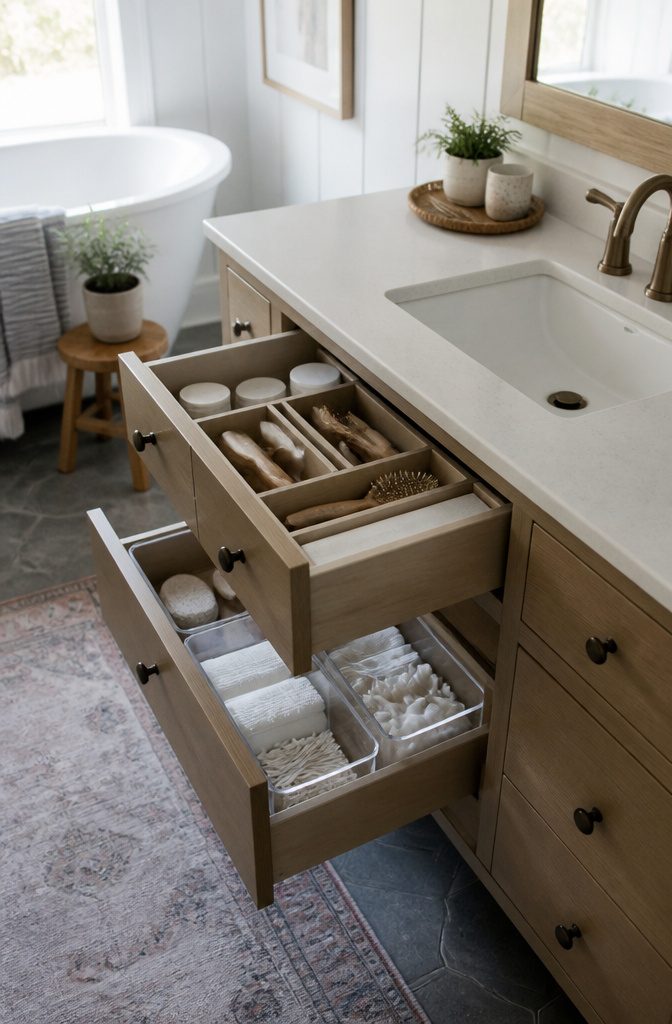
Deep drawers swallow small items whole. A 6-by-6-inch bin corrals hair gels and sprays in one corner, while a 3-by-3-inch compartment traps bobby pins before they migrate to the back.
The iDesign Linus organizers sit just 2 inches tall, shallow enough for narrow vanity drawers, and their rubber feet grip without help.
For anything without built-in traction, Museum Gel on the bottom corners keeps plastic from sliding on plastic.
A dot the size of a pea on each corner anchors a bin firmly enough that it stays put through years of opening and closing.
Basic plastic bins run $8–15 for a set, though I spent closer to $4 per piece at The Container Store for the modular sizes that actually fit my drawer dimensions.
The cheap packs from big-box stores often leave awkward gaps that waste a third of the space.

Say Goodbye to the Search:Powerful magnetism ensures all metal hair clips, bobby pins, and small accessories stay securely in place, visible and ready to use. A set of two...
3. Use Stacking Drawers for Vertical Space
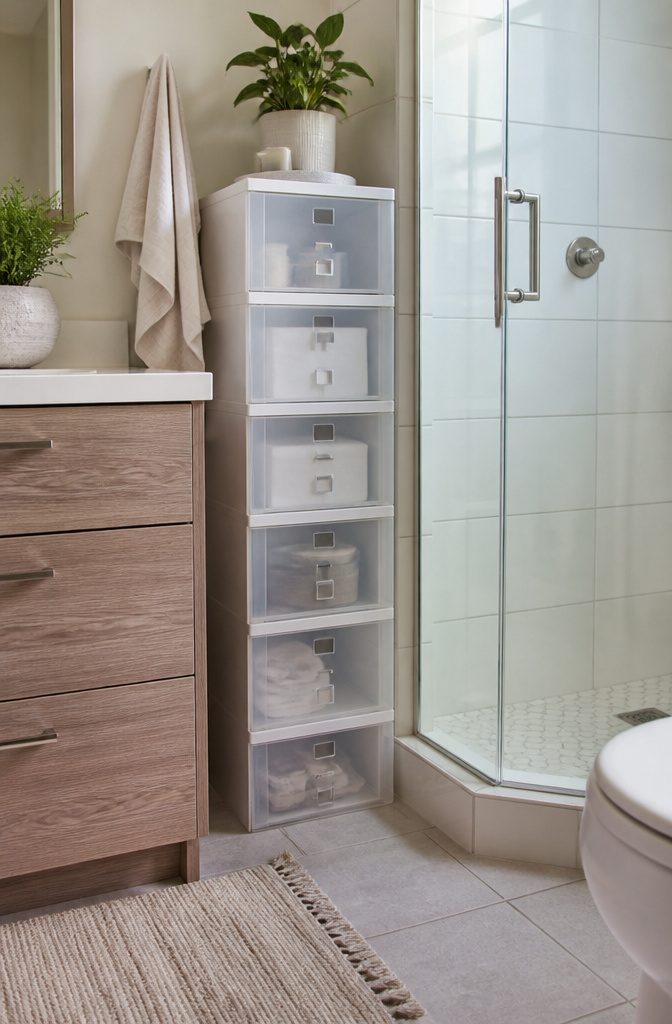
Stacking drawers beat lidded bins for the simple reason that nothing has to come apart to reach the bottom layer. I learned that preference from watching my own morning routine, not from any catalog.
The 12-inch and 14-inch widths fit most standard vanity cabinets without leaving dead space on the sides, and those two sizes cover the majority of under-sink setups in rentals and first homes built in the last few decades.
The Stackable Slide-Out Drawer Organizer and its narrow cousin, the Small Stackable Slide Out Drawer, build upward in tiers so you can see everything at once instead of digging through a single deep cavity.
Wire stackable baskets with handles work too, though they slide less smoothly and the open sides let small bottles tip.
The mistake that wastes money is buying units too tall for the cabinet opening. Measure from the inside base to the underside of the frame, then subtract half an inch for clearance.
A drawer tower that fits the footprint perfectly still fails if it cannot clear the lip when you pull it out to clean.

Stackable Storage Bins: The top of the drawer has groove design ensures stacking. Use these stackable drawers to save space, which is also keep organized

ESSENTIALS STORAGE PREFERRED: The multi-purpose organizer storage is a good helper to keep your vanity or bathroom countertop tidy. It can also be used as under sink organizer, kitchen organization, pantry organizer, refrigerator storage, cabinet storage. Suitable for storing cosmetics, toiletries, perfumes, cleaning supplies, snacks, bottles, spice jars
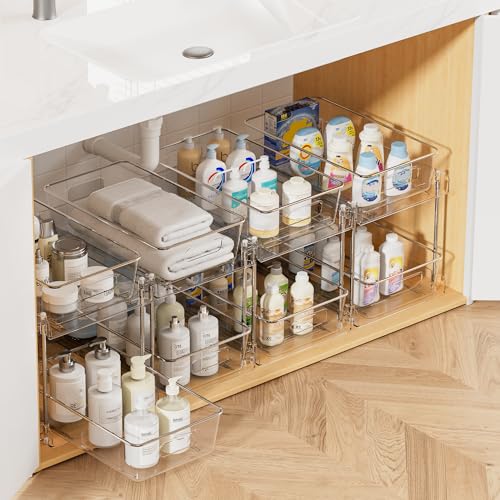
ESSENTIALS STORAGE PREFERRED: The multi-purpose organizer storage is a good helper to keep your vanity or bathroom countertop tidy. It can also be used as under sink organizer, kitchen organization, pantry organizer, refrigerator storage, cabinet storage. Perfect for storing cosmetics, toiletries, perfumes, cleaning supplies, snacks, bottles, spice jars.
4. Label Storage Containers
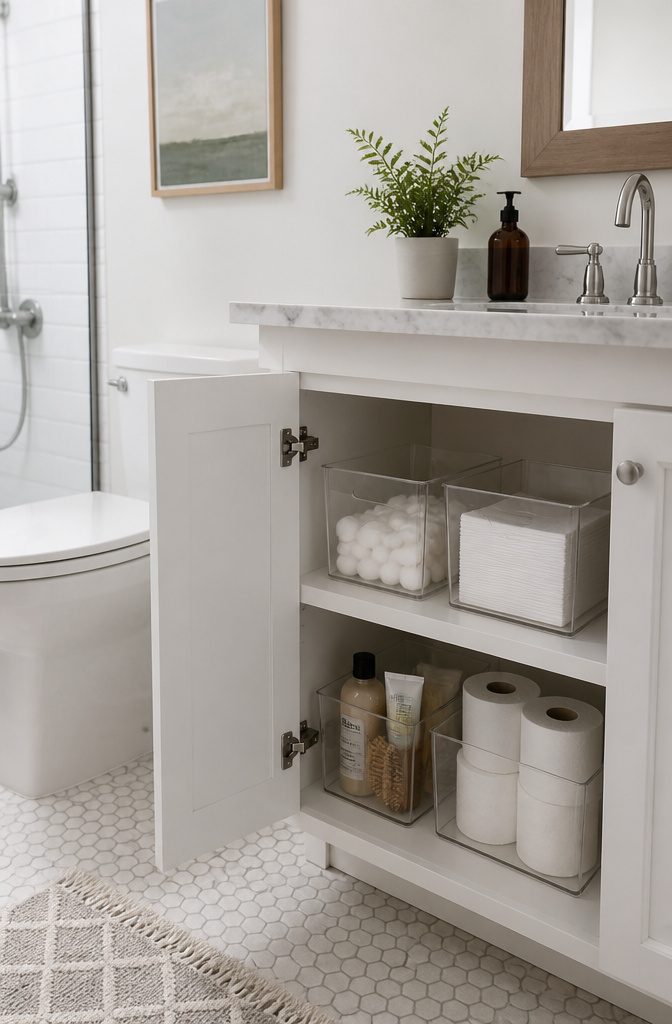
Unlabeled bins in a shared bathroom become black holes inside a month. Someone drops in a razor, then a travel-size shampoo, and soon the whole category system you built has dissolved into a generic "bathroom stuff" pile that nobody owns.
A label is the only thing that makes a bin’s job description visible when everyone is rushing.
I started with masking tape and a Sharpie to test whether my categories would stick.
"Hair," "Skin," "Dental." They looked rough but they worked for three weeks, which was long enough to learn that "Misc" was where my system went to die.
Once the groupings held, I spent $28 on a basic label maker. The printed labels survive steam and splashes better than tape, and they look intentional enough that roommates actually respect the lines.
The real payoff is maintenance.
A labeled bin trains everyone in the house to sort on autopilot. Without that cue, the organizing work you did last weekend becomes the mess you redo next month.

[Stackable Design] Come with 5 storage drawers, included 12.1" W and 4.4''H&7.6‘’H storage containers. The storage containers are stackable, vertical storage will save a lot of space. Put your small objects in acrylic drawers to make your countertop space more tidy.

Available in 2 Different Sizes: The smaller size (S) measures 8.27" x 13.19" x 9.06", and the larger size (L) measures 8.27" x 13.19" x 10.63". High-Low combos make this bathroom organizer versatile for multi-purpose storage and organization, such as kitchen organization, cabinet organizer and storage, bathroom organizer countertop, pantry organizer, under sink organizer, etc

Dustproof Storage Bins---The storage drawers help you to organize everywhere in your home. It is ideal for storing refrigerator food, snacks, medicines and office items. The storage bins has built-in removable dividers to achieve "one box for one thing" or "one box for one category".
5. Catch-All Basket for Infrequent Items
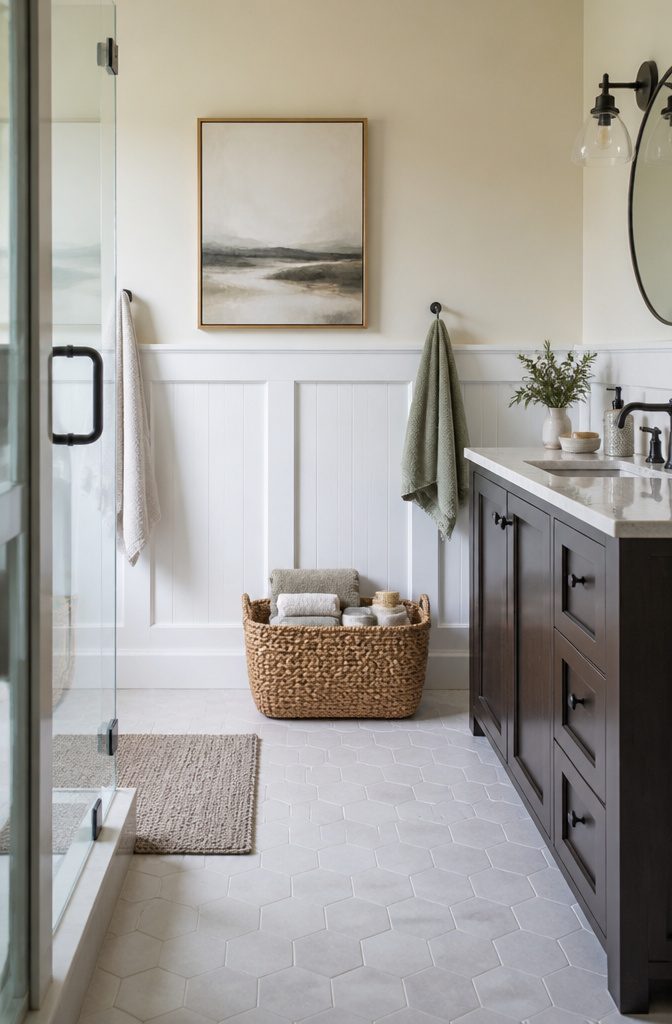
The backup shampoo and travel-size toothpaste you reach for once a month do not earn a spot on the counter.
I learned this the hard way after my "temporary" wire basket sat next to the sink for six months, collecting dust and making the whole vanity feel crowded. A catch-all basket belongs inside the cabinet, not on top of it.
Mine now lives on the floor of the under-sink cabinet, rolled out only when I need it.
The Yamazaki Rolling Wire Basket runs about $35 and moves easily on small wheels, which matters when you are crouched in a tight bathroom reaching past plumbing.
I keep extra razors, a spare deodorant, and the small bottles I save for trips in mine. The wire lets me see what is left without digging, and the open top means I toss things in without unlatching anything.
The mistake is letting convenience become clutter. If you open it less than once a week, it does not get to live where you look every morning.

Premium Material:The drawer organizer is made of non-toxic plastic which may be safely used. The transparent design makes it easy to find what you need quickly

【Perfect for Makeup Drawer Storage】Versatile 10pcs drawer organizer can be combined in 9*12 and 9*18 inch drawer in vanity, they are perfect for organizing cosmetics like lipstick, hair accessories, eye shadow, makeup brush, beauty products, jewelry and more, keep your vanity drawer well organized.

【4 Different Sizes 】our desk drawer organizers set of organization drawers includes : 2.9 x 2.9 x 1.6 inch (8 pcs),5.9 x 2.9 x 1.6 inch (8 pcs),8.9 x 2.9 x 1.6 inch (6 pcs),8.9 x 5.9 x 1.6 inch (3 pcs),You can customize the combination to customize your own drawers,1.6 inch high, perfect for both high and shallow drawers
6. Floating Shelves for Extra Storage
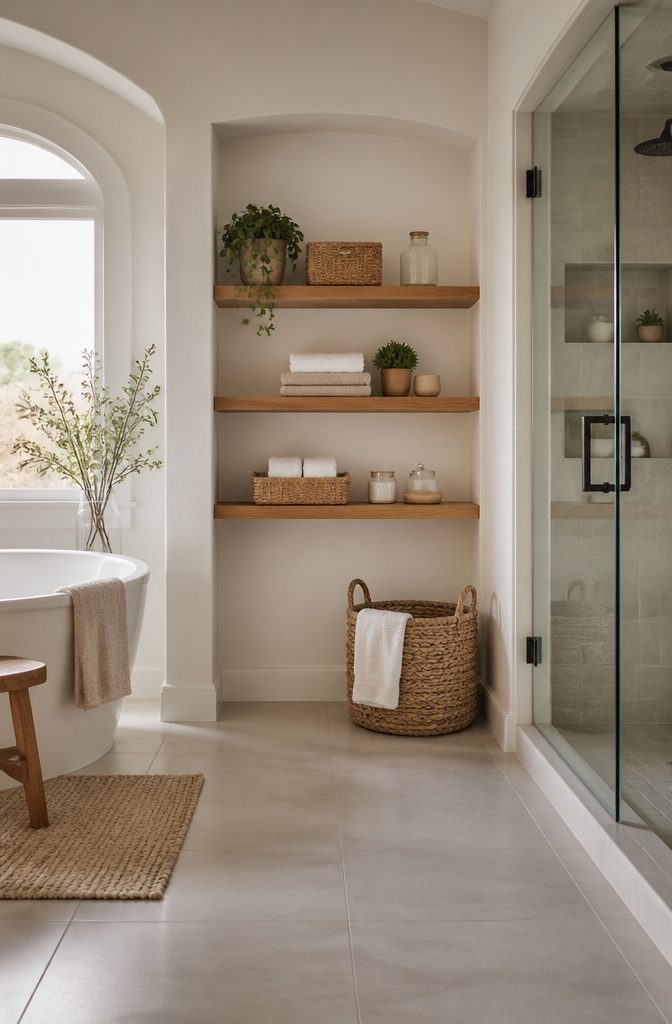
Wall-mounted shelves turn the dead zone above a toilet, beside a mirror, or inside an awkward corner into usable storage without eating floor space.
The standard lengths are 16 inches and 24 inches, and most renters need to stay under a 20-pound weight limit per shelf if they want their security deposit back.
I learned the hard way that mounting height matters more than I thought. My first attempt sat so high above the toilet that reaching for daily items became a small stretch routine every morning.
A shelf you need a step stool to use becomes a shelf you stop using. The IKEA Rågrund corner shelf, at about 20 inches high and roughly $27, shows how low-profile pieces can tuck into tight spots without fighting the room.
For above-toilet work, I now measure from my standing reach downward rather than eyeballing what looks balanced on the wall.

Multiple Large Size Combinations: A set of 2 pcs 15 "x 6" x 2 " & 4 pcs 9" x 6 "x 2" & 4 pcs 6 "x 6" x 2 " large drawer organizer sets give you enough space to customize different combinations to store your items

4 Different Sizes: Our 25 PCS drawer organizer comes with 4 different sizes to meet your storage needs; include 8.8 x 5.5 x 1.9 inches(3 PCS), 8.7 x 2.7 x1.9 inches(6 PCS), 5.9 x 2.7 x1.9 inches(8 PCS), 2.7 x 2.7 x 1.9 inches(8 PCS). You can use the suitable size according to the size of your drawer.

【Make Everything Organized】These versatile drawer dividers trays are perfect for home organization. Fit all kinds of drawers, such as vanity/ bathroom /kitchen /office drawers/craft room, ideal for organizing cosmetics, makeup tools, hair accessories, jewelry, pins, office supply, craft supplies, utensils, etc.
7. Wall Cabinet in the Water Closet
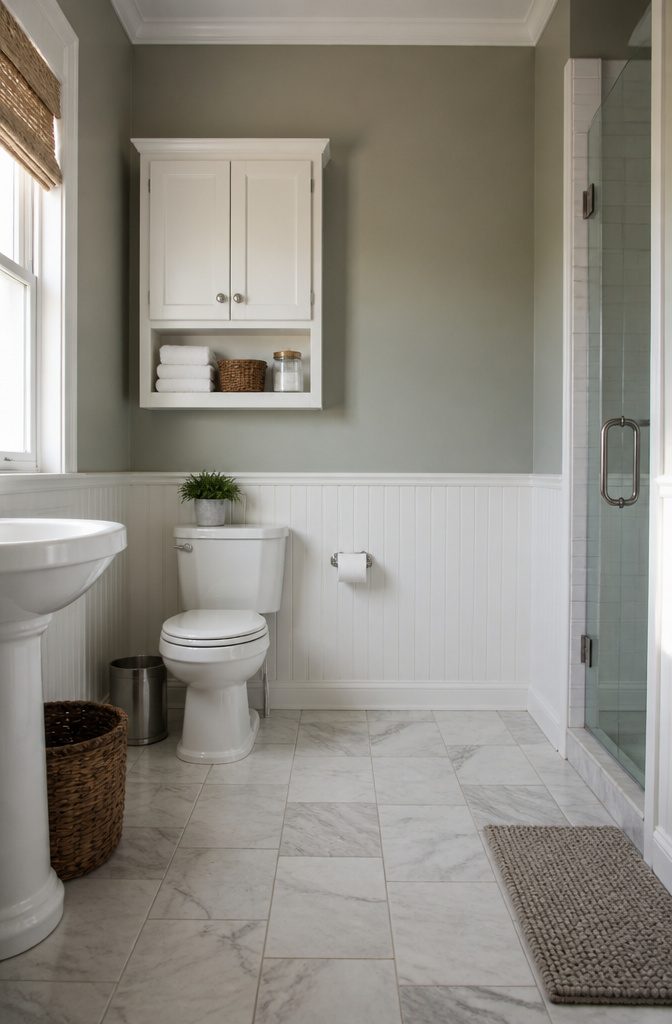
An 18-inch-wide wall cabinet with a 6-inch depth sits above the toilet without crowding the room.
I learned the depth part the hard way in my first apartment, where a deeper shelf caught my knee every time I turned around in that narrow water closet.
The water closet is its own animal. A full over-the-toilet shelf unit works in a combined bathroom, but the separate toilet room is usually just 30 to 36 inches across.
The cabinet needs to mount high enough that the tank lid still lifts freely, about 6 to 8 inches above the flush valve.
I use mine for toilet paper rolls and a small cleaning caddy, nothing heavy enough to make me nervous about drywall anchors in a rental.
The shallow depth forces a choice.
Items either face forward on a single row or you add a small riser inside to see what’s behind. I added a 2-inch acrylic shelf riser from the kitchen section and it doubled the usable layers.
8. Tray to Corral Vanity Counter Items
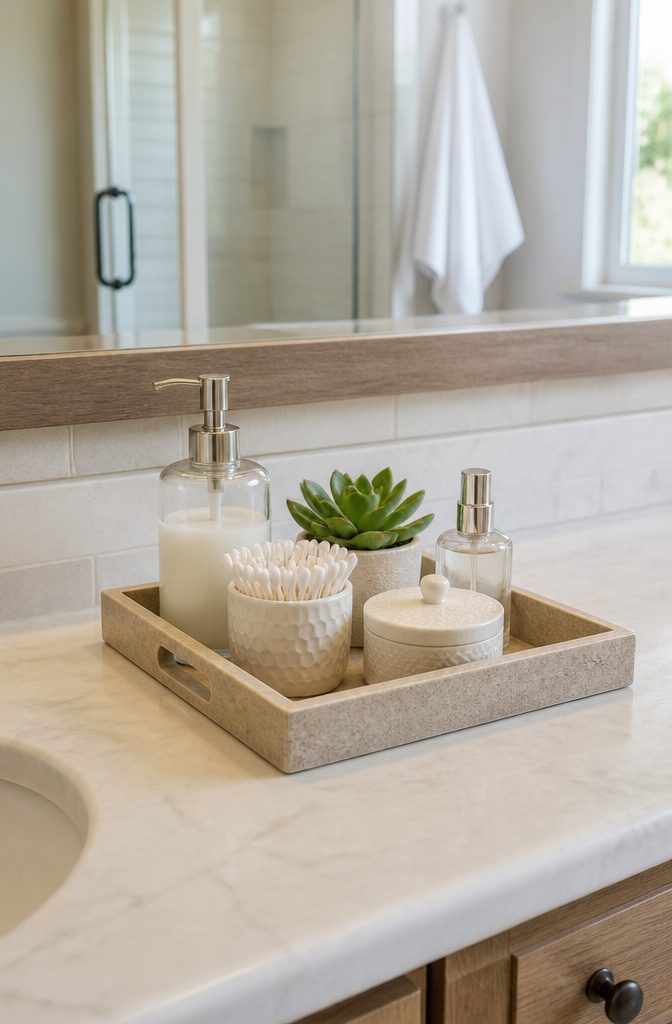
A tray on the vanity counter is the one surface rule that actually holds. Everything that gets used every morning goes in the tray; anything that does not fit goes in a drawer or a cabinet, period.
I learned that the hard way when I tried an 8-by-10-inch tray on a standard vanity and spent six months shoving my toothbrush page __aside every time I reached for moisturizer.
The 8-by-10 works for a single person’s basics: toothbrush, toothpaste, one daily skincare bottle. Two people sharing a sink, or anyone with a morning routine that runs past three products, needs the 12-by-16-inch size or nothing stays contained.
Display only the items you use most often, and corral them together for a tidier look.
That is the whole point.
The tray is not decoration; it is a hard boundary that forces a decision about what deserves daily access. Too small, and you will end up with one foot always outside the line.

Large Storage Drawers--Come with 2 drawer storage organizers, each organizer measures 12"D x 15"W x 5.7"H, and the using size is 10.6"D x 12.8"W x 5"H. Each box has a generous capacity, ideal for bulk storage of daily essentials, such as storing hair care tools, paper towels, hair dryer, toothpaste etc bathroom supplies.

【Stackable Storage Drawers】The top of the drawer features a groove design that ensures secure stacking,saving space. You can place other items on top of the plastic bins to maximize tidiness in your under-sink or cabinet spaces.

✅【LARGE CAPACITY】Stackable Sliding Basket Organizer adopts a mesh basket storage design, which can store seasoning bottles, cans, cups, food, beverages, toiletries and some small accessories, etc. It is very suitable for kitchens, cabinets, living rooms, bathrooms, offices, etc.
9. Spice Rack for Small Item Access
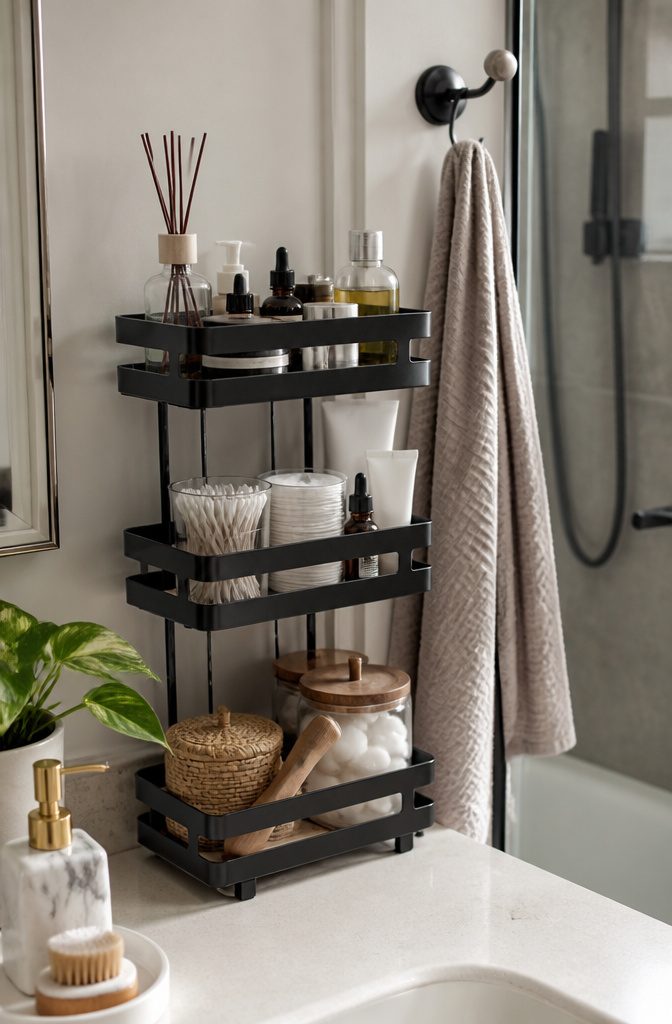
A wall-mounted spice rack flips the usual bathroom storage problem on its head.
Most baskets and bins let bottles sink to the bottom and hide behind each other; a spice rack keeps everything upright and in a single row where you can actually see it.
The 3.5-inch depth on a standard spice rack is enough for most travel-size toiletries, foundation bottles, and hairspray cans.
Anything deeper than that tends to wobble or stick out past the lip. I keep mine right next to the sink, off the vanity counter entirely so the surface stays clear for actual use.
The tradeoff is visibility versus dust. Open racks collect more of it than a lidded basket would, so this works best for the products you reach for daily, not the occasional hair mask or backup serum.
If you already have a catch-all basket tucked in a closet for those infrequent items, the spice rack fills the gap between that slow storage and the chaos of a countertop.

Dustproof Storage Boxes---The storage drawers help you to organize everywhere in your home. It is excellent storage boxes for organizing skincares,lotion,bathroom toiletries, baby bottle,beauty supplies,medicine. The storage bins height fit 7" high bottle lotion,create a dust-free and neat storage space for your items

𝐌𝐚𝐱𝐢𝐦𝐢𝐳𝐞 𝐔𝐧𝐝𝐞𝐫 𝐒𝐢𝐧𝐤 𝐒𝐩𝐚𝐜𝐞 - Designed with a custom-fit silicone mat and L-shaped structure, this under sink organizer fits perfectly around plumbing while protecting cabinets from water, spills, and leaks. Measuring approximately 11.8"W x 15.9"D x 13.8-16.9"H, it’s ideal for most kitchen and bathroom cabinets.

[Stackable Design] Come with 3 storage drawers, included 12.1" W and 2PCS 4.4'' Tall storage containers. The storage containers are stackable, vertical storage will save a lot of space. Put your small objects in acrylic drawers to make your countertop space more tidy.
10. Basket on the Back of the Toilet
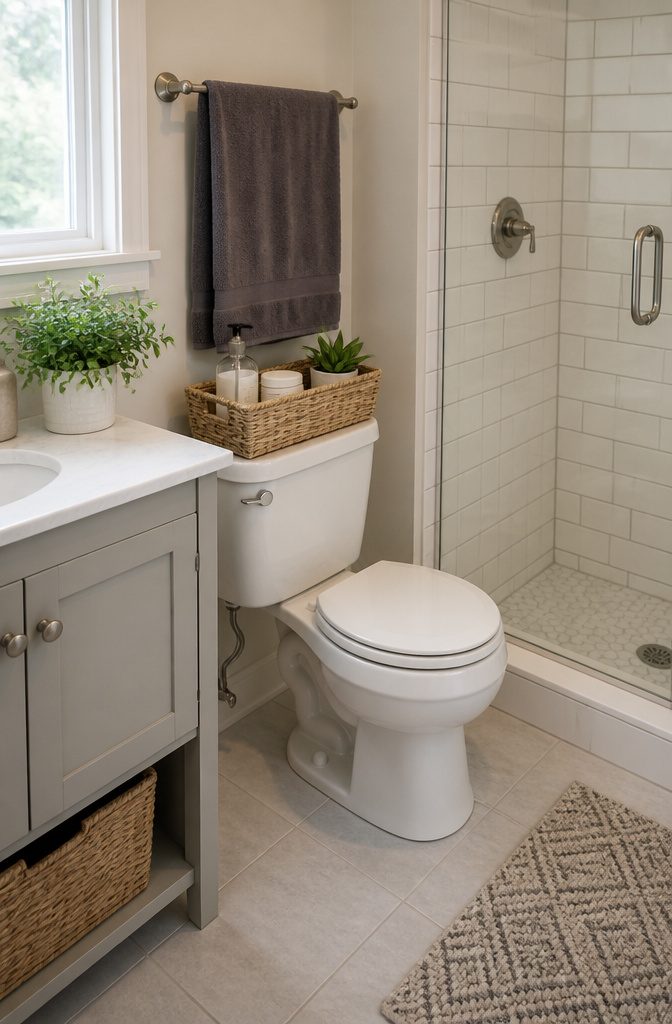
A freestanding basket or narrow bin on the toilet tank lid gives you one extra shelf without drilling a single hole.
The catch is the flush handle. A six-inch clearance on the handle side keeps the lever free and the basket from getting knocked every time someone finishes up.
I learned the weight limit the hard way when I filled a wire basket with full shampoo bottles and the whole thing slid backward, scratching the porcelain with a sound that still makes me wince.
The tank lid is not a countertop. It slopes, it vibrates, and it costs more to replace than any basket saves you.
A light wire or woven bin with a flat bottom stays put better than something tall and heavy.
I keep it to two rolls of toilet paper, a small plant, and one backup hand soap. Anything more, and you are asking gravity to forgive you.
If the lid has any curve to it, a shallow tray inside the basket keeps items from tipping.
For renters, this is the whole point: no hardware, no patching, no explanation to the landlord. Just lift it off when you leave.

【Holds 177 Items】 ---- Organize up to 177 everyday items in one set! These Clear plastic drawer organizers fit effortlessly into bathroom drawer organizer, vanity organizer, office drawer organizer, bedroom, closet, or garage desk drawers.

【Multifunctional】These versatile drawer dividers trays are suitable for various locations in your home, which can be makeup organizer for vanity, junk drawer organizer, drawer organizer tray, bathroom drawer organizer and office organizer. It can be used to organize cosmetics, makeup tools, hair accessories, jewelry, pins, office supplies, craft materials, utensils, and more

INCLUDES: 5 metal trays each measuring 1 inch deep. One tray measures 12 x 3 in., one measures 9 x 3 in., one measures 9 x 6 in., one measures 6 x 3 in., and one measures 3 x 3 in.
11. Medications Belong Elsewhere
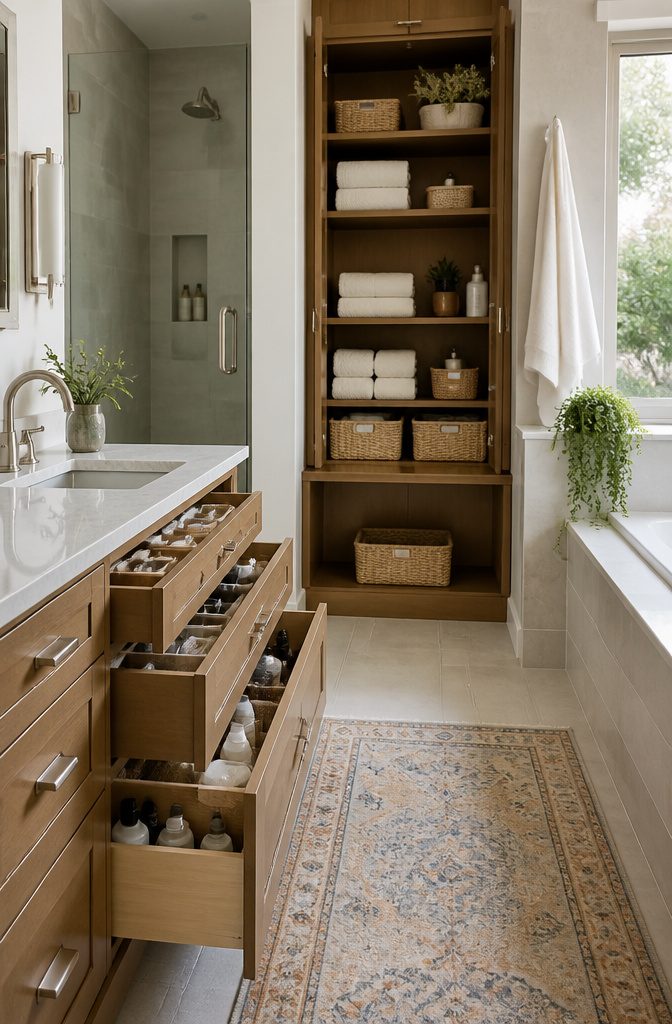
The medicine cabinet is the worst spot for actual medications, no matter what the name suggests.
Steam from showers pushes humidity past what pills and liquids can handle, and the temperature swings that come with a small, closed room speed up chemical breakdown.
The FDA recommends storing most medications at room temperature, generally between 68°F and 77°F, with brief excursions allowed down to 59°F or up to 86°F. A bathroom that hits the 80s after every shower and holds moisture in the walls fails that test daily.
I learned this the hard way when my thyroid medication turned chalky months before the expiration date. The pharmacist explained the humidity had degraded the coating, which meant the active ingredient was likely breaking down too.
A bedroom drawer or a closet shelf away from any heat source fixes this completely. In my current setup, a small bin on the top shelf of the closet holds all medications and first-aid supplies together, dry and stable.
In a previous apartment, the linen closet sat in the hallway rather than the bathroom, and that worked just as well. The key is distance from water and temperature swings, not the label on the door.
12. Floor Tower for Shower Storage
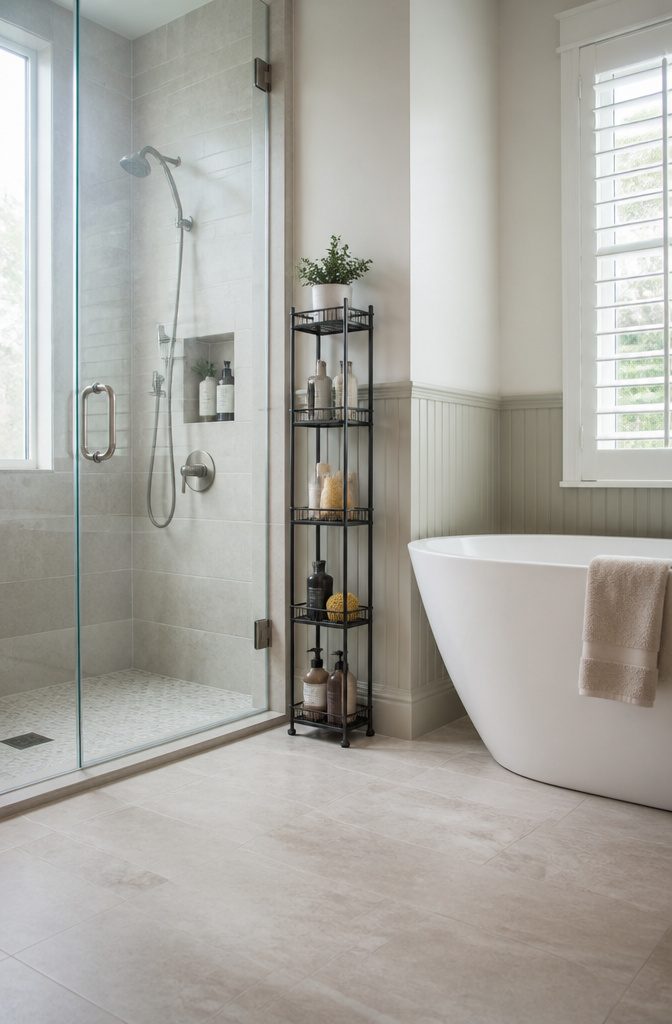
A floor tower wedged into the shower corner buys back space you did not think you had.
Most tub-shower combos leave an awkward triangle between the surround and the curtain, and the units that fit it are 8 or 11 inches wide, with the narrower one clearing a curved rod and the wider one suiting a straight wall.
Rust-proof means powder-coated steel or anodized aluminum, not the chrome-plated wire that starts weeping orange stains by month four.
The mistake that wastes the money is the height. A tower that clears the faucet nicely still has to miss the shower head, and in a standard 72-inch enclosure the head sits low enough that a five-shelf unit brushes it.
The water sprays against the top tier, collects, and leaves a puddle on the floor you will blame on the curtain until you notice the rust blooming from the inside out.
I measure from the pan to the head, then subtract four inches for spray bounce, before I order.
13. Rolling Cart for Flexible Storage
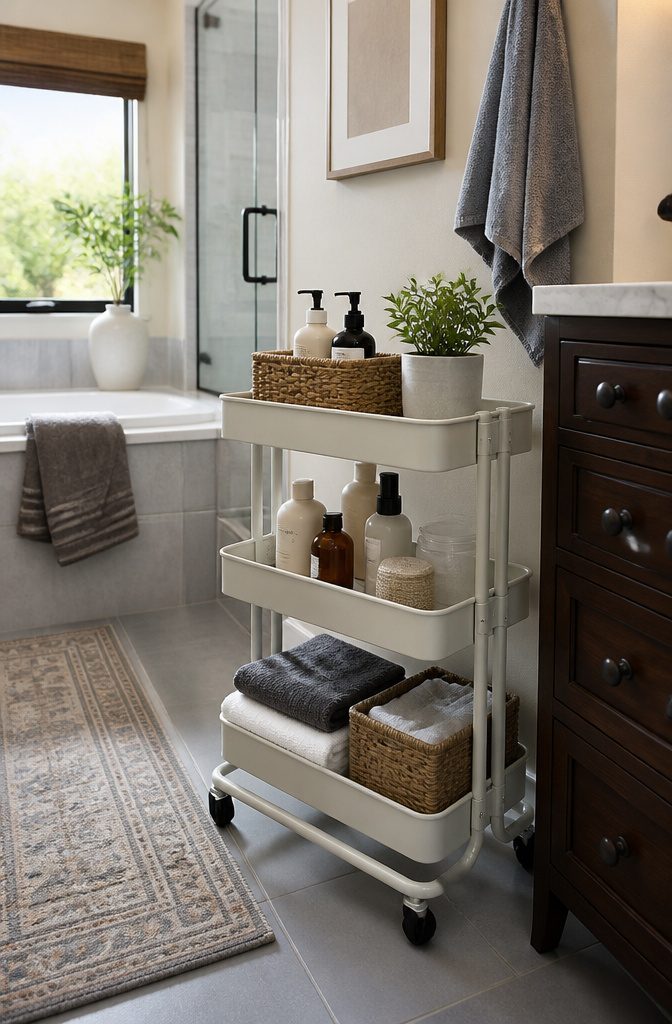
The IKEA Råskog Utility Cart fills a gap most bathroom storage ignores: the 13.5 by 17.5 inches of floor space between fixtures where nothing built-in fits.
Three tiers hold daily essentials and roll wherever you need them, sink to shower to tucked inside a closet when company shows up.
I spent about twenty minutes on assembly, not the fifteen some people report. The hex key IKEA includes works fine, but lining up the third tray while holding the frame square took me longer than the instructions suggested.
For roughly $40, the epoxy-coated steel frame handles humidity better than the wire racks I have replaced twice.
The slotted trays drain water, which matters more than I expected. A damp washcloth or a bottle that drips does not pool underneath, and that alone keeps mildew from forming in the corners where solid shelves hide it.
Lockable wheels matter too. A cart that drifts every time you lean on it ends up parked in a doorway, unused.
14. Optimize Existing Counter and Cabinet Space
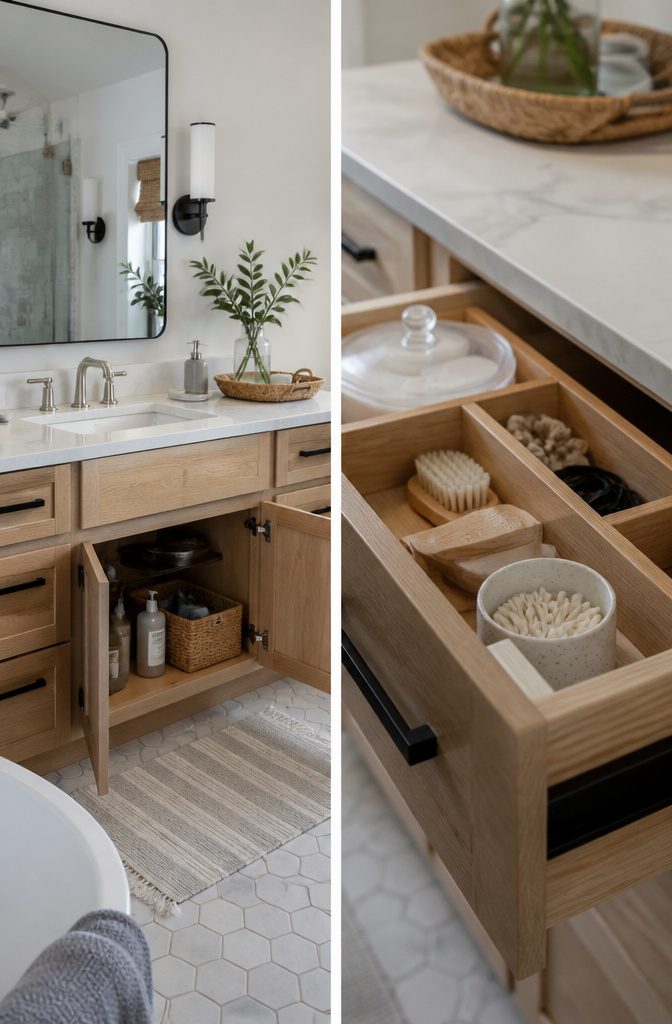
Before adding a single shelf or bin, measure what is already yours.
Most bathroom sinks leave about 18 inches of vertical clearance between the cabinet floor and the bottom of the bowl, and that gap is where under-sink storage lives or dies.
The IKEA Rågrund sink shelf, at around 20 inches high, sits just above that line for many standard vanities; its triangular shape steps around the drain pipe while the bamboo surface stays visible enough that you remember what you stored.
I have watched that height rule fail twice in friends’ rentals, once with a stackable drawer that jammed against the P-trap and once with a shelf that cleared the pipe but blocked the shutoff valves.
Door-mounted organizers and tension rods cost less and ask nothing of the existing footprint.
A rod hung inside the cabinet door corrals spray bottles by their triggers, keeping them off the damp cabinet floor and freeing the 18 inches below for items that actually need it.
Lazy Susans work better than fixed bins for daily skincare, since deep cabinet corners otherwise become black holes; the spinning turntable brings the back row forward without unpacking everything in front of it.
15. Over-the-Toilet Storage Solutions
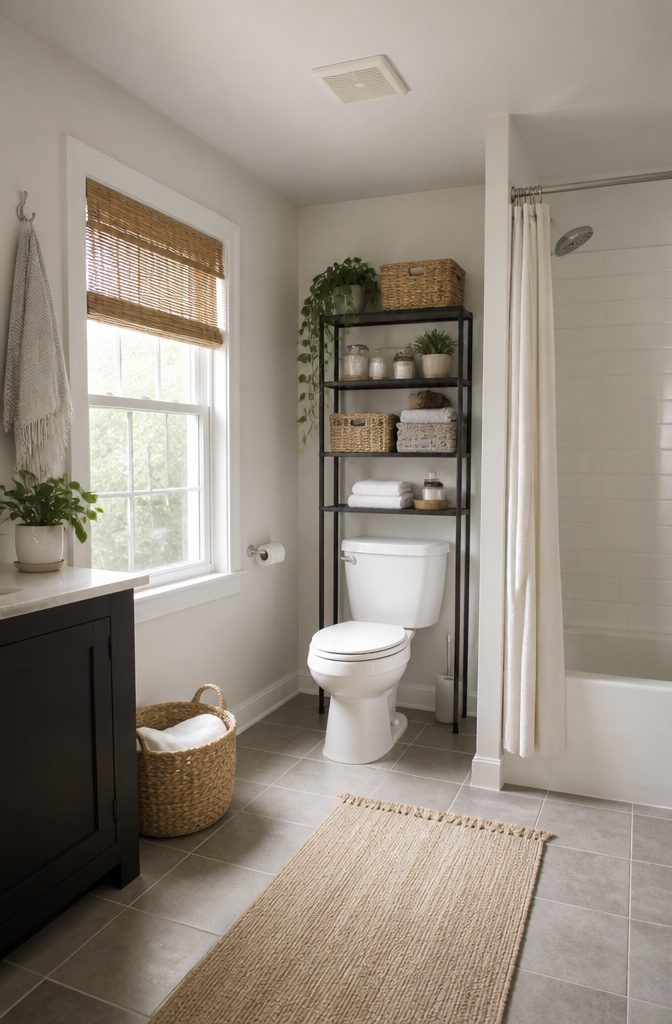
The 24 to 30 inches above a toilet tank is dead space most renters never touch, which is a shame, because a freestanding etagere or wall-mounted cabinet there can hold a full week’s towels and the backup toiletries that usually clutter the vanity.
Aim for a total height around 67 inches, which clears the standard toilet and tank without brushing the ceiling in an 8-foot room.
Depth matters more than width here: the unit needs to sit far enough forward that the tank lid lifts freely for repairs, a mistake I see constantly in friends’ bathrooms where they wedged in a slim shelf that looked perfect online but now requires unbolting the whole unit to reach the flapper.
Wall-mounted cabinets keep the floor clear and feel built-in, but they demand studs or serious anchors; freestanding ladder styles like the West Elm Modern Leaning Over-the-Toilet Cubby gain stability from an included wall anchor and took about an hour to assemble in testing.
Mahogany and engineered wood finishes hold up to shower steam without warping, though metal or bamboo etagere styles run cheaper if open shelving works for your routine.
Closed storage hides the visual noise of spare toilet paper and cleaning bottles, which matters in a bathroom you share or see from the hallway.
What I Spend and Where I Save
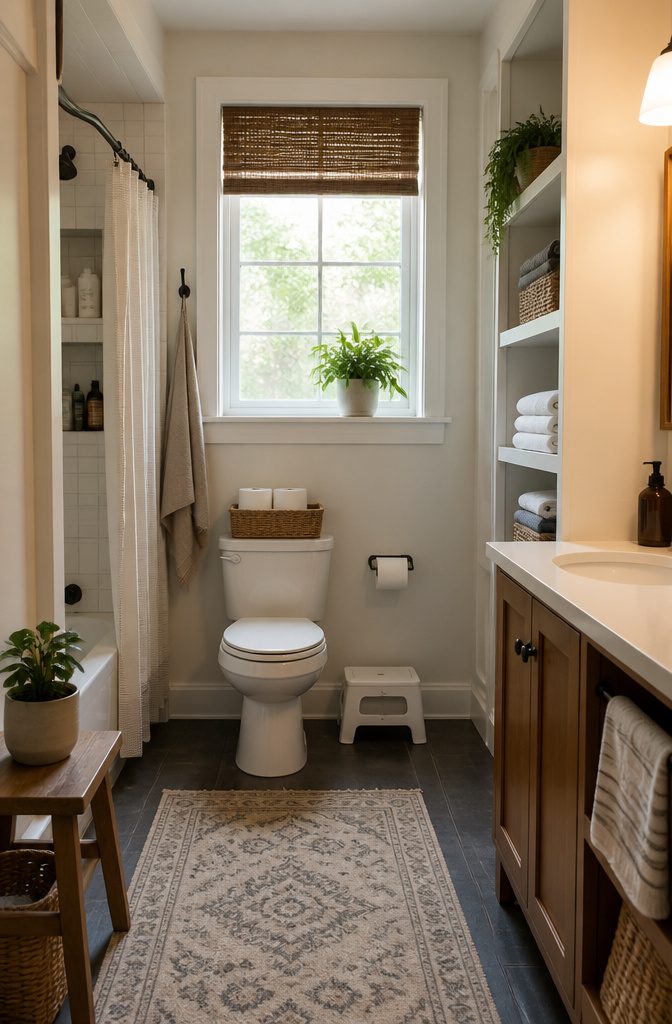
Two hundred dollars is the ceiling that keeps me honest, and the first cut is anything that hides behind a cabinet door.
A trash can sits in plain sight every morning, so the $30 Simplehuman 4.5L Round Step Can earned its place: steel construction, soft-close lid, and a white finish that disappears against tile.
The dog has clawed at mine since 2022 without scratching it, which matters more than the price tag in a house where corners are tight.
The rest of the budget goes to what actually holds the clutter. iDesign Linus Shallow Drawer Organizers run about $4 at The Container Store, and at two inches deep they fit the narrow drawers most bathrooms inherit.
The 3.3-by-9.6-inch compartment swallows two hair brushes; the 3-by-3 corrals sample-sized creams and elastics without sliding around.
I skip matching sets entirely. The $4 Target bins perform the same containment as the $15 ones, and the difference across six or eight units is what pays for the can that steps quietly every time you press the pedal.
Shared Bathroom Rules That Stick
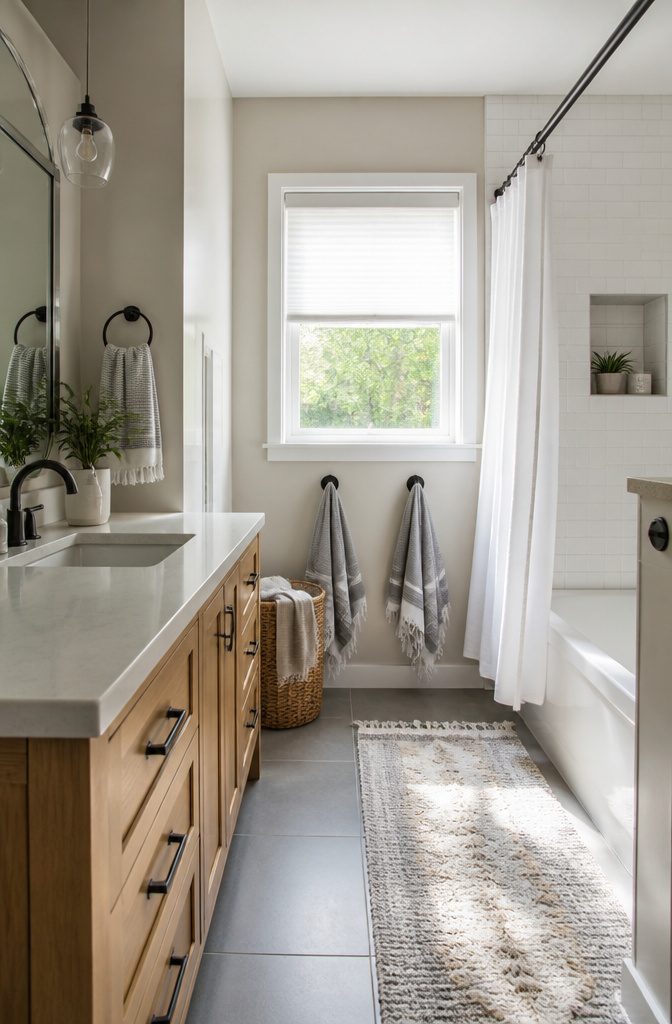
Two people sharing one bathroom sink means the mess doubles faster than anyone admits.
The system that held up for me was one drawer each, no exceptions, with a narrow middle drawer or countertop bins for the stuff you both reach for: toothpaste, the good hand soap, backup toilet paper.
Labels matter because they turn "where did you put my…" into a question that answers itself.
I learned the hard way that "shared" needs a five-minute conversation, not an assumption. In my last place, my roommate thought shared meant communal property; I thought it meant communal storage with personal ownership intact.
Toothpaste ran out, blame followed. A bin labeled "both use" with a second labeled "refills" solved most of it.
The rest is agreeing that a product goes in the shared zone only if both of you actually use it weekly. Everything else lives in your drawer or finds another home.
Weekend Timeline
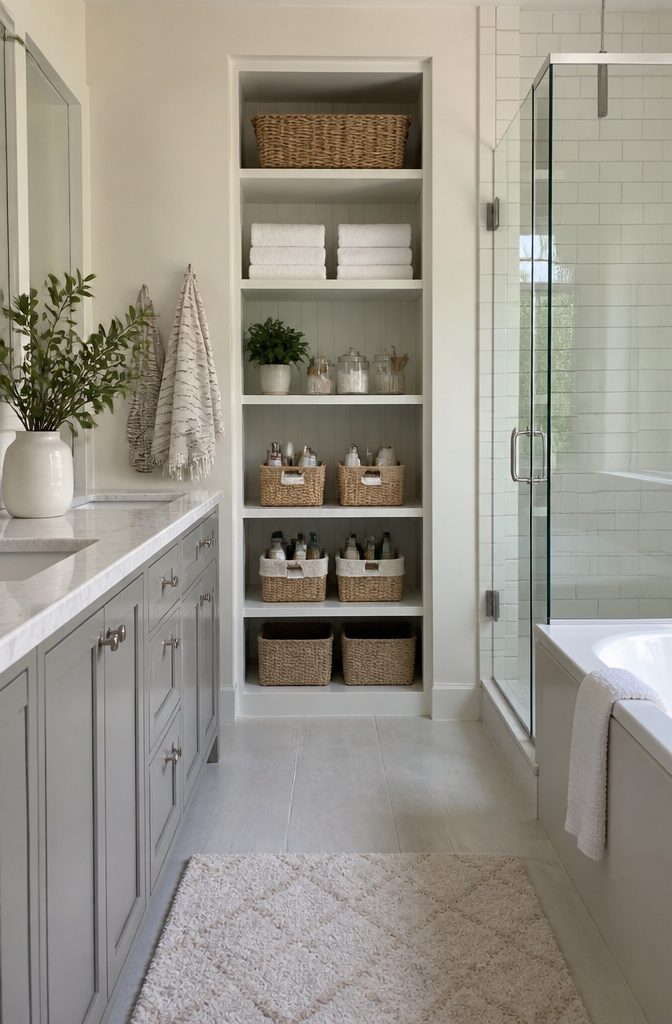
Saturday morning is for pulling everything out of drawers and cabinets, not for looking at pretty bins online. The mistake that cost me a return trip to IKEA was starting with shopping before measuring.
I had a cart full of Rågrund corner shelves and a Råskog utility cart before I realized the pedestal sink in my rental had only about 20 inches of clearance underneath, and the cart’s three 11-by-15-inch trays would block the door swing entirely.
Afternoon is when you measure every surface that matters: the open space below sinks, the width of cabinet interiors, the distance between toilet tank and wall.
Write it down. Then shop with numbers in hand.
The Rågrund shelves fit that 20-inch height limit and tuck around pipes without a fight, and the Råskog’s lockable wheels only help if you have a floor path wide enough to roll it.
Sunday is installation and adjustment. The bamboo Rågrund pieces fit together in about five minutes, but give yourself an hour for trial placement.
Humidity in a bathroom means checking that water drains through slotted trays rather than pooling, especially if you’re storing bath toys or cleaning supplies.
By dinnertime the cart stays put where you need it, and the shelves sit flush without bumping the bowl.