1. Declutter Like Crazy
Every organizing bedroom idea starts with the same unglamorous move: pull everything out and decide what actually stays. The cute bins and matching hangers come later, and they only work if there is real space to put them in.
Last spring I tried to skip this step in a 10×12 bedroom. I sorted one drawer, shuffled a closet shelf, and called it decluttered.
Two weeks later the surfaces were worse than before because I had never faced the pile of worn-out leggings and college-era event tees I was still "getting to." The room felt smaller with the clutter rearranged instead of removed.
Keep a donate bin within arm’s reach while you work.
The momentum dies the second you have to walk downstairs to bag something up. A trash can matters just as much for the obvious junk, the expired samples, the packaging you have been stepping over.
You can either have the space or you can have the stuff; holding both is the fantasy that sinks most bedroom projects before they start.
2. Create a Home for Each Item
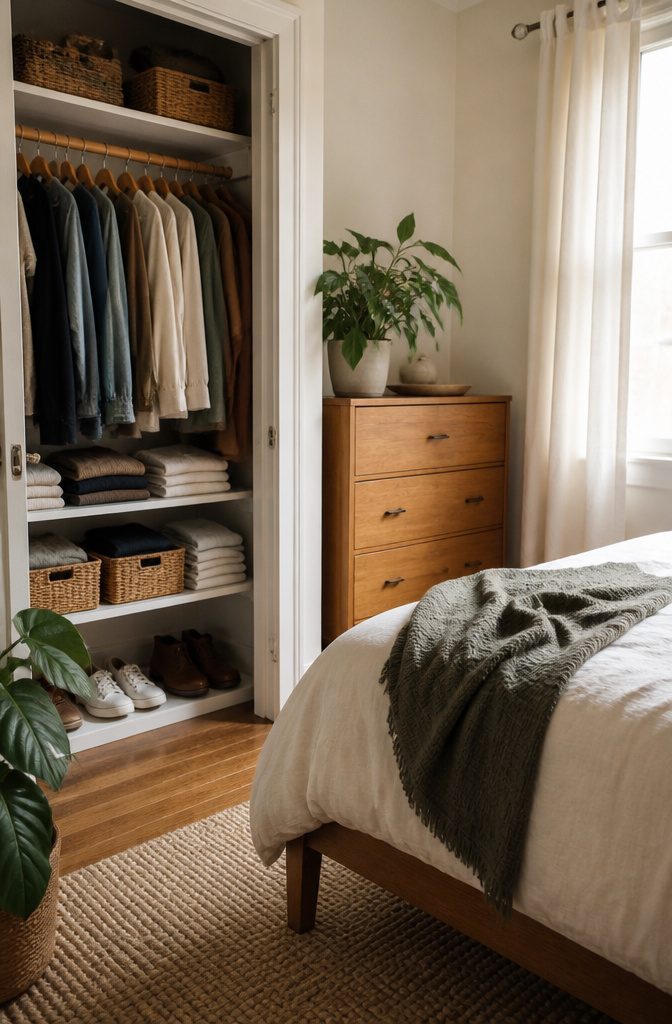
A clear spot beats a clear surface every time.
The sweater draped over the chair, the mail on the dresser, the charger on the nightstand: those piles start because the item has no home, not because you are lazy about putting it away.
I learned this the expensive way.
I bought a set of canvas bins first, then tried to assign them jobs. One was too shallow for the stack of folded jeans I planned to store.
Another swallowed a tangle of belts so completely I forgot they existed. The bins became clutter with handles.
Now I measure the space, list what actually lives there, and buy after.
The belt problem needed a shallow tray, not a deep bin. My bedside drawer is 14 inches wide, so a 12-inch organizer leaves room to slide, not wedge.
The charger lives in a clip-on pocket screwed to the back of the nightstand; 30 seconds to install, invisible from the front, and the cord never crosses the top again.
A designated spot means you can put something away in the dark, half-asleep, without thinking.
That is the test. If you have to decide where it goes, the system is already broken.
3. Use Under-Bed Storage
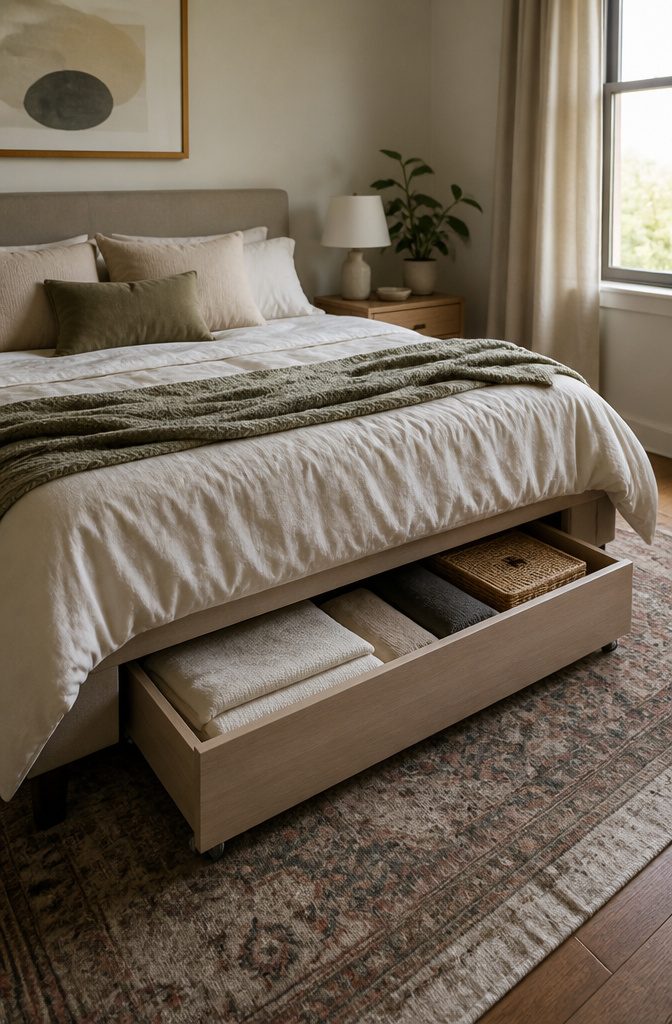
A standard bed frame with 5.5 inches of clearance rules out most rolling bins before you even open the package.
I learned that the hard way after buying two sets with casters that sat half an inch proud of the frame, leaving the whole box wedged at an angle.
Platform beds sit lower still, sometimes flush to the floor, so the storage math changes completely.
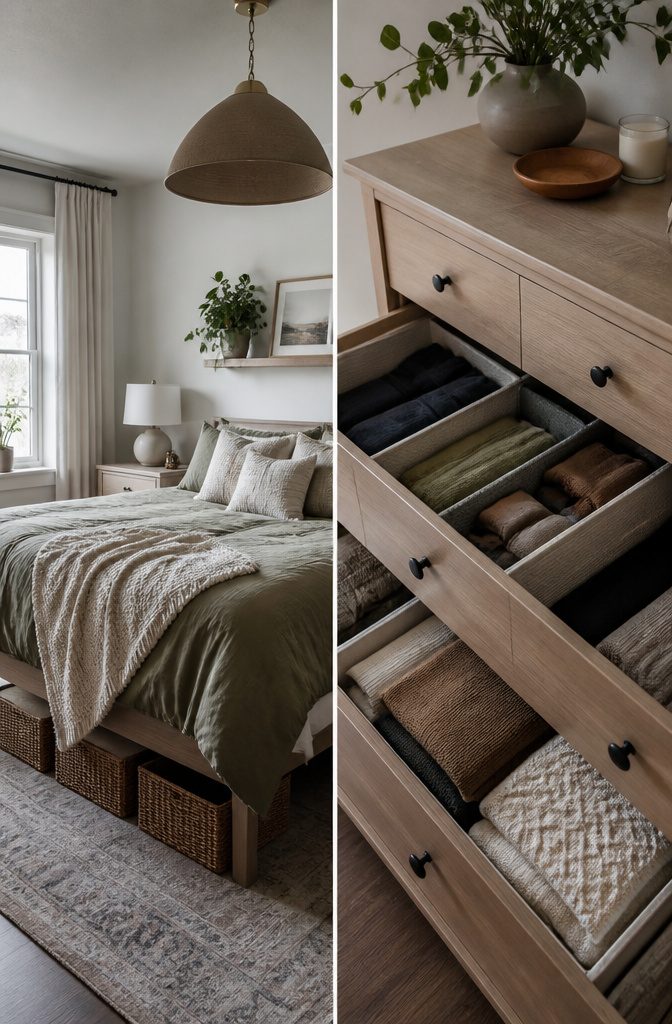
For those few inches, shallow lidded bins win. Linens, seasonal clothes, and shoes are the obvious candidates, and they do stay out of sight.
I kept spare bedding and off-season sweaters under mine for about two years before the dust became visible on the lids, which was my signal to pull everything out and wash the storage itself.
A lid that actually seals, not just rests on top, buys you more time than any fabric "under-bed organizer" without one.
Clear totes help you remember what you buried, though I have seen shoe organizers with individual pockets work for accessories you grab less often.
The key limit is the height, not the width. Measure the gap from floor to rail on your exact frame, then subtract a quarter inch for rug pile or uneven floors.
4. Use Baskets for Organization
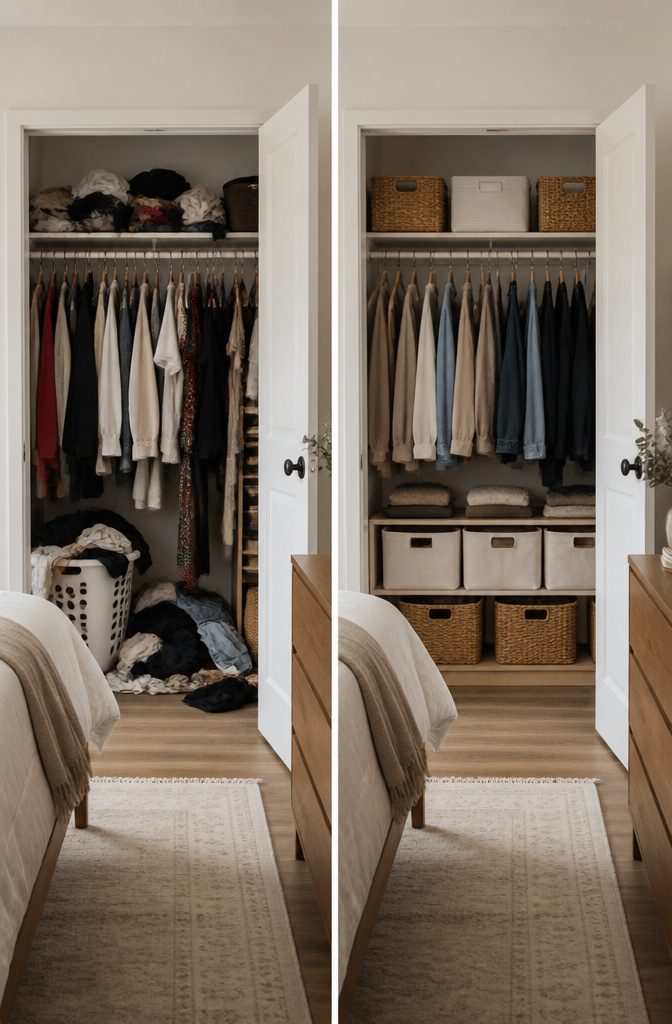
Baskets keep visual clutter low without hiding what you own behind a door you forget to open.
The material matters more than the label. I spent about eight dollars each on wire baskets from a discount store, only to watch the thin coating flake where jeans rubbed the corners inside six months.
Wicker held its shape longer, though the natural fibers collected dust and darkened near the bottom where my hand lotion had spilled.
Fabric bins were cheapest at roughly five dollars, but the sides slumped once I loaded them with anything heavier than scarves.
For daily items, open-top baskets win because a lid is one more step between you and the thing you need at 6 a.m.
I keep socks and workout clothes in open wire on the shelf. For the spare sheets and off-season sweaters I touch monthly, lidded fabric bins stack flat and keep the dust out.
5. Install Hooks for Hanging Items
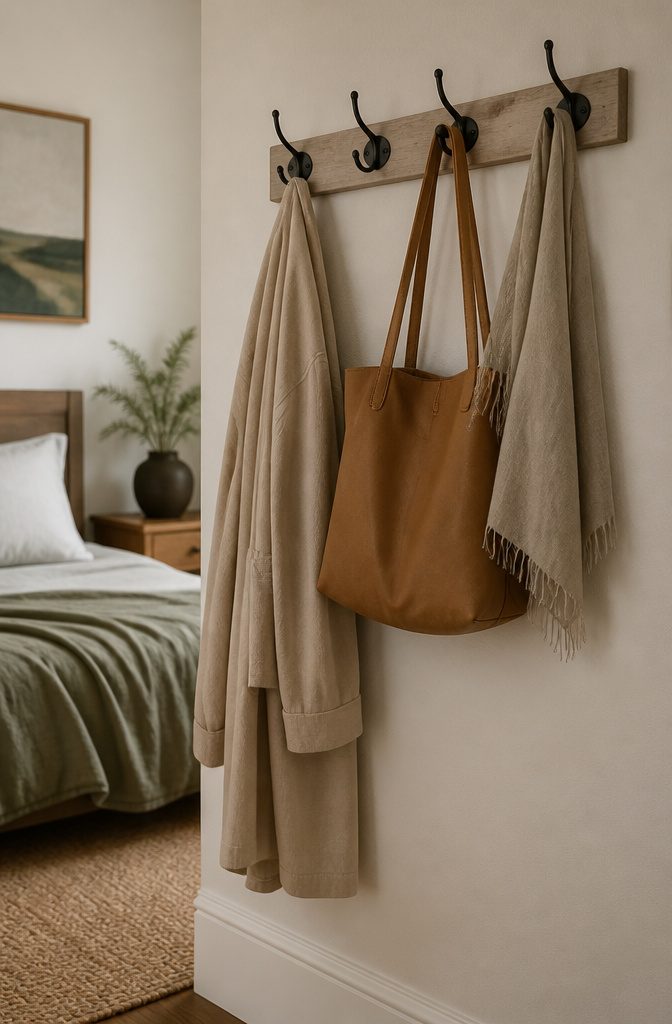
Hooks turn the back of a door or the blank wall beside a dresser into storage without eating floor space. I have tried three kinds over the years, and only one taught me a lesson I still remember.
Adhesive hooks work for lightweight items like tomorrow’s outfit or a thin robe, but the adhesive strips harden over time and lose grip.
In a rental bedroom I once used a large adhesive hook for a heavy canvas tote, and the strip pulled a palm-sized patch of paint clean off the wall when it failed.
The landlord noticed at move-out, and that was $120 I had not planned on. Screw-in hooks hold weight you can trust, though they leave holes to patch later.
Over-door hooks are the safest bet for renters; they hang on the frame without touching paint, and the better ones have padding so they do not scar the wood.
For bags, robes, and the outfit you set out the night before, I put one screw-in hook at shoulder height inside the closet for a robe, a row of two over-door hooks for bags, and a single over-door hook facing the room for tomorrow’s clothes.
The last one keeps the outfit visible so I actually wear what I planned instead of defaulting to something else at six in the morning.
6. Use Drawer Dividers
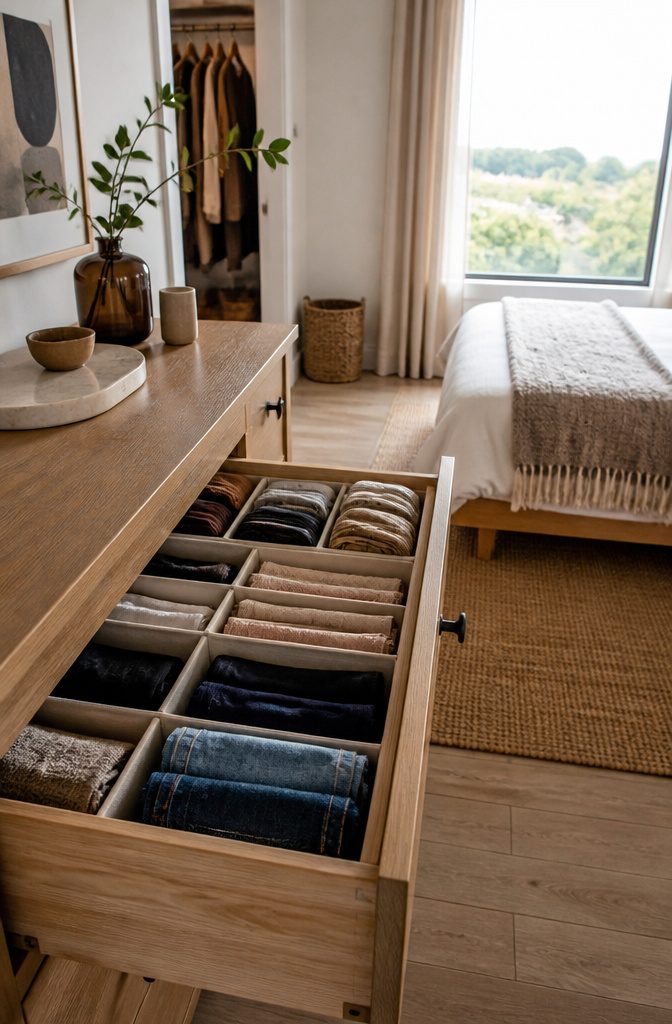
The $12 plastic set from Target looked fine in the cart, but the dividers slid around every time I opened my sock drawer. Socks bunched into the gaps by Wednesday.
The $38 bamboo set, which I ordered after the plastic failed, had a rubberized bottom that actually gripped the drawer base. Those stayed put through winter.
Both worked well enough for underwear, though the bamboo slots were a half-inch wider, which meant folded briefs sat flat instead of rolling.
Accessories were where the bamboo earned its price: watches and sunglasses fit the deeper compartments without stacking, while the plastic shallow trays let everything slide to one corner.
There was still the third drawer, the shallow one under my mirror that neither set fit. That drawer stays empty now, which turned out to be the better organizing bedroom idea than forcing a system where it did not belong.
7. Maximize Vertical Space
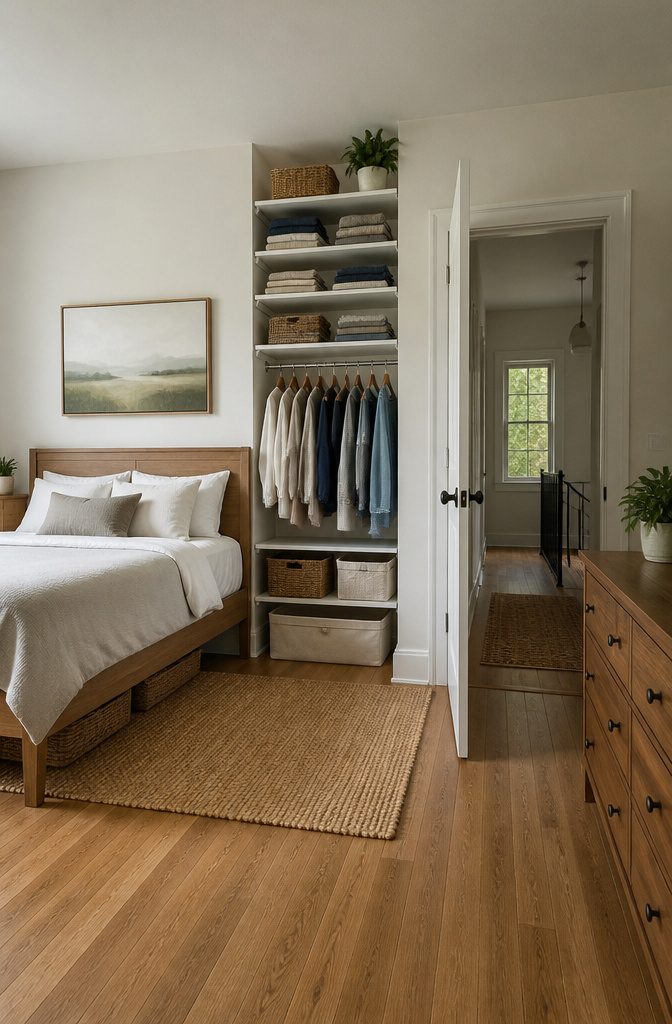
Wall-mounted shelves eat up zero floor space, which matters in a bedroom where every square foot counts.
I learned that the hard way after two failed installs where I hit nothing but drywall; a stud finder finally fixed that, and now I check every mount point twice before I drill.
Tall bookcases look like an obvious win, but 84-inch ceilings killed one system I had my eye on.
The unit needed a few extra inches for assembly swing, and that gap between the top shelf and the ceiling turned into a dust trap I did not want to manage.
Measure your full ceiling height, then subtract the assembly clearance the manufacturer lists, before you commit.
Over-door organizers hang on the frame without a single hole, which makes them the safest bet for renters.
The pockets work best for shoes, accessories, or the folded items you grab less often, the same stuff you’d stash on a high shelf you need a step stool to reach.
8. Use a Rolling Cart for Storage
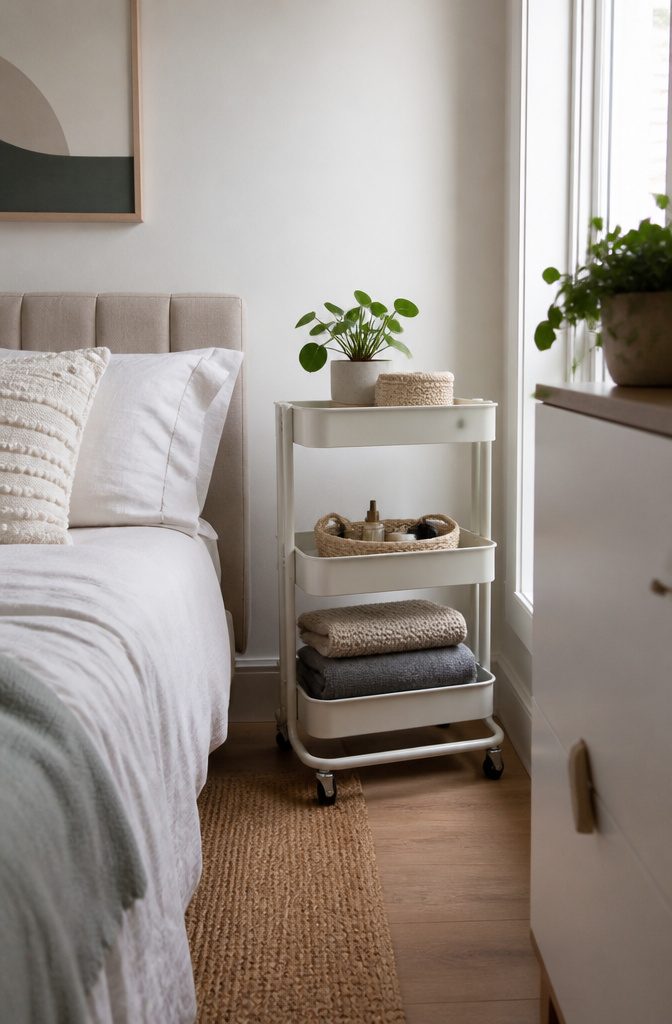
A three-tier metal cart became my nightstand substitute in a 9-foot-wide room where a standard table would have trapped me against the wall. The top shelf held a lamp, my phone, and a water glass.
The middle shelf kept three books and a small basket for lip balm and hand cream. The bottom shelf swallowed extra blankets and the charger I would have tripped over otherwise.
The fourth wheel stopped swiveling after eight months, probably from the weight of those blankets pulling unevenly. I flipped the cart, found the caster housing packed with dust and hair, and cleaned it out with a toothpick and compressed air.
It spun again, but looser than before. For the price, I still preferred it to a nightstand I could not move when the bed needed pulling out to change sheets.
9. Choose Multifunctional Furniture
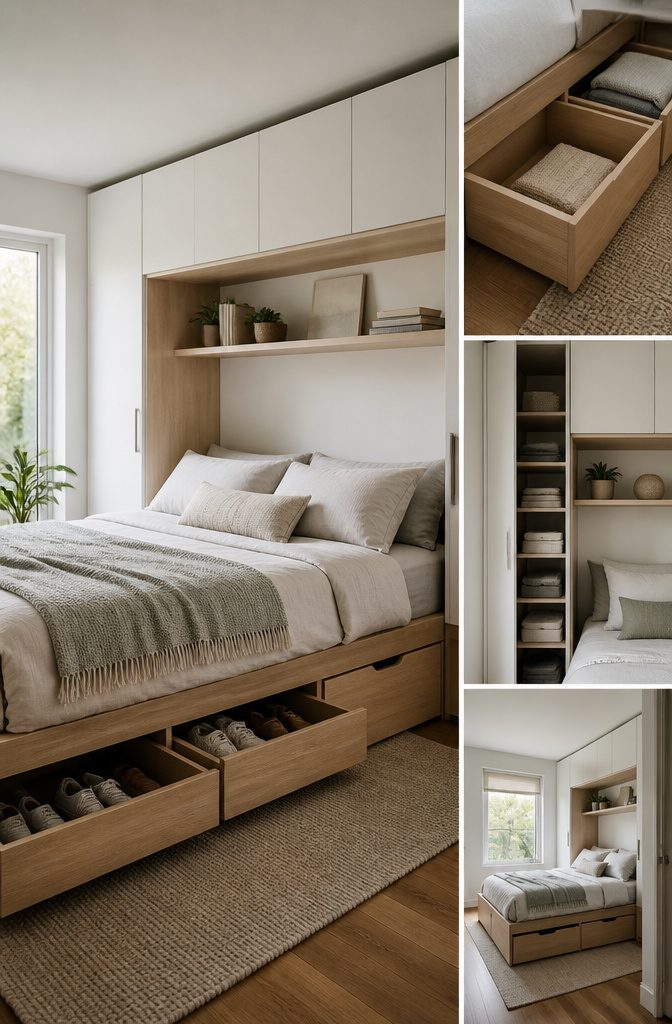
A storage ottoman at the foot of my bed held three folded blankets and the spare sheets I rotated through, which cleared an entire drawer in the dresser.
The one I kept cost $89 from a big-box store and survived two moves before the hinge finally split.
I almost bought a bed frame with drawers built into the sides, but the clearance was so low that the drawers only slid out about ten inches before catching on the carpet.
The storage was too shallow to fit a standard sweater box, which made it useless for anything bulkier than a single folded sheet. That frame went back to the warehouse, and I ate the $45 restocking fee.
Instead I found a wall-mounted desk that folded flat to six inches deep when I wasn’t using it. The desk, the ottoman, and a second storage bench I bought for the closet added up to $340 total.
The bench stayed; the desk I kept for a year before realizing I never actually folded it up, so I sold it and recouped about half.
Multifunctional pieces only earn their floor space if you use both functions regularly, not if one of them is a party trick you forget exists.
10. Keep Surfaces Clear
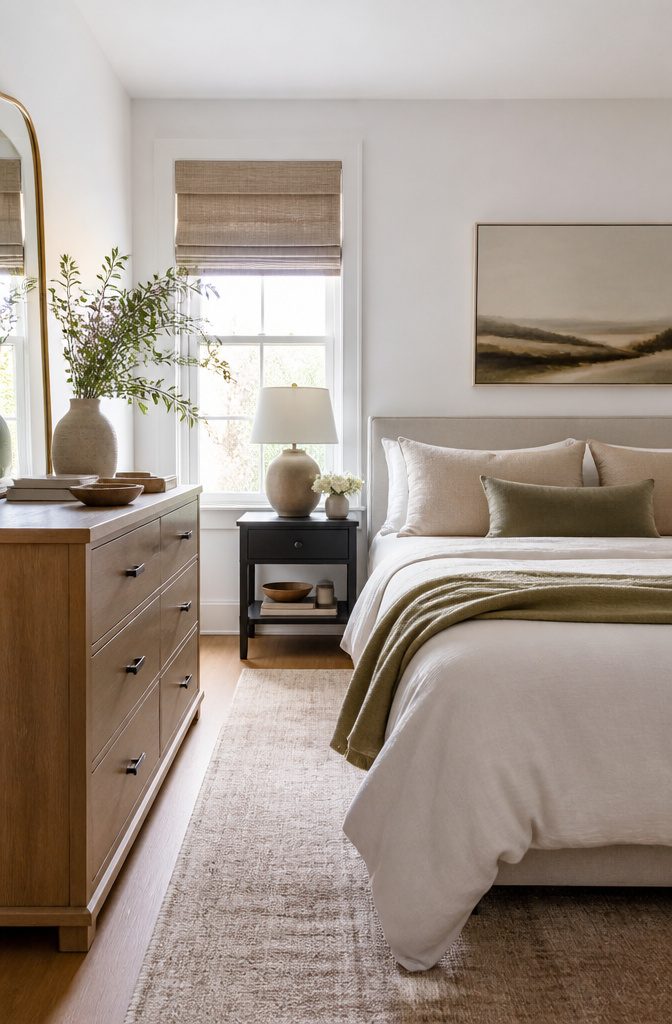
The two-item rule sounded generous enough when I first read about it: a lamp and one other thing on the dresser, period. I tried it for about six weeks and spent most of that time negotiating with myself.
The water glass counted as half, the book was just visiting, the hair tie didn’t really qualify as an item. Surfaces stayed cluttered because the rule had too many doors built into it.
The one-item rule leaves no room to bargain.
On my dresser, that’s a ceramic tray for earrings. On the nightstand, a small wooden bowl for lip balm and whatever I’m reading, which the bowl holds together so it reads as one object.
The floor beside my bed was the real test; clothes piled there for three years because I had no system for the not-clean, not-dirty middle ground.
A single wall hook for a canvas bag solved it. The bag hangs empty most mornings, which is the signal that the system is working.
11. Use a Nightstand With Storage
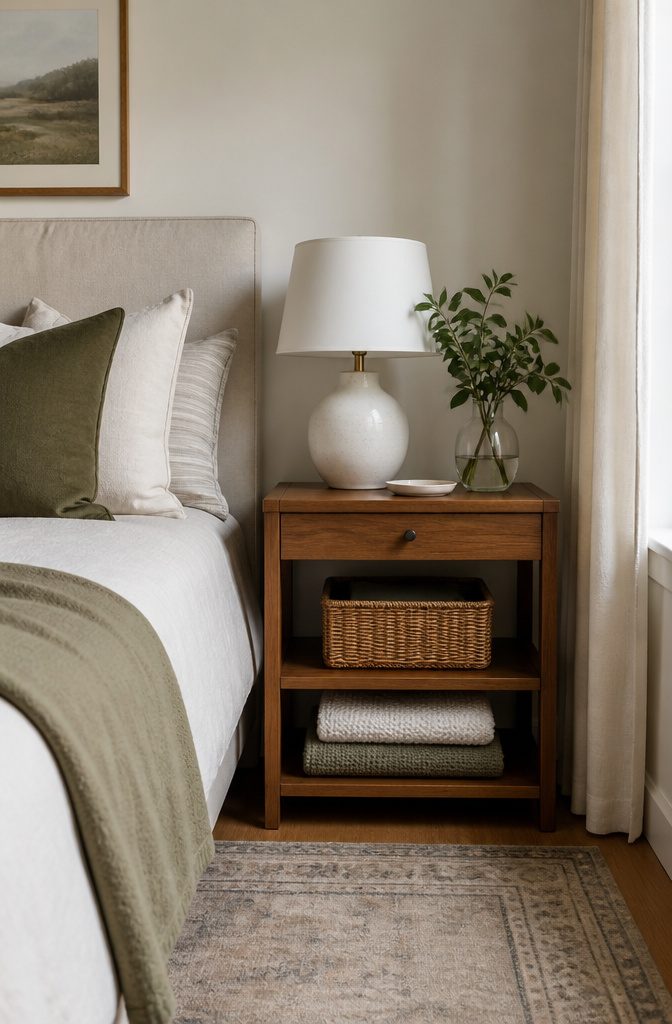
An open-shelf nightstand looks tidy for about a day, then your glasses, book, and lip balm sit right there in the open, catching dust and eye contact every time you walk in.
The drawer changes the whole equation. I bought a $79 Target nightstand with a single drawer and a small lower shelf maybe eight years ago, and it survived four moves without a wobble.
The drawer hides the mess I actually live with: reading glasses, whatever paperback I’m halfway through, two lip balms, my phone, and the charger I would otherwise kick to the floor.
The lower shelf holds a small basket for backup tissues, so even that looks intentional.
The open nightstand I had before made me feel scattered because I looked scattered. The drawer doesn’t add that much storage, maybe six inches deep, but it resets the room every morning when I push it closed.
12. Label Storage Bins
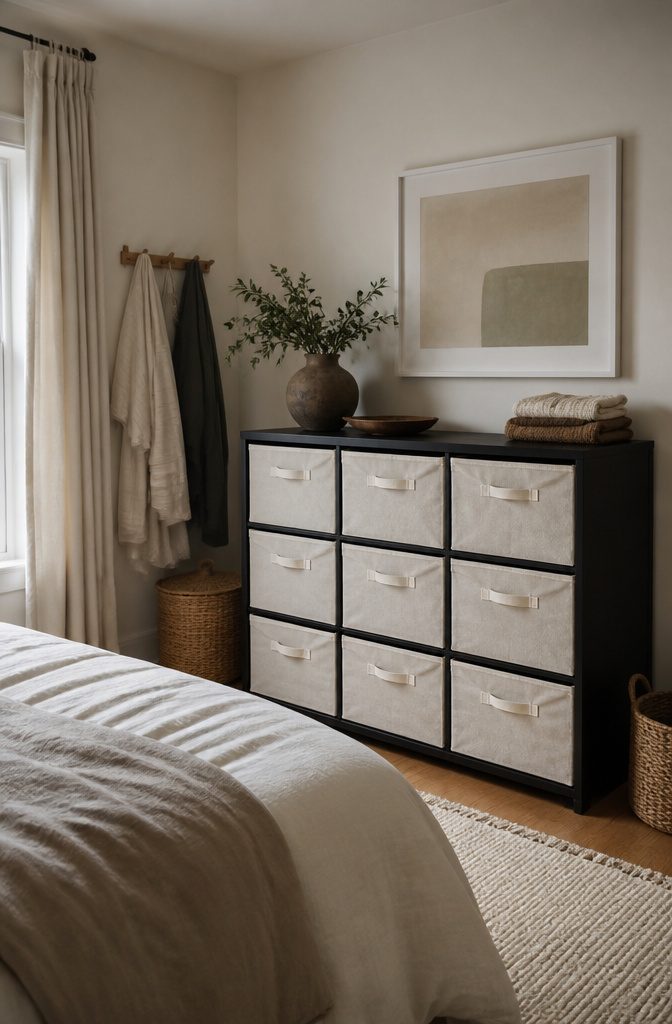
Two years ago I bought a Brother label maker for the closet storage bins.
Before that, I had been using masking tape folded over the edge and a Sharpie, and that system lasted about eight months before the edges curled and the writing smeared into a blue blob.
The label maker strips have held up through two seasonal rotations with no lifting, no fading, and no squinting.
The mistake I made, though, was labeling three bins on the long side instead of the short side. When the bins sit on the shelf in their standard orientation, the labels face the wall.
I have to pull each one out to read it, which defeats the entire point. Those three bins still hold off-season sweaters I meant to rotate last October and never found the motivation to deal with.
Label the short side of any bin that slides onto a shelf, even if it feels wrong during the first pass. That geometry determines whether you can scan or whether you handle every item twice.
The label maker itself was about thirty dollars. Tape refills run six to eight dollars yearly for a bedroom closet’s worth of seasonal rotation.
The time it saves comes back in fifteen-minute increments each changeover, which is enough to actually get the switch done on a Sunday evening instead of leaving the summer clothes in a heap for three weeks.
13. Rotate Seasonal Clothing
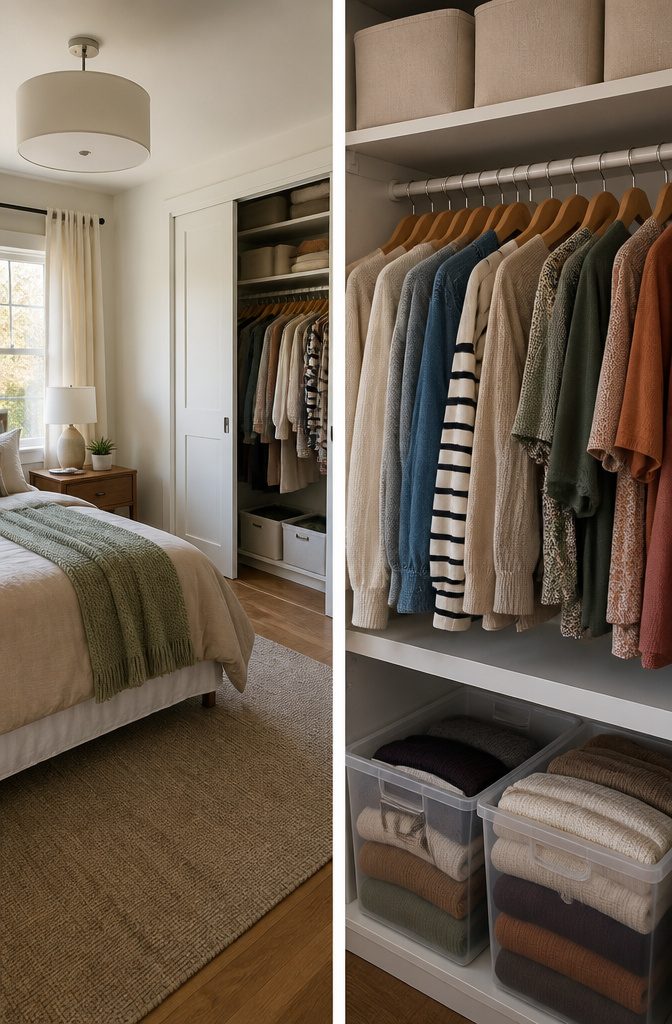
The November and April weekends I spend swapping clothes between closet and under-bed bins are the only thing keeping my bedroom dresser from overflowing.
Shallow lidded bins slide flat under the frame and hold the off-season pieces out of sight, which matters when you are working with a few hundred square feet and no walk-in closet.
I lost a charcoal cashmere sweater for two winters because it had slipped between two vacuum bags I tried first, the kind you roll to compress.
The seal failed sometime around January, the bag puffed back up, and the sweater became invisible behind a bin of summer linens.
The vacuum bags that actually work are the ones with a proper valve and a zip closure you can feel click shut; I now lay them flat, label the corner, and stack them inside the bin rather than trusting them as the bin itself.
The bins on wheels from Target, teak if you want them to look intentional, roll out far enough that I can lift the lid without dragging the whole thing into the middle of the room.
Two weekends a year, four bins, about twenty minutes per swap is the routine that keeps the morning outfit hunt under two minutes.
14. Use Slim Matching Hangers
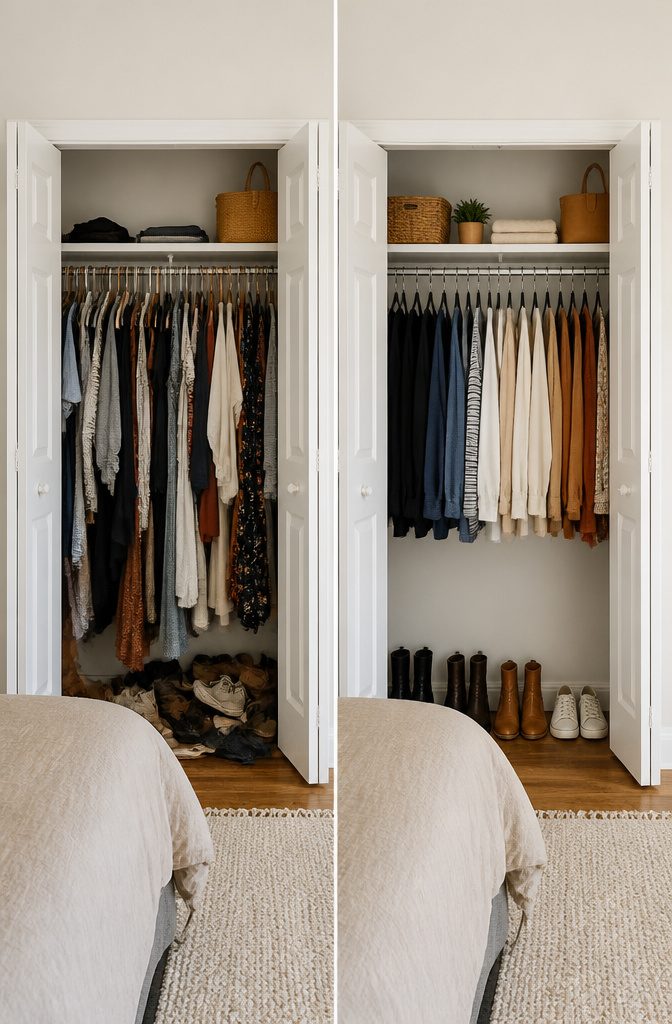
The plastic hangers I had been using since college took up more rod space than I realized until I swapped them out for 0.2-inch velvet hangers and gained a full six inches across the bar.
A 50-pack ran me $19.99, which meant the whole closet converted for under forty dollars.
Uniformity matters more than the material itself. Matching slim hangers create the visual order that makes a closet look intentionally kept rather than just not messy.
I tried color-coding by category, shirts on gray and pants on black, but maintaining the system added friction to every laundry day. The sorting stopped being worth the look within a month.
The velvet keeps clothes from sliding to the floor, which saves the space and hassle of picking up what the plastic let drop.
15. Keep Shoes Organized
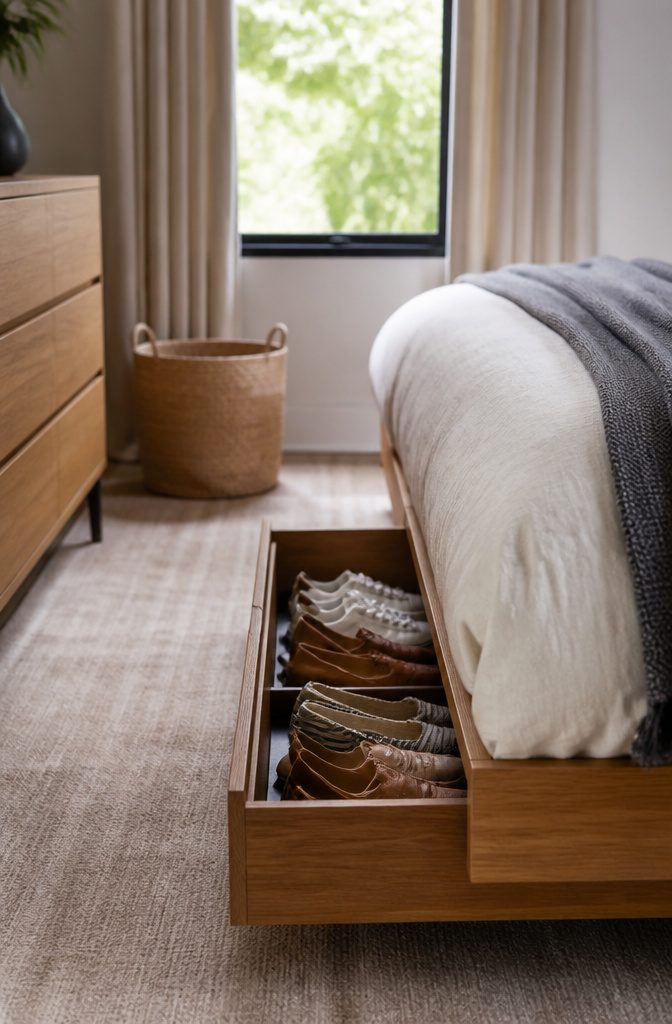
The over-door shoe rack seemed smart until the bedroom door started catching on the frame every time I opened it.
Twenty dollars and a week of irritation later, it came down. The floor pile that replaced it was worse: shoes I forgot I owned, dust collecting in the treads, the morning hunt for the right pair.
Clear boxes fixed the visibility problem; I could see the navy loafers without opening lids. What they did not fix was the math.
I had twelve pairs in my head as "enough." The actual count was thirty-four, which meant buying more boxes than planned and rethinking what deserved the prime closet real estate.
The flats I wore twice a year went to a bin under the bed. The four pairs in rotation stayed at eye level.
16. Make Your Bed Daily
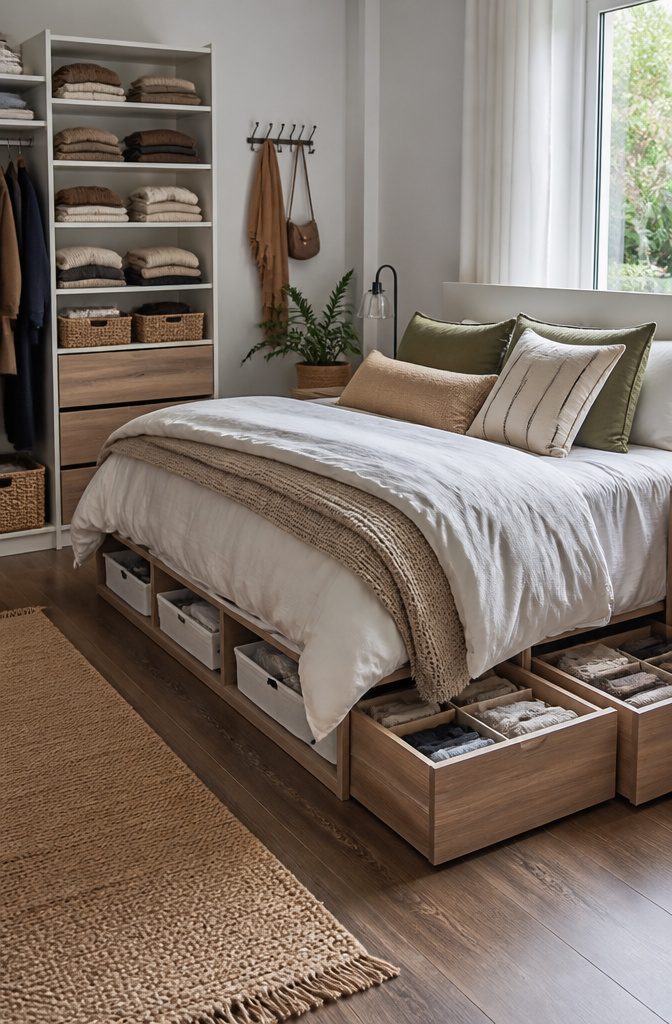
A made bed sets the standard the rest of the room gets measured against.
Once the pillows sit square and the cover lies flat, the wrinkled T-shirt on the chair or the stack of magazines on the dresser announces itself in a way it never did against rumpled sheets.
The whole habit takes about 90 seconds, maybe less once your hands learn the motion.
I used to fight the duvet every morning, smoothing and tugging at wrinkles that would not quit, until I switched to a cover with a little texture to it.
The slight crinkle reads as intentional now, not sloppy, and the bed still looks finished.
The morning it actually changed was not dramatic.
I came back from the shower, saw the bed pulled together, and noticed the nightstand next. It had three things on it instead of twelve.
The floor had only shoes, not shoes plus yesterday’s belt plus a mug. The bed had drawn a quiet line, and everything else had crept back behind it without my deciding anything.
17. Display Items Instead of Storing Them
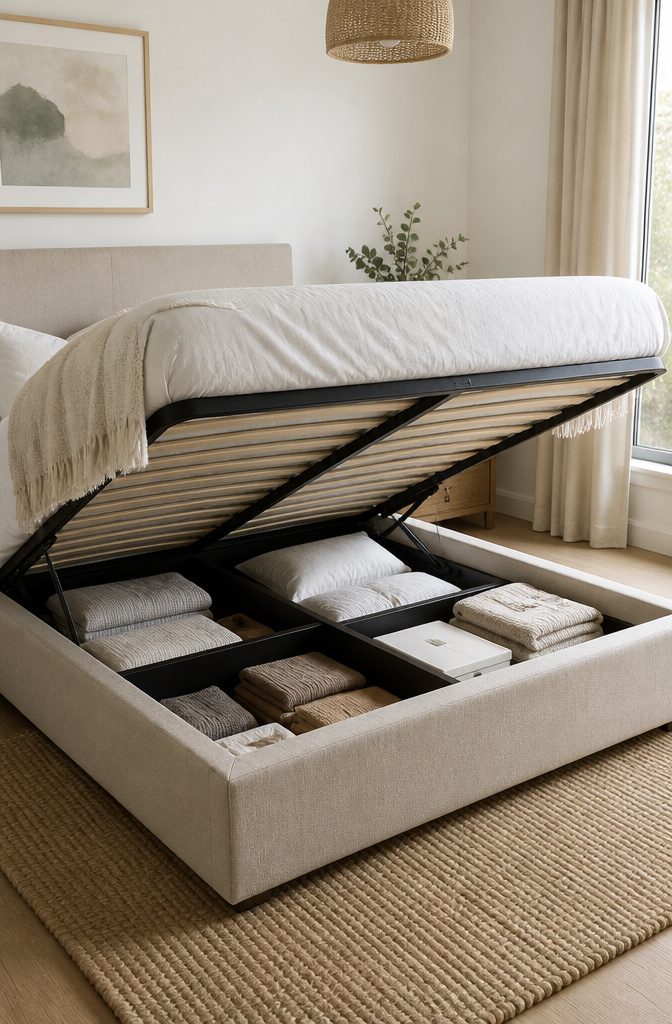
Jewelry used to live in a box on my dresser, which meant every morning started with untangling chains and fishing for earrings I could not see.
A stand-up organizer with a simple bar and S-hooks changed that. Necklaces hang in a line I can scan in about two seconds, and the whole thing reads as decoration against the wall instead of clutter on a surface.
The same logic worked for hats, which were eating an entire drawer.
I mounted a few basic hooks in a loose grid above the closet door. Baseball caps and a single wide-brim piece now cover what would otherwise be blank wall, and the drawer they freed up holds socks.
Three scarves I never wore because I forgot I owned them got folded over a short curtain rod mounted at shoulder height. The colors add something to the room, and I actually rotate them now.
The dusting tradeoff is real.
Open display collects more dust than a closed drawer. A quick weekly swipe with a microfiber cloth keeps the jewelry from going dull, but I did not factor that ten minutes in when I planned the swap.
For me the visibility still wins, but someone allergic to extra chores might prefer glass-front storage instead.
18. Rearrange Furniture for Optimal Space
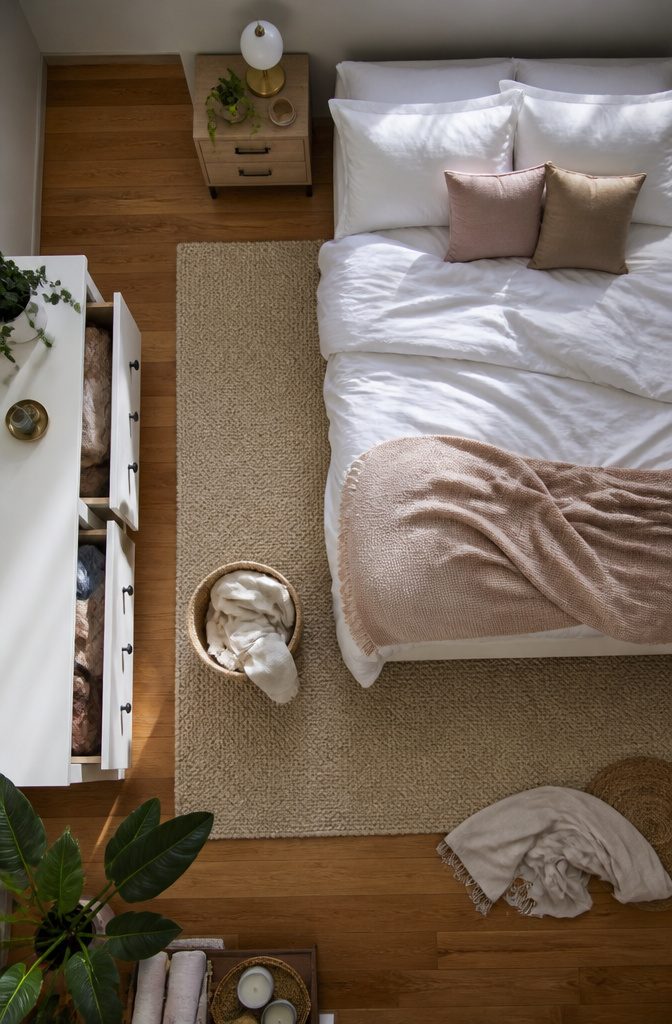
The first layout I sketched put the headboard against the 10-foot wall with the dresser opposite, which looked balanced on paper but left only 18 inches between the bed frame and the closet door.
Two more versions tried diagonal placement and a floating bed in the center of the room; both blocked the HVAC vent behind the nightstand or forced the door to swing into the mattress edge.
The 63-inch bed dictated more than I expected.
What finally worked came from a clearance rule I picked up reading older organizing manuals: 24 inches of walkable space on at least three sides for any bed you actually have to make and strip.
In the winning layout, the headboard shifted to the shorter wall, the dresser tucked into the remaining 37 inches of floor space beside it, and the foot of the bed opened directly toward the door.
The vent stayed clear, the door swung full arc, and the path from bed to bathroom became a straight line instead of an obstacle course.
I drew five layouts total.
Two failed on the door or vent test. One failed because I measured the wall without the baseboard and lost two inches I did not have.
What Organizing Actually Costs
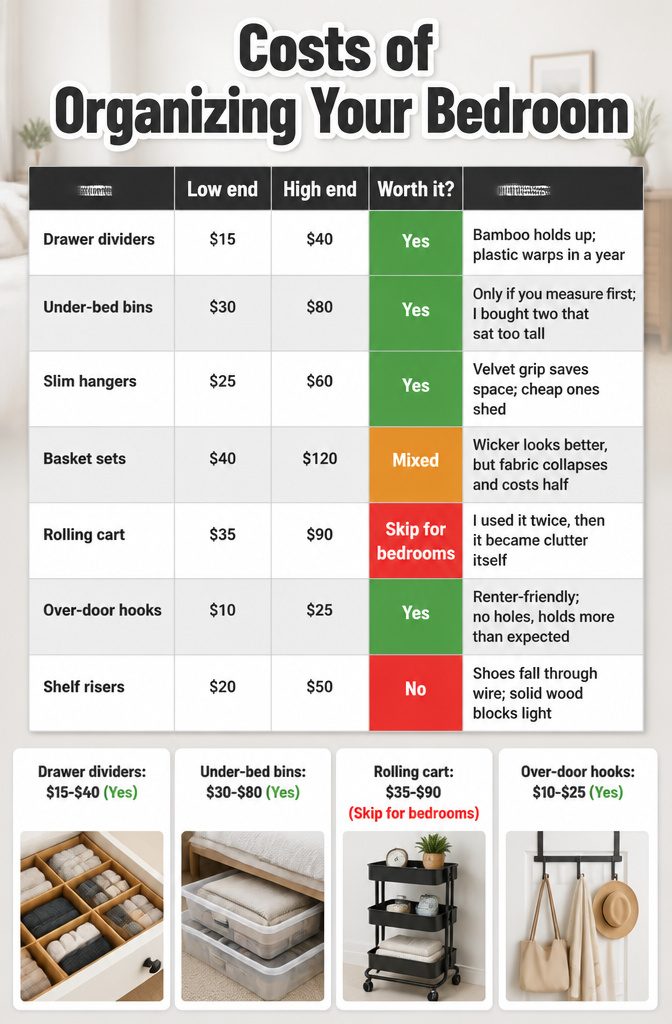
Across three bedrooms, I spent between $200 and $600 each, and the split between worth-it and skip-it was sharper than I expected.
| Item | Low end | High end | Worth it? | Notes |
|---|---|---|---|---|
| Drawer dividers | $15 | $40 | Yes | Bamboo holds up; plastic warps in a year |
| Under-bed bins | $30 | $80 | Yes | Only if you measure first; I bought two that sat too tall |
| Slim hangers | $25 | $60 | Yes | Velvet grip saves space; cheap ones shed |
| Basket sets | $40 | $120 | Mixed | Wicker looks better, but fabric collapses and costs half |
| Rolling cart | $35 | $90 | Skip for bedrooms | I used it twice, then it became clutter itself |
| Over-door hooks | $10 | $25 | Yes | Renter-friendly; no holes, holds more than expected |
| Shelf risers | $20 | $50 | No | Shoes fall through wire; solid wood blocks light |
The rolling cart was my clearest mistake.
It seemed flexible, but bedrooms do not have the traffic pattern that makes wheels useful. I moved it to the bathroom eventually.
Small Bedroom Math
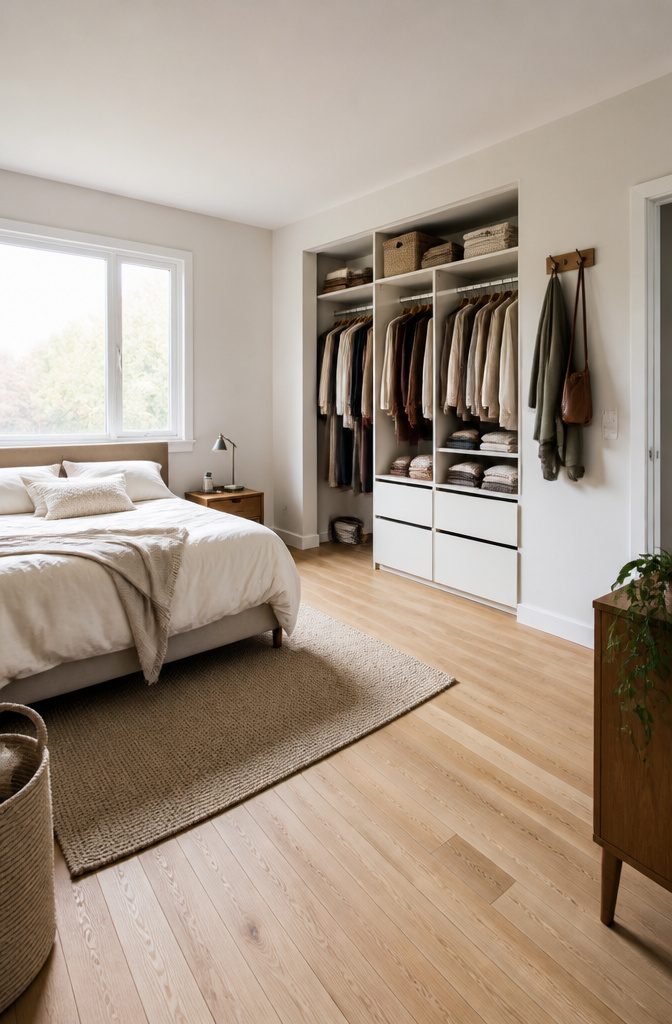
My first apartment bedroom was 70 square feet, and that number dictated every purchase.
The bed had to be a full, not a queen. The dresser became a narrow three-drawer unit that slid into the closet, because floor space was the one thing I could not manufacture.
What surprised me was how much the same math applied when I later had 120 square feet, then 200. The proportions change, but the priority stays identical: circulation space around the bed.
I measure from the mattress edge, not the frame, because that is where your shin actually travels at 11 p.m.
Thirty inches on at least one side lets you make the bed without climbing onto it, and that is the difference between a room that functions and one that merely holds furniture.
In the 70-square-foot room, I had 26 inches and paid for it with bruised knees for two years.
At 120 square feet, I held out for 32 inches and the room felt larger despite holding the same bed. The extra six inches cost me a wider nightstand, which was the correct trade.
In 200 square feet, the temptation is to add a bench or a second dresser, but I would rather keep that circulation zone and use wall-mounted storage above head height.
The floor area around the bed is what makes a bedroom feel like a bedroom instead of a storage unit that happens to contain a mattress.