

I grab the bottom rail, that sleek weighted bar at the base, and push up, feeling the spring-loaded tension inside the headrail engage like tiny invisible hands catching my shade. When I stop, an automatic brake locks it tight, with no cords dangling and no knots wrestling back.
To lower, I tug down gently with the same resistance and same control at any height I want, whether halfway or barely cracked.
Motorized versions hide rechargeable batteries up top for remote operation.
The mechanism is elegant and safe, providing smooth operation compared to traditional corded blinds.
How to Raise and Lower Cordless Blinds

I’ll never forget the first time I grabbed my cordless cellular shade, pushed up, and nothing happened. I yanked harder, panicked, then laughed when I finally learned the gentle secret. To raise and lower cordless blinds, you don’t pull chains or twist wands. You simply grasp the bottom rail, push up to raise, pull down to lower. This intuitive design works through a spring-loaded internal mechanism inside the headrail, a tension system that winds and raises with your touch. When you stop, the brake engages, holding your shade exactly where you want it. The sleek bottom rail contains a weight bar for stability, keeping everything straight and smooth. There are no tangles, no frustration, just effortless operation that makes sense.
How Cordless Blinds Lock at Any Height

How exactly do cordless blinds stay put when you let go halfway up the window? The answer lies in the lift mechanism.
That weight bar inside your bottom rail works with an internal brake or clutch to create tension. When you position the blind where you want it, such as halfway for afternoon light, the brake engages automatically. No fumbling, no cords, just a secure lock that holds firm.
Whether you’ve got a motorized lift or manual control, that internal system knows when to grip. The springs and clutch work together so your blind stops exactly where you left it, every single time.
How Cordless Blinds Work Without Visible Cords

Where do all those cords even go? The answer lies in the engineering of cordless blinds. The internal lift system lives in the headrail, while the bottom rail provides a grip point for manual operation. This design eliminates dangling strings and tangled messes, creating a clean, cord-free appearance that enhances any room’s aesthetic.
When you lift or lower cordless blinds, the tension mechanism and internal brake engage, locking the shade at your desired height. This system functions like an internal elevator mechanism. Motorized cordless options offer app-controlled operation while maintaining the same cord-free design and clean appearance. Once installed, cordless blinds provide both functional and visual benefits that users consistently prefer to traditional corded alternatives.
Your Control Options: Push, Pull, or Motorized
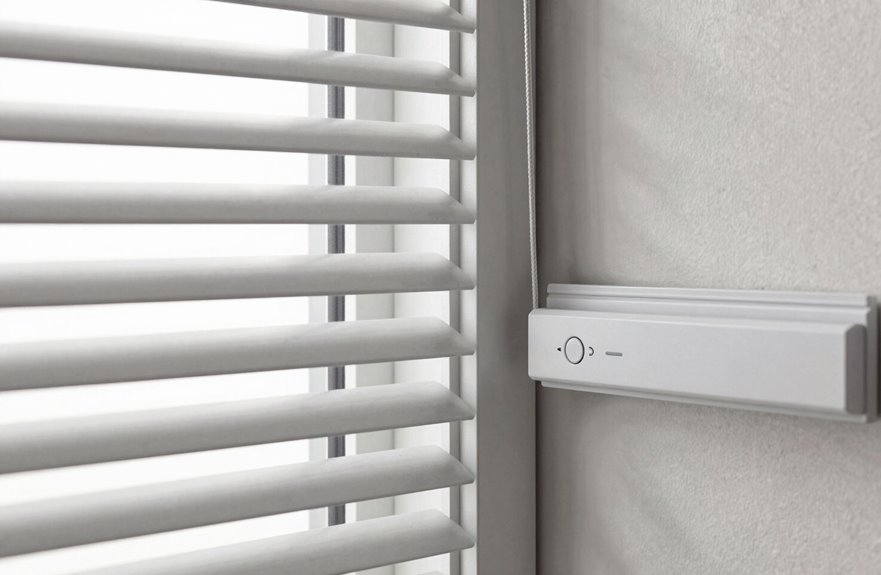
I used to wrestle with tangled cords like it was my morning workout, but now I just lift the bottom rail with my fingertips, feel the spring catch, and achieve perfect golden-hour light. You can also tug down to lower them, or if you prefer, tap a wall switch and watch them glide up while you’re still holding your coffee. Motorized or manual options are both available, and both deliver satisfying results.
Push-Pull Operation
Fumbling with tangled cords feels outdated. Cordless blinds eliminate this frustration. You grab the bottom rail, push up to raise, and pull down to lower.
Inside the headrail, a spring-loaded tension mechanism manages the movement. This mechanism works like a silent bouncer, holding your blind exactly where you want it. It releases when you need movement, then locks when you stop. Manual operation feels satisfying and responsive.
The tension mechanism spreads evenly, so no lopsided sagging occurs. You can hold coffee in one hand and adjust blinds with the other. This simplicity delivers practical benefits.
Motorized Control
Push-button convenience transforms my lazy Sunday mornings into something straight out of a sci-fi flick. My motorized cordless blinds run on a rechargeable battery tucked discreetly inside the headrail. USB-powered and wireless, they require no electrician and eliminate dangling cords.
I grab my remote, tap the wall switch, or bark commands through Alexa, and that tiny motor whirs to life. Raising, lowering, precise positioning; my windows become stage curtains responding to my whim. Control4 syncs every room into automated scenes, such as “Movie Night,” which drops them all at once.
The practical downside exists: I’ve been caught twice with dead batteries, stranded mid-lift, fumbling for the manual pull that doesn’t exist. Regular recharging prevents this frustration.
When to Upgrade to Motorized Cordless Blinds

Why settle for yanking chains when you could be sipping coffee, tapping your phone, and watching your shades glide down like they’re auditioning for a sci-fi film? I upgraded my cordless blinds to motorized blinds last year, and I won’t go back.
Here’s when you know it’s your moment:
- You’ve got hard-to-reach windows behind furniture (I’m looking at you, loft skylight)
- Safety matters. No cords means reduced hazards for kids or pets
- You’re craving smart home integration and scheduling sunrise scenes from bed
- You’re done wrestling with manual control methods
My rechargeable batteries last for extended periods. Check installation compatibility, pick your remote control or app, and make the switch. Motorized blinds eliminate the friction from daily window treatments.
Best Windows for Cordless Blinds
I’ve installed cordless blinds on everything from tiny bathroom windows to sprawling living room sliders. Not every window works well with the same system. Standard and mid-width windows function excellently for cordless setups, especially when little hands or curious pets are around. However, large picture windows require more than spring tension alone; motorized options are more practical in these cases. For hard-to-reach spots above sinks or behind bulky sofas, motorized cordless blinds eliminate the need to stand on tiptoes or fish for a bottom rail.
Ideal Window Sizes
For windows that truly shine with cordless blinds, matching the mechanism to your space is essential, like pairing the right shoe to an outfit without the stress or blisters.
Size guidelines matter when selecting cordless blinds. Here’s what actually works:
- Small windows (under 36 inches) work well with a simple bottom-rail lift; push up, pull down, done.
- Medium windows (36–72 inches) are the sweet spot for most cordless blinds, requiring no motor.
- Wide windows (over 84 inches) need motorized shades or split sections.
- Always check your window recess depth. Ignoring this measurement can create headrail installation problems.
Pick what fits your space and you’ll have a functional solution that works for your home.
Reach and Accessibility
Where do your arms actually reach when you’re fumbling for that bottom rail at 7 a.m., still half-asleep and clutching your coffee? We’ve all been there, stretching awkwardly while that cordless lift sits too high up.
Accessibility works best with standard window sizes, where that bottom rail sits comfortably within arm’s reach. The tension mechanism holds firmly, giving you easy operation without awkward stretching. When windows exceed standard heights or stretch wider than 84 inches, adjusting them requires significant physical effort. I’ve nearly spilled my drink more times than I’ll admit.
Motorized cordless systems eliminate these challenges. No maintenance required, no stretching necessary. For deep-set windows or tricky trim, measure twice to ensure smooth reach and daily convenience.
Window Style Compatibility
How do you match a blind to a window with distinctive architectural features? Flat blinds under 84-inch widths work best for cordless options, eliminating installation complications.
Window style compatibility works as follows in practical applications:
- Roller shades & cellular shades provide clean lines that coordinate with modern window frames.
- Faux wood blinds offer classic aesthetics without cord management issues, suitable for kitchen spaces.
- Top-down bottom-up shades benefit tall windows by allowing independent control of light and privacy at different heights.
- Motorized cordless options serve hard-to-reach windows without requiring furniture-based access methods.
Large openings require vertical cordless blinds, which operate effectively with sliding glass doors.
Common Cordless Blind Problems and Fixes
The appeal of cordless blinds fades quickly when the tension system goes slack, leaving the bottom rail sagging at uneven heights. Remove the headrail gently, tighten the internal mechanisms with a flathead screwdriver, or replace worn springs to restore proper function.
Motorized cordless shades fail when batteries deplete at inconvenient times. Keep spare lithium batteries readily available for immediate replacements. Ladders inside the shade may peek out and ruin the sleek appearance; carefully tilt them back into position.
Bottom rail sticking from dust accumulation requires monthly vacuuming of tracks. Spring tension loss can be addressed by manually stretching and resetting the springs. Regular maintenance prevents these common failures.
How to Maintain Cordless Blind Mechanisms
Fixing a sagging bottom rail feels great, but I’d rather not do it every month. Cordless blinds thrive with just a little maintenance, and window treatments that function reliably are worth the effort.
Here’s my maintenance routine:
- Dust weekly – I swipe the bottom rail and headrail with a microfiber cloth, keeping that tension system grit-free.
- Spot-clean fabrics – Never submerge anything; moisture wrecks spring-loaded and motorized mechanism interiors quickly.
- Check battery-powered units – I mark my calendar for charging; dead batteries mid-adjustment prevent unnecessary frustration.
- Test motion monthly – Gentle up-and-down movements keep smooth operation functioning as designed.
Regular maintenance prevents costly repairs and keeps your cordless blinds operating smoothly for years.
Cordless Blinds: Safety, Style, and Smart Features
During my first nursery renovation, I discovered cordless blinds eliminate strangulation hazards. That safety benefit improved my confidence in the nursery environment.
The lift mechanism is tucked inside the headrail or bottom rail. You simply push up or pull down that bottom rail, and the tension system locks everything exactly where you want it. There’s no sagging or fuss. My spring-loaded ones glide smoothly.
Motorized options offer significant convenience. I control mine with a remote control while holding coffee. The child-safe credentials align with safety standards that many parents prioritize.
The smart features integrate with Alexa for voice-activated control. These blinds can be operated hands-free through voice commands.