
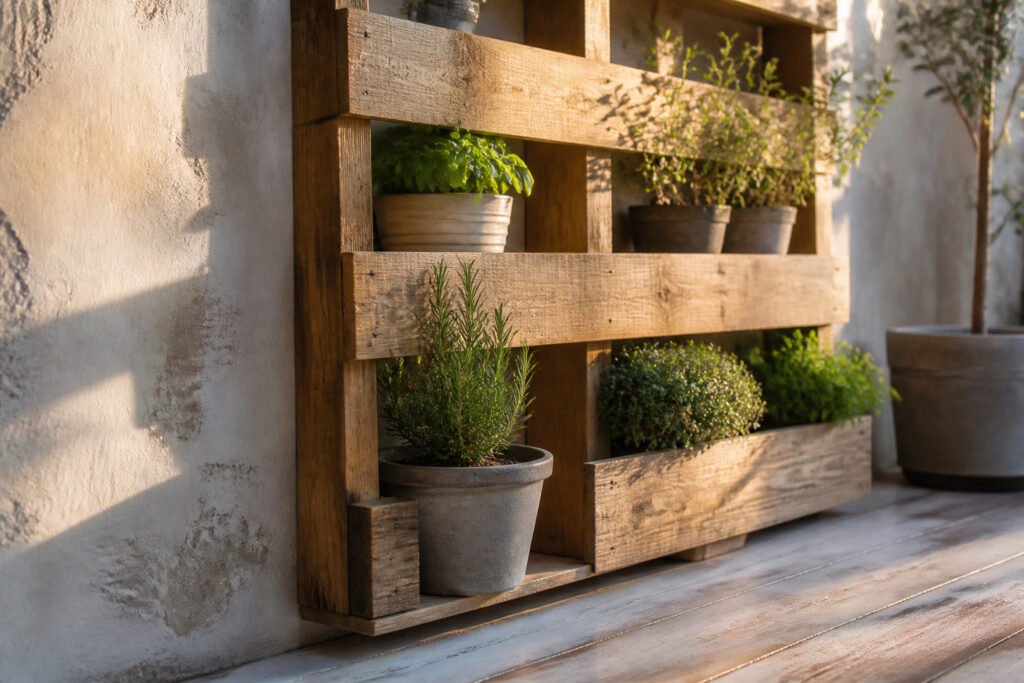
1. Tool Storage on a Wall or Leaned in the Corner
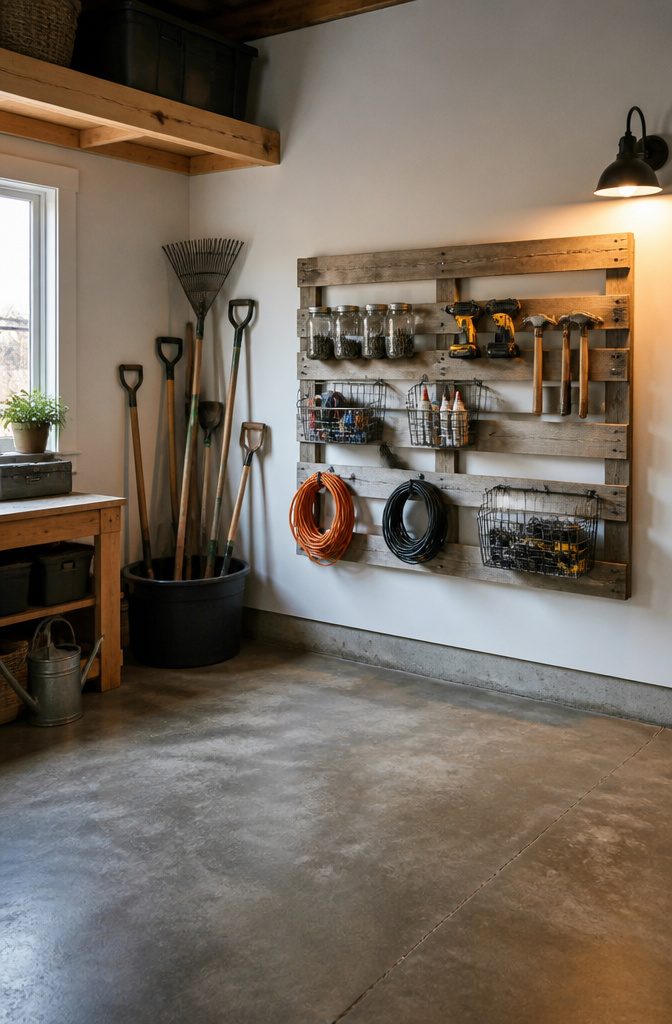
A full pallet screwed to garage studs at all four corners turns into open shelving for jars of fasteners, drills, and hammers.
S-hooks at any height let you hang baskets of tape and glue or larger gear like extension cords, keeping the floor clear without building anything custom.
The same setup leans against the wall if you rent and cannot drill, though it needs a corner or a heavy anchor against tipping when you pull a shovel free.
Leaning works better for long-handled yard tools, rakes, and brooms that do not fit the shelf spacing. Wall-mounted wins for smaller items you grab often; leaned suits the bulky stuff you haul out twice a month.
Pallets run free behind hardware stores and groceries if you ask, or about $10 from certain online sellers. Either way, check that the boards are sound and the nails sit flush before you load it up.

HEAVY-DUTY GARAGE TOOL ORGANIZER: Revolutionize your garage with this wall-mounted storage hero! Designed to hold shovels, brooms, power tools, and more, it can support up to...
2. Kitchen Racks for Pots, Pans and Spices
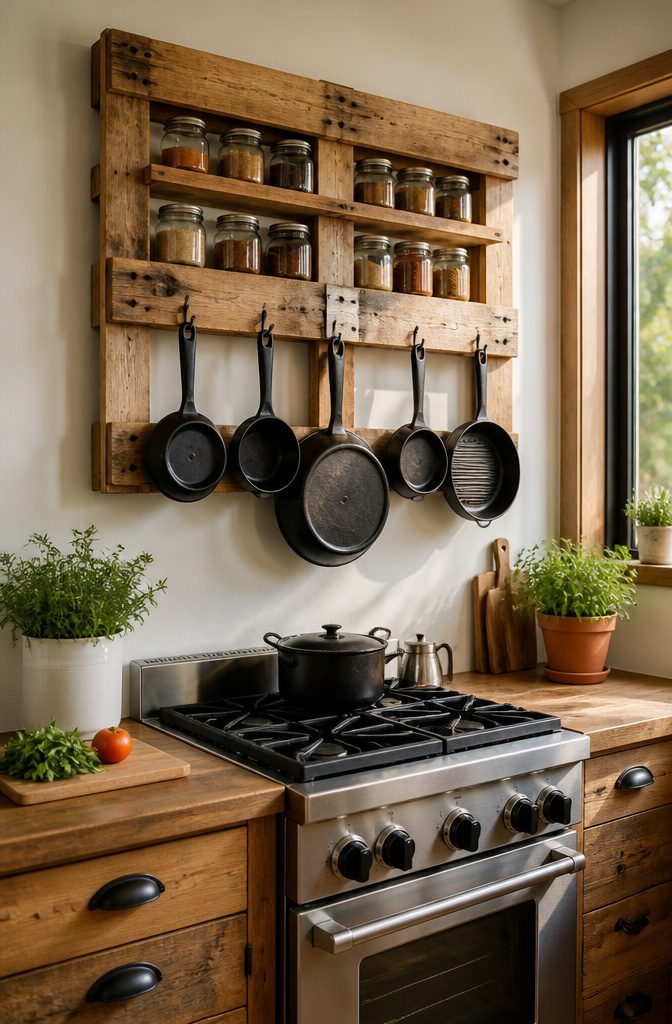
Kitchen wall space above the stove or beside the fridge is usually where clutter lands first.
A pallet section mounted there turns that dead zone into a rack sized to the actual gap you have, not to a store-bought dimension that leaves two inches of wasted space on each side.
The pallet stays whole for this one, which saves a step. Pots and pans hang from hooks screwed into the middle planks; the outer frame boards keep everything from sliding off when you reach past for the colander.
For spices, shallow mason jars or oil bottles fit between the slats with a small L-bracket shelf added underneath.
One variation runs the pallet vertically beside a cabinet for a narrow herb garden, jars hung from the front face so the plants get window light without eating counter depth.
Hand tools handle the cuts if that is what you own. A handsaw and a drill are slower than a miter saw but entirely enough; the video proof of that matters more than the tool brand.
Sanding is worth the half hour, because splinters in a kitchen rack are a problem you notice every morning. Paint or stain after sanding, or leave it raw if the kitchen already has enough wood tones competing.
The real decision is how many hooks versus how many shelves. Heavy cast iron needs the center of the pallet, where the support hits studs.
Light spices can ride the edges. Map that out before the first screw goes in, because a rack that lists under a loaded skillet is a rack you stop using.

【Decorative】 The kitchen utensil hanger comes in beautiful quality and color, simple and stylish, adding an elegant look to your space.

Elegant and Practical Design - Combines a storage shelf with two-tier hanging bars, this wall mount pot rack not only organizes pans, pots, spice jars, and bakeware but also enhances any kitchen decor with its simple, stylish design.(pots pans not included)

High Quality - Constructed of heavy duty iron and coated with environment-friendly matt paint to avoid rusting, maximum loading capacity can up to 30lb. Attractive and sturdy.
3. Backyard Storage for Garden Tools and Planters
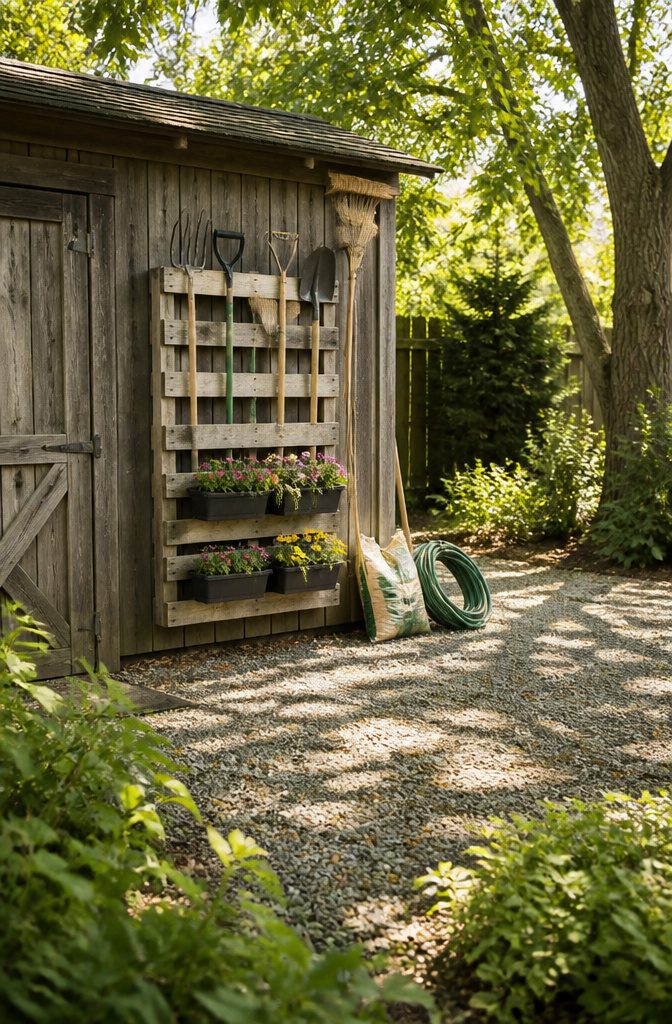
Outdoor pallets rot fast unless you treat them like exterior lumber. I learned that the hard way with a hose caddy that turned gray and splintered inside two seasons.
Now anything that sits in the yard gets the same finish I’d put on a fence: exterior-grade paint, outdoor stain, or a sealant. The choice matters less than doing all six faces, including the ends where water wicks in.
A vertical planter needs sides on each shelf if you want it to hold soil rather than just pots.
I like the three-box design spaced up two uprights: line the boxes with membrane, fill with soil, and you have herbs or salad greens in a footprint under a square foot.
The same frame works for pool noodles and cleaning tools if you skip the liner and leave the shelves open.
For gardening gear, a pallet leaned against the shed wall with the slats horizontal gives you instant slots for long-handled tools.
Turn the slats vertical and screw on a couple of scrap-wood ledges, and you have a home for gloves and a hand trowel.
Either way, the bottom slat needs to sit on pavers or gravel, not soil, or it turns into a moisture bridge that rots the whole piece from the ground up.

SET INCLUDES: 1 rotating spice rack and 16 jars with removable sifter and labeled caps

COMPACT – Our spice rack has a narrow profile even though it holds 20 jars. It only measures 13.5"H x 7.5"W x 7.5"L. It’s a huge space saver and a great way to organize your spices inside your cabinet, shelf, pantry, or counter.

Durable glass bottle bodies is one-piece, resistant to temp range from -20℃ to 150℃ , dishwasher safe to daily use for kitchen cooking. The acacia wood lid have passed 500 times of open-close test - no loosening, no cracks, better than normal materials, say goodbye to the hassle of frequent replacements.
4. Living Space Furniture With Hidden Storage
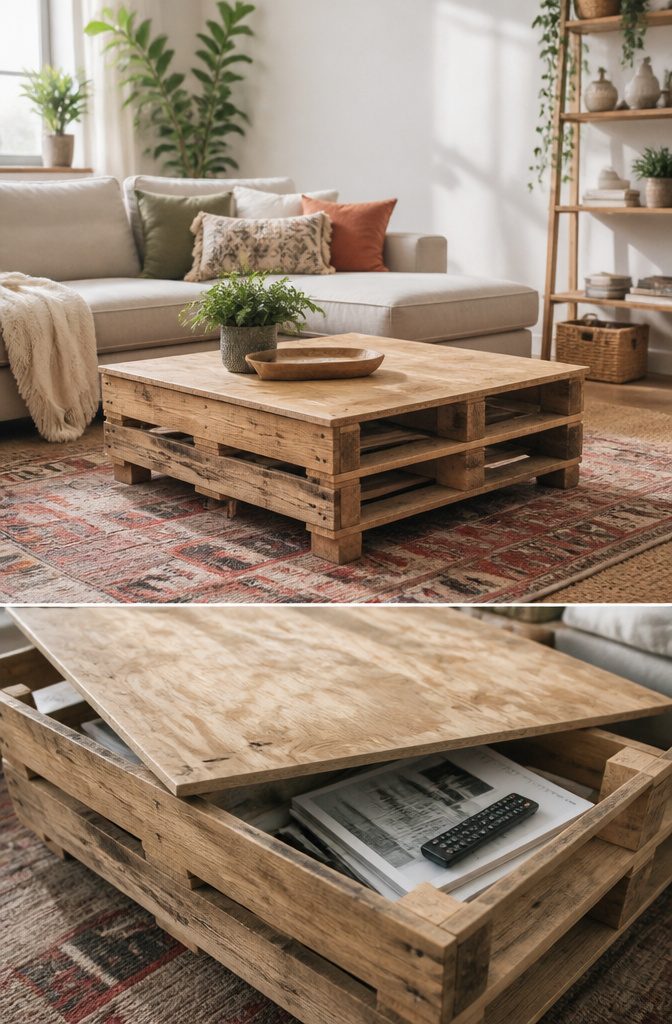
Pallet coffee tables with built-in storage work best when you keep the pallet intact and add a shallow box on top.
The slats already create natural gaps; line the underside with thin plywood and you have a compartment for magazines or remotes that stays hidden until someone lifts the lid.
Casters raise it to standard coffee table height and let you roll it aside when you need floor space.
For entryways, a single pallet stood on end becomes a coat rack with a shelf. The bottom slat stays horizontal for shoes or a mail basket, while hooks screwed into the top crossbeam hold coats and keys.
The weight sits low enough that wall anchoring is optional in most rentals, though a pair of L-brackets against the baseboard keeps it from tipping if you load the hooks unevenly.
Pallet wood is free or runs under $20 per unit ordered online, so a failed cut costs you an afternoon, not a budget. Paint or stain covers the mismatched boards; the variation in grain becomes texture instead of a flaw.

BUILT FOR RESISTANCE: This barrel planter is made from high-quality resin, offering excellent weather resistance. Moreover, the planter is waterproof, preventing issues like cracking, fading, and leaking, ensuring long-lasting durability.

Solid Fir Wood Construction for Long-Lasting Durability: Crafted from solid fir wood, our square planter boxes feature a naturally weather-resistant finish that withstands outdoor elements year-round. The rich, unique wood grain adds a warm, rustic charm to any space, making it the durable choice for growing flowers, herbs, vegetables, and succulents, while blending seamlessly with patio, garden, or porch decor.

🌼Folding Design & Easy Setup🌼 No tools or accessories required. So simple its structure it is that there is no need to worry about how to put all parts together. By following the detailed instruction, just need unfold the frame and put the bottom panel into the planter. More, folding design makes the wooden planter box easy to store and save much space.
5. Toy Bins and Sports Equipment Racks
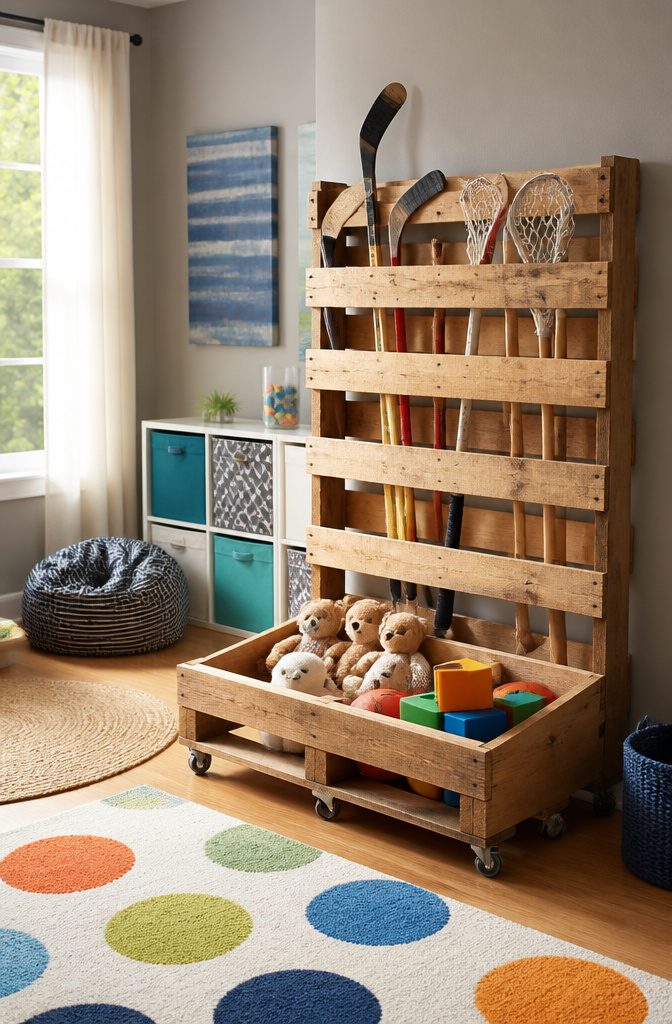
Kids leave a trail of stuff that shifts by season, and a pallet cut in half gives you two ways to follow it.
Mount one half vertically against the wall and slide hockey sticks, bats, or lacrosse sticks straight through the slats like a tool rack scaled down.
Add a couple of hanging baskets for balls and small gear, and the same footprint handles both the daily dump and the weekend sport.
The other half works better flat, maybe on casters, as an open bin for stuffed animals, blocks, or the doll collection that migrates between rooms.
I like that nothing latches; a three-year-old can put their own mess back, which matters more than it looking catalog-tidy.
If you want the project to take the whole weekend instead of an afternoon, break the pallet down completely and build a lidded chest.
The wood is already free or low-cost, so the only real expense is hardware and whatever paint color gets the kids to actually use it.

【35 Slots and 6 Side Hooks】This garden tool organizer uses vertical slots to keep rakes, shovels, brooms and other long-handled tools upright, while side garden tool hangers organize hand tools and accessories for compact garden tool storage.

Multifunctional Garden Tool Organizer: Garden tool storage can organizes up to 50 garden tools, including yard tools, farm tools, lawn tools, and cleaning equipment etc. Provide large capacity in a compact size. It simplifies tool storage and organization. Height-adjustable feet suitable for uneven ground. Suitable for garage, garden, shed, outdoors and backyards

Generous Storage Capacity: The garden tool storage is equipped with 35 square slots, which are suitable for I-handle tools such as shovel and rake; garden tool rack equipped with 11 hooks, it is easy to hang accessories such as water pipes, pruning shears, axes, etc
6. Custom Shelving Units for Any Room
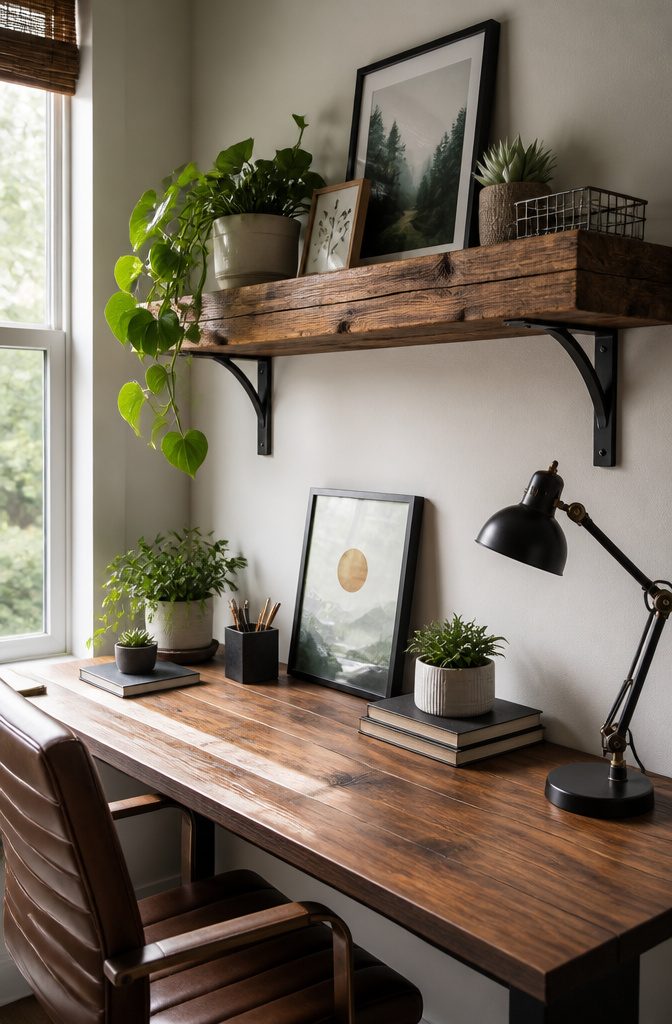
Disassembled pallet planks and basic shelf brackets make the simplest floating shelf you can build. Sand the boards, stain or paint them if you want, and mount the brackets to the wall.
Some pallet planks run narrow, so you may need to screw two pieces together with perpendicular supports across the back to get a usable depth.
If you would rather skip the teardown, a section of the original pallet frame works as a ready-made ledge. Cut off a portion, add a bottom plank, and you have a slim shelf with a built-in front guardrail.
That lip keeps cookbooks or small planters from sliding off, and the rustic profile sits well in a kitchen or above a desk.
Freestanding units take more time but give you full control over height and span. Frame up sides from pallet stringers, slot planks in as shelves, and paint the whole piece to match the room.
A wall-mounted system using the same plank-and-bracket approach scales to whatever wall space you have; two narrow planks joined beat one that sags under weight.
The cost stays low because the wood is free or close to it, and a weekend is enough for any of the three.

4-Outlet Power Strip:This garage shelf wall mount features an integrated 4-outlet power strip with a 6.5-foot cord for easy charging. Charge your tools directly on the shelf without the hassle of searching for outlets. By combining storage and functionality, this tool rack saves space while ensuring your power tools are always ready for use.

All Metal Material: Our garden tool organizer, both backboard and hooks are made of iron, which makes it more durable and solid.And its load-bearing capacity far exceeds other usual ABS material tool hooks. It is deal for various tools like shovel, rakes, bikes, broom, mop, trust that what you get is what you see,any dissatisfaction please contact our customer service team

Adjustable and Removable Bins Are Color Coded for Easy Organization of Parts and Tools
7. Decorative Wall Pieces With Storage Built In
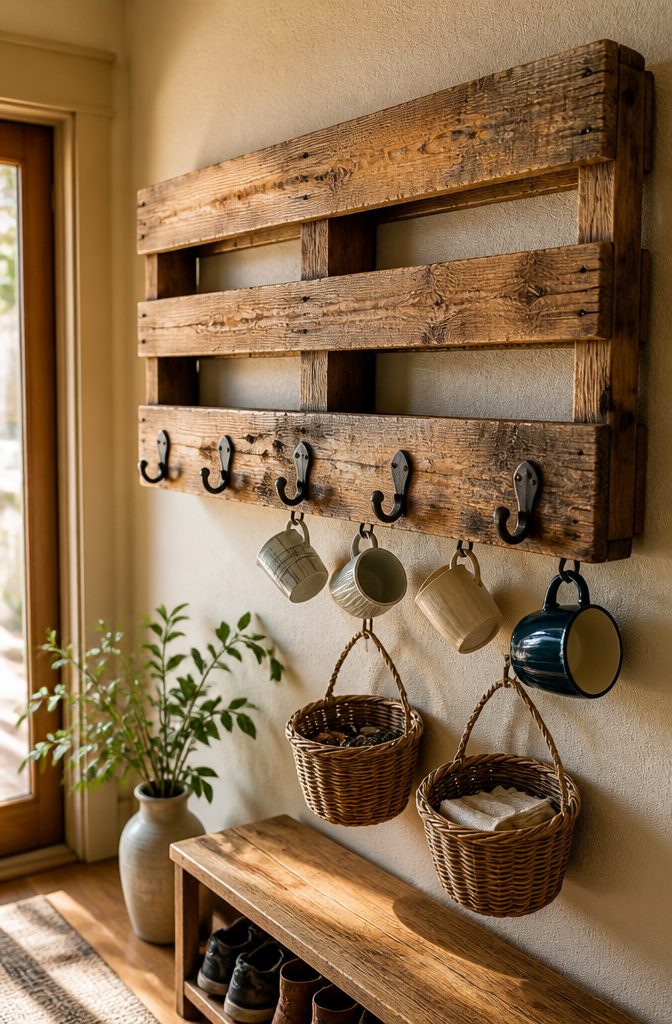
A full pallet hung flat on the wall becomes rustic wall art that actually holds your stuff.
Decorative hooks turn it into a mug holder; farmhouse cast iron coat hooks run about $18.95 for five, ornate vintage wall hooks about $21.99 for four, or brass bath hooks from the Magnolia line at Target at $4.99 each if your kitchen leans cleaner.
The pallet stays whole, so the project takes an afternoon, not a weekend of deconstruction.
The same idea scales to bookshelves or display ledges. A pallet cut in half mounts vertically for slim book storage in a kid’s room or your own magazine stack.
Hooks underneath hang baskets for the loose items. For sports gear, lean the pallet against the garage wall and slide hockey sticks, lacrosse sticks, or baseball bats straight into the slats.
No hardware needed, no holes in the rental wall. The look is deliberate roughness, not unfinished; leave the stamp burns and let the wood age.

【Classic Pipe Bar Design】Trendy industrial pipe bar design in matte black color; easily blend into any kitchen decoration styles. What you will receive: set of two 21 inches pot hanging rail with total 10 S hooks included for hanging pots and pans on wall. (mounting hardware for solid/concrete wall included.)

CLOSED LOOP HOOKS: The 10 sliding hooks feature a closed-ring design so loops will not fall off when you grab pans; they rotate 360 degrees for smooth access

<b>DO NOT COME OFF</b>:These s hooks are perfect for wire rack of shelves.Unlike regular S hooks that have equal size hooks at each end, these have a tight enough hook portion so that the hooks do not come off the wire shelf when you lift stuff out of the grocery bags.Also there is a wide hook for hanging items.
How to Read Pallet Markings for Safety
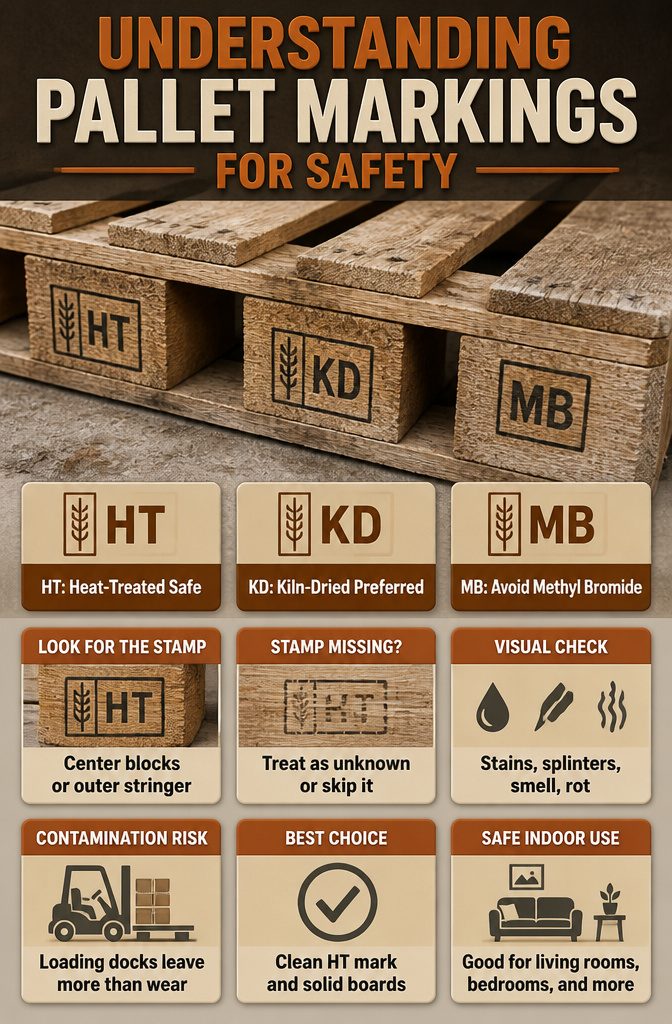
Pallet markings tell you whether the wood is safe to bring indoors, and most people walk right past the stamp without looking for it.
HT means heat-treated and KD means kiln-dried; either one is what you want for a project that sits in your living room or bedroom.
Skip anything marked MB, which means methyl bromide, a chemical treatment that does not belong in enclosed spaces where you store clothes, toys, or kitchen items.
The stamp itself is usually inked on one of the center blocks or the outer stringer, sometimes faint enough that you need to brush sawdust off to read it.
If the marking is worn away or missing entirely, treat the pallet as unknown and either pass on it or limit it to garage or outdoor use.
Even a properly marked pallet needs a visual check. I look for dark stains that might be oil or something less identifiable, splintered boards that will snag fabric, and any smell of chemicals or rot.
A pallet that has been dragged through loading docks for years can carry contamination the stamp never accounted for. When in doubt, a pallet with a clean HT mark and solid boards is the one worth hauling home.

3-Tier Wall-Mounted Spice Rack – Maximize kitchen or pantry space with this vertical wooden organizer, designed to hold up to 18 spice jars. The wall-mounted design keeps countertops clear while providing easy access to all your spices.

A Complete Spice Tools Set - 4 x Spice Rack, 24 x Square Empty Glass Spice Jars,386 Spice Labels, 1 x Collapsible Silicone Funnel, 1 x Chalk Marker

Organized and Accessible: The spice rack's 4-tier design and quick-find labels make it easy to view and access all your spices, helping to effectively sort and organize your spice collection and reducing time spent searching for the right one during cooking.
Where Pallets Come From and What They Cost
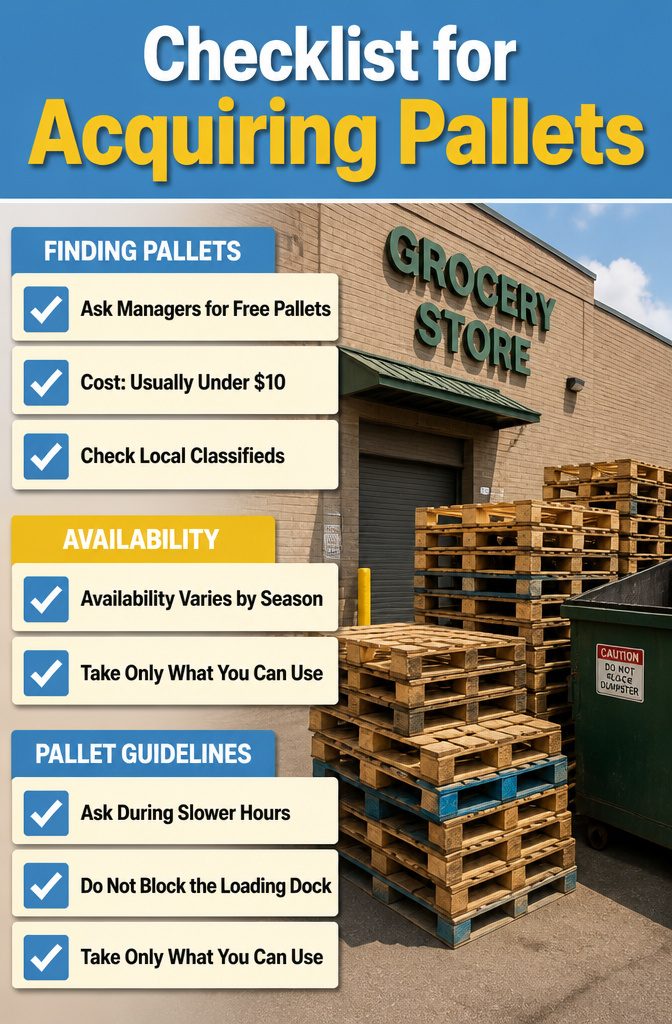
Pallets sit behind grocery stores and hardware stores more often than most people notice, and the ones that do not get returned to a pooling service are usually free for the asking.
I have walked through back lots where a dozen or more were stacked against a dumpster, and the only cost was the slight awkwardness of asking the manager.
Some businesses do sell them, though online listings or local classifieds rarely go above $10 per pallet, so even paid sources stay within a weekend-project budget.
Availability changes by location and season. A store receiving weekly produce shipments may have a steady pile, while a small hardware store might only generate two or three a month.
The etiquette is straightforward: ask during slower hours, do not block the loading dock, and take only what you can use. Pallets marked for return to a supplier, usually the cleaner, newer ones, are not up for grabs.
The worn ones with a few cracked boards are the ones typically free to leave, and those boards are perfectly fine for storage projects where you will be cutting and sanding anyway.

Wooden Material: Made of wood with a sturdy and stable frame, these planter boxes are suitable for everyday use and bring a rustic style to desks, shelves, patios, balconies, and garden spaces.

Durable Wooden Construction: Made from eco-friendly wood that is biodegradable and resistant to wear and corrosion.

100% Cedar Wood: Our garden bed is constructed using sustainably sourced cedar wood, known for its durability against the elements.
Sizing and Adapting a Pallet to Fit Your Space
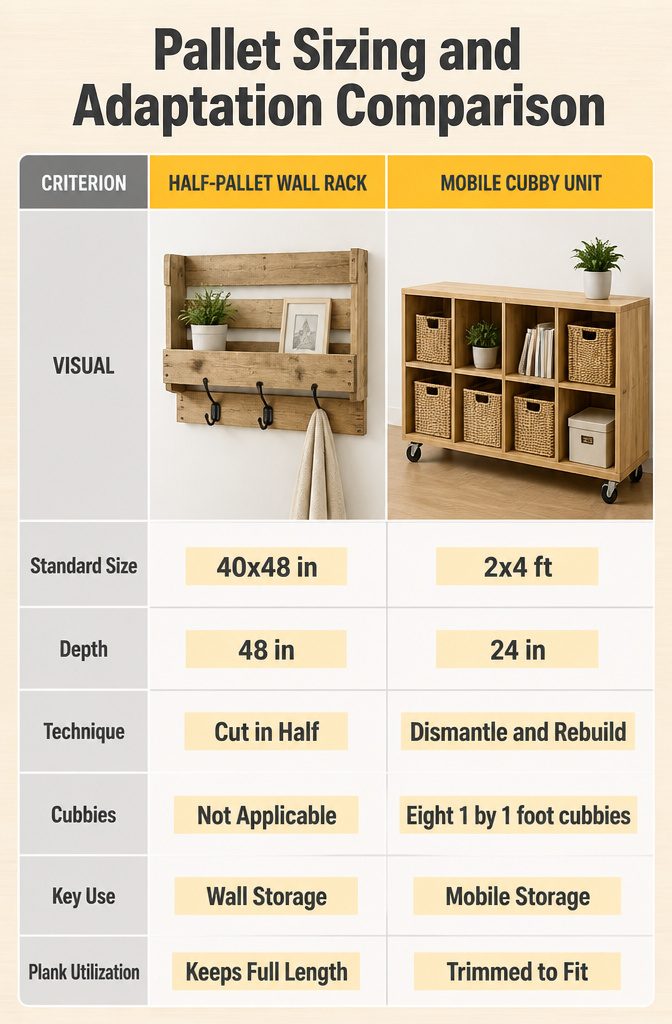
Pallets almost never arrive in the dimension you actually need. A standard pallet runs roughly 40 by 48 inches, which is either too deep for a narrow entryway or too wide for a gap beside a washer.
The first move is deciding whether to cut the pallet in half along the middle support beam, keeping two beams for stability, or to dismantle it board by board and rebuild to a new footprint.
For the mobile unit I ended up building, the frame measured 2 by 4 feet with eight 1 by 1 foot cubbies 24 inches deep. That depth matches a standard pallet plank after trimming, so the sides could stay solid without extra ripping.
I cut the horizontal slats to length first, then used the original 2-by-4 stringers as vertical dividers, toenailing them into new top and bottom rails.
Joining pallet wood demands patience. The nails are spiral-shank and fight coming out; I learned to cut them flush with a multi-tool fitted with a flush-cut blade rather than pound them through and split the grain.
Where two pieces meet at a right angle, a single screw through the face is asking for a crack. A pocket hole or a simple half-lap joint carries the load better, especially on a piece that will roll on casters.
If your space is truly tight, a half-pallet wall rack keeps the full 48-inch length but only 20 inches of depth. The other half becomes a second unit, or scrap for the cubby faces.
Either way, measure your baskets, bins, or spice jars before the first cut. The sources all agree: build to the contents, not to the pallet.

KEEP LONG-HANDLED TOOLS UPRIGHT AND EASY TO REACH. This vertical resin storage shed or tall outdoor storage cabinet fits long-handled tools, patio umbrellas, and gardening supplies, so yard gear stays organized and off the ground.

Gardening Supplies Storage – The Afton Wall Organizer combines a rock-solid wall shelf and hanging hooks for storage of your outdoor tools and supplies. Perfect for your garden shed or garage.

【Buy with Confidence】GIOTORENT tool organizer can be used for many years with confidence and are guaranteed to be stable and sturdy. Top Customer Service:We will offer 7/24 service. If you have any questions, please feel free to contact us